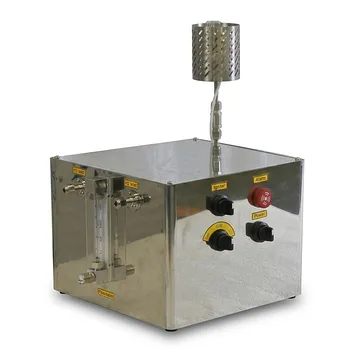
How a Nitrogen Flow Meter Ensures Reproducibility in Aux-CN Thermal Annealing: Achieving Precise Material Consistency
Updated 3 months ago
Precision gas flow control is the cornerstone of material consistency. By maintaining a stable, constant-pressure environment, a nitrogen flow meter ensures that the thermal polycondensation process remains isolated from environmental variables. This rigorous regulation prevents the formation of structural defects and guarantees that every batch of Gold-modified Carbon Nanodots (Aux-CN) exhibits identical electronic and optical properties.
Core Takeaway: The nitrogen flow meter ensures reproducibility by simultaneously purging reactive byproducts and preventing atmospheric contamination, which standardizes the shallow trap energy distributions and luminescence efficiency of the resulting Aux-CN films.
The Role of Environmental Isolation
Preventing Oxidative Defects
The flow meter regulates the introduction of inert nitrogen to displace atmospheric oxygen within the high-temperature furnace.
Preventing air infiltration is critical, as oxygen can cause unintended oxidation or introduce structural defects into the Carbon Nanodot framework.
This isolation ensures that the chemical composition of the Aux-CN remains pure and consistent across different experimental runs.
Continuous Removal of Reaction Byproducts
Thermal polycondensation naturally generates byproduct gases that can interfere with the reaction kinetics if allowed to accumulate.
The nitrogen flow meter maintains a steady stream that carries these byproducts away from the material surface.
By keeping the local environment "clean," the meter ensures the chemical transition occurs under the same conditions every time.
Standardizing Material Properties
Stabilizing Internal Furnace Pressure
The flow meter allows for the precise adjustment of the gas volume entering the chamber, which stabilizes the internal pressure.
Fluctuations in pressure can alter the rate of polycondensation, leading to variations in the physical structure of the carbon dots.
A constant-pressure environment acts as a thermal and mechanical stabilizer for the growing Aux-CN films.
Defining Electronic Energy Levels
The reproducibility of Aux-CN performance depends heavily on the distribution of "shallow trap" energy levels.
Because the nitrogen flow meter standardizes the furnace environment, it ensures these energy levels are distributed identically in every batch.
This consistency is what allows researchers to record reliable and repeatable luminescence efficiency measurements.
Understanding the Trade-offs
The Risk of Flow Rate Imbalance
Setting the flow rate too high can lead to localized cooling of the sample, which disrupts the temperature uniformity required for annealing.
Conversely, a flow rate that is too low may fail to fully purge oxygen or remove byproducts, leading to batch-to-batch contamination.
Achieving reproducibility requires identifying the "sweet spot" where gas exchange is sufficient without compromising thermal stability.
Equipment Calibration Dependencies
The accuracy of the reproducibility depends entirely on the calibration of the flow meter itself.
Minor drifts in the meter’s sensors over time can lead to subtle changes in the nitrogen-to-byproduct ratio.
Regular maintenance and calibration are necessary to ensure that the "constant" environment remains truly constant over long-term research cycles.
How to Apply This to Your Process
To achieve the highest level of reproducibility in nanoparticle fabrication, consider the following strategic focuses:
- If your primary focus is optical consistency: Prioritize the flow meter’s ability to purge byproducts, as these residues are the leading cause of variance in luminescence efficiency.
- If your primary focus is structural integrity: Focus on maintaining a strictly constant internal pressure to ensure the shallow trap energy level distributions remain uniform across all films.
- If your primary focus is scaling production: Implement automated flow controllers to eliminate manual adjustment errors and ensure the environment remains identical across larger furnace volumes.
By mastering the balance of gas flow and pressure, you transform a sensitive chemical reaction into a precise and repeatable manufacturing protocol.
Summary Table:
| Mechanism | Function in Annealing | Impact on Aux-CN Properties |
|---|---|---|
| Inert Purging | Displaces atmospheric oxygen | Prevents oxidative defects and ensures chemical purity |
| Byproduct Removal | Carries away reaction gases | Standardizes luminescence efficiency and trap energy |
| Pressure Stability | Maintains constant gas volume | Ensures uniform polycondensation and structural integrity |
Elevate Your Material Research with THERMUNITS Precision
At THERMUNITS, we understand that reproducibility is the heartbeat of material science. As a leading manufacturer of high-temperature laboratory equipment, we provide the advanced thermal processing solutions you need to master complex reactions like Aux-CN annealing.
Our comprehensive range includes:
- Furnaces: Muffle, Vacuum, Atmosphere, Tube, Rotary, and Hot Press models.
- Systems: CVD/PECVD systems and Vacuum Induction Melting (VIM) furnaces.
- Specialized Gear: Dental Furnaces, electric rotary kilns, and high-quality Thermal Elements.
Whether you are in industrial R&D or academic research, our equipment is engineered to provide the precise control required for superior heat treatment. Contact us today to discuss how our solutions can enhance your lab's efficiency and experimental accuracy.
References
- Yanfeng Fang, Yuanjian Zhang. Timescale correlation of shallow trap states increases electrochemiluminescence efficiency in carbon nitrides. DOI: 10.1038/s41467-024-48011-y
Mentioned Products
People Also Ask
- How does a precision gas control system for H2/Ar mixtures contribute to Mo2C catalysts? Optimize Phase Purity.
- How does a high-precision gas flow meter contribute to the study of biomass pyrolysis kinetics? Enhance Data Accuracy
- How do Mass Flow Controllers (MFC) and gas mixing systems work together during nanobelt yarn tests? Precision Gas Sensing
- How do precise gas flow meters and cylinder systems contribute to controlled zinc volatilization? Enhance Your Results
- Why is a high-precision mass flow meter required to control 5% H2/Ar mixed gas during the thermal treatment of FeCoNiMnCr catalysts? Essential for HEA-HEO Synthesis

Tech Team · ThermUnits
Last updated on Jun 03, 2026