The Architecture of Isolation: Why the Vessel Defines the Crystal
Aug 13, 2026
The Invisible Laboratory
In the synthesis of $Cr_{0.92}Te$ single crystals, the most important work happens in a space where nothing is supposed to exist.
Chemical Vapor Transport (CVT) is a slow, deliberate dance. For over 130 hours, atoms migrate across a temperature gradient, seeking a state of perfect order. But this dance requires a stage that is both incredibly strong and completely invisible.
The high-purity quartz ampoule is not just a container. It is a hermetically sealed world, engineered to withstand the violence of 1000 °C while maintaining the silence of a high vacuum.
The Cost of Structural Failure
In material science, precision is often a battle against time. At temperatures exceeding 1000 °C, most materials soften, react, or breathe.
Thermal Endurance
High-purity quartz is selected for its ability to maintain structural integrity under intense thermal loads. If the ampoule sags or deforms by even a few millimeters, the internal thermal gradient shifts.
When the gradient shifts, the crystal growth fails. The quartz must remain a rigid, unchanging boundary for the duration of the reaction.
The Problem of Devitrification
Time is the enemy. Extended exposure to heat leads to devitrification—the transition from an amorphous state to a crystalline one.
- The quartz turns cloudy.
- It becomes brittle.
- It loses the very strength required to survive the final cooling phase.
Engineering the Void
The purity of $Cr_{0.92}Te$ depends entirely on what is not in the tube. By evacuating the ampoule to $10^{-5}$ Torr, we remove the "noise" of the atmosphere.
Oxygen: The Great Corruptor
Without a perfect vacuum, chromium and tellurium oxidize instantly. A single leak, measured in microns, can ruin a week of synthesis. The quartz ampoule acts as a definitive barrier, ensuring that the only chemistry occurring is the one the scientist intended.
The Iodine Shuttle
Inside this vacuum, iodine acts as the transport agent. It picks up the precursors at the hot end and drops them at the cold end. This mechanism requires a stable "saturated vapor pressure." The ampoule must be sized with mathematical precision; too small, and the internal pressure causes an explosion; too large, and the transport slows to a halt.
The Technical Reality of CVT
| Feature | Technical Requirement | Impact on $Cr_{0.92}Te$ |
|---|---|---|
| Material Purity | >99.99% $SiO_2$ | Prevents lattice contamination |
| Pressure Limit | Must exceed internal vapor pressure | Ensures safety and containment |
| Sealing Quality | Flame-sealed at $10^{-5}$ Torr | Eliminates oxidation risks |
| Wall Thickness | Typically ≥2mm | Resists deformation at 1000°C |
The Engineer’s Trade-off
Every choice in the lab is a balance of risks. Quartz is chemically inert and thermally stable, but it is also inherently brittle.
Success in CVT is found in the margins. It requires the right vessel, but it also requires a furnace that can maintain a temperature gradient with surgical precision. If the furnace fluctuates, the pressure inside the quartz fluctuates, and the crystal stops growing.
Precision Beyond the Vessel
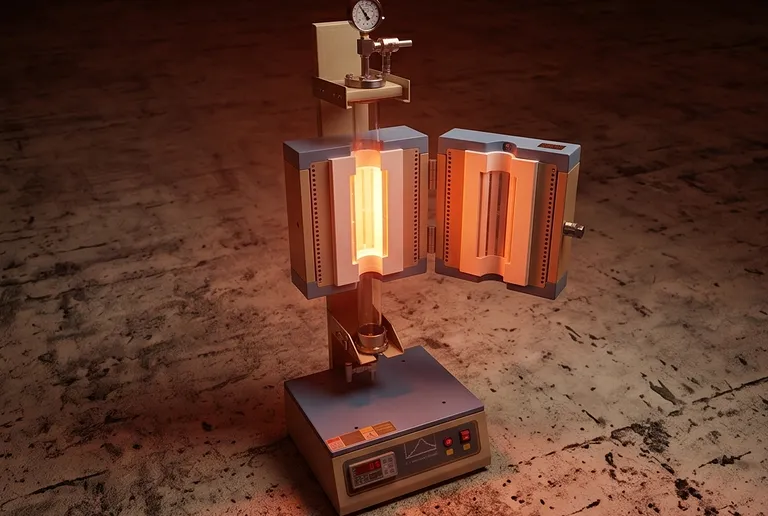
At THERMUNITS, we understand that the ampoule is only as effective as the environment surrounding it. The delicate physics of vapor transport requires a stable, reliable thermal foundation.
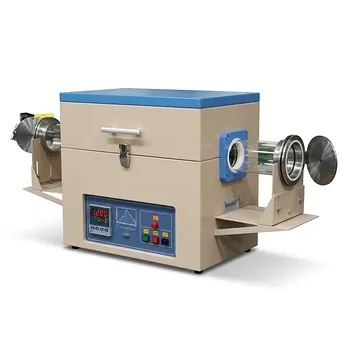
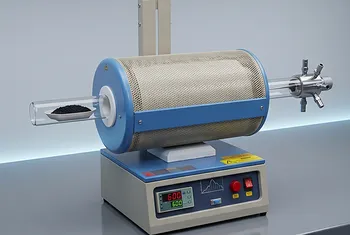
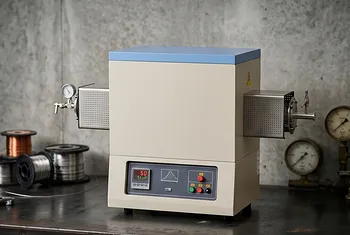
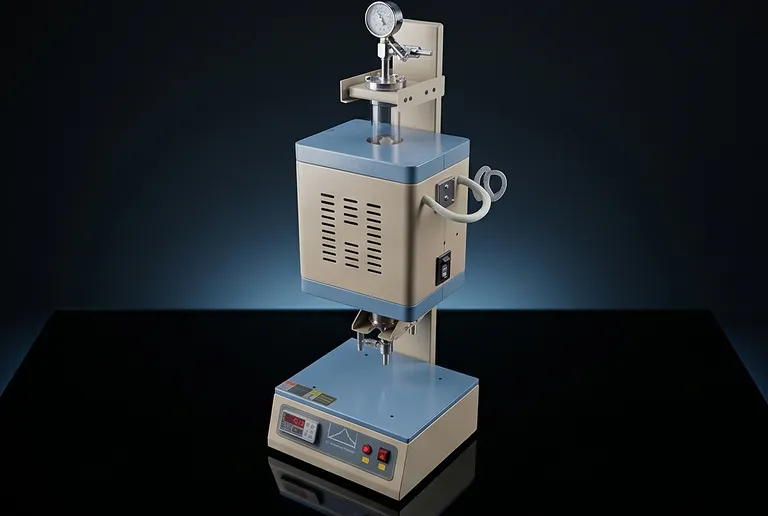
As a leader in high-temperature laboratory equipment, we design the systems that make these "sealed worlds" possible. From precise Tube Furnaces designed for CVT gradients to advanced Vacuum and Atmosphere systems, we provide the control that material R&D demands.
Our range includes:
- Tube & Muffle Furnaces: Optimized for long-duration stability.
- CVD/PECVD Systems: For controlled vapor phase deposition.
- VIM & Hot Press Furnaces: For high-purity alloy and material synthesis.
The path to a perfect crystal begins with a perfect environment.
Quick Links
Suggested Products
1100°C High Temperature Quartz Chamber Furnace 8 Inch OD with 7.6 Liter Capacity and Vacuum Atmosphere Capability High Temperature Vertical Atmosphere Controlled Furnace with Automatic Bottom Loading and 1700°C Capacity for Advanced Material Research High Temperature 1200C Split Tube Furnace with Hinged Vacuum Flanges and 4 Inch Quartz Tube for Laboratory ResearchFurther Reading
The Geometry of Heat: Engineering Magnetic Biochar Through Controlled Pyrolysis The Architecture of Absence: Why Atmosphere Control Defines the Fate of Mesoporous Carbon The Thermodynamic Sanctuary: Managing Atomic Migration in High-Vacuum Furnaces The Geometry of Heat: Why Atmosphere Control is the Silent Architect of Micro-Copper The Geometry of Stability: Why LFP Regeneration Demands Atmospheric Discipline
ThermUnits
Last updated on Apr 14, 2026
Related Products
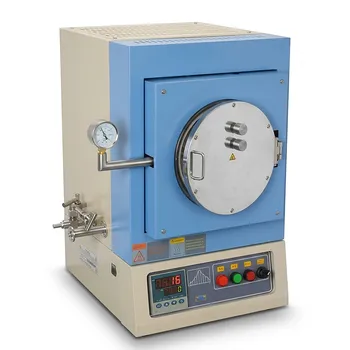
1100°C High Temperature Quartz Chamber Furnace 8 Inch OD with 7.6 Liter Capacity and Vacuum Atmosphere Capability
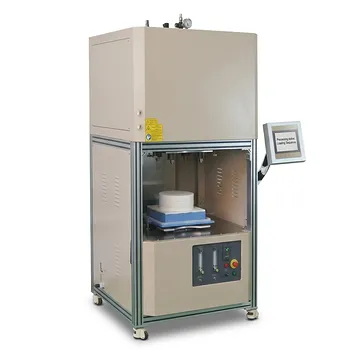
High Temperature Vertical Atmosphere Controlled Furnace with Automatic Bottom Loading and 1700°C Capacity for Advanced Material Research