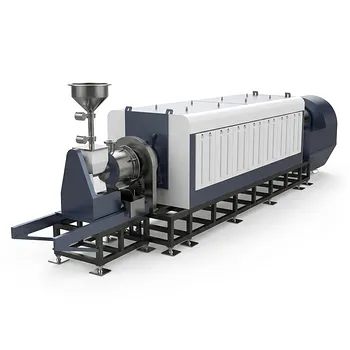
What is the critical function of continuous Nitrogen Gas injection? Enhance Carbon Yield and Safety in Torrefaction
Updated 3 months ago
Continuous Nitrogen gas injection is the primary mechanism for maintaining process integrity during biomass torrefaction. By establishing a strictly anaerobic environment, it prevents the biomass from igniting or undergoing unwanted oxidative combustion at elevated temperatures. Additionally, it serves as a vehicle to transport moisture and volatile organic compounds (VOCs) out of the reactor, ensuring the final bio-char product remains chemically stable and uniform.
Nitrogen acts as both a protective shield against combustion and a cleaning agent for the reaction chamber. Its continuous flow is essential for shifting biomass from a low-energy raw state to a high-carbon, energy-dense solid fuel while preventing material loss through oxidation.
Preventing Oxidative Combustion
Establishing an Anaerobic Environment
The introduction of high-purity Nitrogen effectively displaces oxygen from the furnace interior. Because torrefaction occurs at high temperatures (typically 200°C to 300°C), the presence of even small amounts of oxygen would trigger immediate ignition or combustion.
Maximizing Carbon Retention
By maintaining an inert atmosphere, the Nitrogen ensures that the biomass undergoes thermal decomposition rather than burning. This allows the process to maximize the retention of carbon elements within the solid product, increasing the overall energy density of the resulting fuel.
Regulating the Reaction Environment
Removal of Volatile Compounds and Moisture
As biomass heats up, it releases water vapor and various volatile organic compounds (VOCs). The continuous flow of Nitrogen acts as a carrier, "sweeping" these byproducts out of the reactor to prevent them from interfering with the chemical transformation.
Ensuring Product Consistency
The steady removal of these gases ensures that the thermal decomposition remains stable throughout the cycle. This results in a final product with consistent physical and chemical properties, which is critical for industrial-scale energy applications.
Understanding the Trade-offs and Constraints
The Cost of High-Purity Inerting
While Nitrogen is effective, the requirement for a continuous supply of high-purity gas adds to the operational expenditure (OPEX) of a torrefaction facility. Producers must balance the cost of gas consumption against the yield and quality of the bio-char produced.
Gas Flow Rate Optimization
If the Nitrogen flow rate is too low, volatiles may accumulate and lead to secondary reactions that degrade product quality. Conversely, an excessively high flow rate can lead to thermal energy loss, as the gas carries away heat that should be used for the torrefaction process itself.
How to Apply This to Your Project
Recommended Strategies for Implementation
Proper gas management is the difference between a high-value carbon product and an inefficient waste process. Consider these factors based on your specific operational goals:
- If your primary focus is Maximum Energy Density: Prioritize a steady Nitrogen flow to ensure the process remains strictly in the torrefaction stage, preventing any carbon loss through oxidation.
- If your primary focus is Operational Safety: Implement continuous oxygen monitoring alongside your Nitrogen injection to ensure the atmosphere remains fully inert during high-temperature phases.
- If your primary focus is Process Efficiency: Calibrate the flow rate to the minimum volume required to effectively remove volatiles without significantly cooling the reactor core.
The strategic use of Nitrogen as a carrier gas transforms biomass torrefaction from a simple heating process into a controlled chemical synthesis for high-grade fuel.
Summary Table:
| Key Function | Role in Process | Primary Benefit |
|---|---|---|
| Anaerobic Inerting | Displaces oxygen to prevent ignition | Maximizes carbon retention and safety |
| Volatile Removal | Transports moisture and VOCs out | Ensures chemical stability and uniformity |
| Flow Optimization | Sweeps reaction chamber continuously | Prevents secondary reactions/degradation |
| Heat Management | Regulates the reaction environment | Produces high-energy density solid fuel |
Optimize Your Biomass Research with THERMUNITS Thermal Solutions
As a leading manufacturer of high-temperature laboratory equipment for material science and industrial R&D, THERMUNITS understands the precision required for successful biomass torrefaction. Our systems are engineered to provide the stable inert environments and precise gas flow control necessary to maximize your carbon yield and ensure process safety.
We offer a comprehensive range of thermal processing solutions tailored for researchers and industrial innovators, including:
- Atmosphere & Vacuum Furnaces for precise inerting.
- Tube & Rotary Furnaces ideal for continuous torrefaction studies.
- Muffle, CVD/PECVD, and Dental Furnaces.
- Hot Press & Vacuum Induction Melting (VIM) Furnaces.
- Electric Rotary Kilns and specialized Thermal Elements.
Ready to elevate your lab's efficiency and product quality? Our technical team is here to help you select the ideal furnace configuration for your specific heat treatment requirements.
Contact THERMUNITS Experts Today
References
- Tae-Gyeong Lee, Jae Sang Lee. Quality Enhancement of Torrefied Biopellets Prepared by Unused Forest Biomass and Wood Chip Residues in Pulp Mills. DOI: 10.3390/app14209398
Mentioned Products
People Also Ask
- How does the electric rotary kiln support environmental compliance and sustainability? Achieve Zero-Emission Production
- What are the maintenance and service life advantages of an electric rotary kiln? 25+ Year Longevity & Low Maintenance
- What thermal efficiency can be expected from an electric rotary kiln compared to fuel-fired alternatives? Gain 95% efficiency.
- How does the use of an electric rotary kiln facilitate CO2 capture in cement and lime production? Achieve High-Purity CCUS
- Which minerals and specialty chemicals are commonly processed using electric rotary kilns? Precision Thermal Processing Guide

Tech Team · ThermUnits
Last updated on Jun 03, 2026