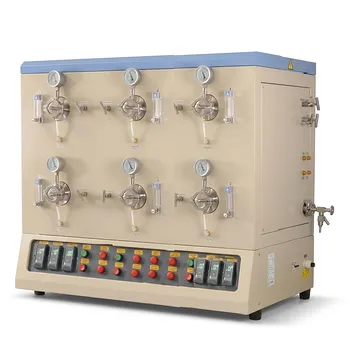
What is the critical role of a Multi-channel Temperature Recorder? Master Precision in Long-Term Thermal Monitoring
Updated 3 months ago
In long-term thermal monitoring, the Multi-channel Temperature Recorder serves as the primary engine for high-resolution data synthesis and model validation. It enables the continuous, synchronous acquisition of temperature data from multiple points over periods exceeding 24 hours, transforming raw thermal signals into actionable time-temperature curves. This capability is essential for identifying critical thermal thresholds, such as ignition points and peak heating rates, which are fundamental to understanding complex processes like spontaneous combustion.
The Multi-channel Temperature Recorder is the bridge between raw thermal activity and validated scientific models. By providing stable, multi-point synchronization over extended durations, it allows researchers to pinpoint exact ignition events and heating behaviors that single-point or short-term monitors would miss.
The Mechanics of Long-Term Thermal Data Acquisition
Sustained Stability Over 24-Hour Windows
The device ensures data integrity for periods often exceeding 24 hours. This stability is vital for observing slow-developing thermal events that occur in materials prone to spontaneous combustion.
Without this continuous recording, the transition from a steady state to a critical thermal runaway could be missed entirely.
Synchronous Multi-Point Measurement
By recording multiple thermocouple points synchronously, the recorder provides a spatial-temporal view of heat distribution. This allows for a more comprehensive understanding of how a thermal front moves through a substance.
The resulting data sets are used to generate detailed time-temperature curves that reflect the reality of the entire experimental environment rather than a single isolated point.
Transforming Data into Predictive Models
Identifying Critical Ignition Points
High-resolution data sets are necessary to determine the exact ignition point of a material. Continuous recording ensures that the precise moment where a steady rise becomes a self-sustaining reaction is captured with accuracy.
Validating Theoretical Models
These recorders are indispensable for validating theoretical models for spontaneous combustion. By comparing experimental curves against mathematical predictions, researchers can refine their understanding of chemical reactivity.
Determining the maximum heating rate is another critical function. This metric serves as a key indicator of how aggressively a material will react under specific environmental conditions.
Understanding the Trade-offs
Data Management Challenges
Recording from dozens of channels over long periods creates massive data sets that require significant storage and processing power. Analyzing this information requires robust software to filter electronic noise from actual thermal trends.
Sensor Placement Sensitivity
The accuracy of the recorder is heavily dependent on the quality and placement of the thermocouples. Misaligned or poorly shielded sensors can lead to misleading time-temperature curves, even if the recorder itself is a high-precision instrument.
How to Apply This to Your Project
When integrating a multi-channel temperature recorder into your thermal analysis workflow, consider your specific research objectives:
- If your primary focus is validating theoretical models: Ensure the recorder supports high-resolution synchronous sampling to capture the subtle nuances of spontaneous combustion dynamics.
- If your primary focus is identifying ignition thresholds: Prioritize devices with high stability over 24-hour periods to avoid data drift during long-duration experiments.
Proper thermal monitoring transforms unpredictable heat shifts into a clear, manageable roadmap for safety and scientific discovery.
Summary Table:
| Key Feature | Research Benefit | Practical Application |
|---|---|---|
| 24h+ Stability | Continuous data integrity | Capturing slow-developing spontaneous combustion |
| Synchronous Sampling | Spatial-temporal heat mapping | Generating precise multi-point time-temperature curves |
| High-Res Data | Critical threshold detection | Identifying exact ignition points and peak heating rates |
| Model Validation | Mathematical accuracy | Refining theoretical models for chemical reactivity |
Elevate your material science research with THERMUNITS, your premier partner for high-temperature laboratory equipment. Our comprehensive range of thermal processing solutions—including Muffle, Vacuum, Tube, and Rotary furnaces, along with CVD/PECVD systems and high-precision temperature monitoring tools—is designed to meet the rigorous demands of industrial R&D and advanced heat treatment. Discover how our expertise can optimize your experimental results. Contact our experts today to find the perfect thermal solution for your lab!
References
- Kira Piechnik, Andrea Klippel. Self‐ignition of forest soil samples demonstrated through hot storage tests. DOI: 10.1002/fam.3198
Mentioned Products
People Also Ask
- Why is high-purity alumina selected for sample trays? Key to High-Throughput Sintering Success
- How does a high-throughput tube furnace achieve precise sulfurization? Expert Control for CoS2–Co(OH)F Nanostructures
- How does the precise temperature control of a tube furnace influence the formation of V2AlC MAX phase? Expert Insights.
- What is the function of argon gas flow within a tube furnace during the selenization of MOFs? Essential Process Guide
- What is the effect of introducing camphor as a carbon source in a tube furnace CVD? Boost CNT Density and Growth

Tech Team · ThermUnits
Last updated on Jun 03, 2026