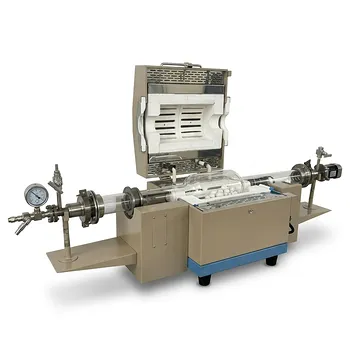
Why are high-precision mass flow meters essential for hydrogen reduction experiments? Ensure Accurate Material Results.
Updated 3 months ago
Precision gas control is the foundation of reliable chemical reduction. High-precision mass flow meters (MFMs) are essential because they provide the exact regulation of hydrogen concentration and flow rates required to transform magnetite powder into metallic iron. Without this level of accuracy, the reduction atmosphere becomes unstable, making it impossible to collect valid data on metallization rates or reaction kinetics.
Core Takeaway: High-precision mass flow meters ensure a stable and reproducible reduction atmosphere by strictly controlling gas composition ratios. This precision is the only way to guarantee that the resulting metallization data reflects the chemical process rather than fluctuations in the experimental setup.
The Critical Role of Gas Composition
Maintaining the Thermodynamic Reduction Capacity
In magnetite powder reduction, the ability of the gas to "reduce" the ore is strictly limited by its concentration ratio, such as the $H_2/CO$ ratio. Even minor deviations in this ratio can significantly alter the chemical potential of the atmosphere, leading to inconsistent results. High-precision MFMs allow researchers to fix these ratios with certainty.
Stabilizing the Reduction Atmosphere
A stable atmosphere is the prerequisite for obtaining accurate metallization rate data. If the total flow rate or the gas concentration drifts during the experiment, the rate of oxygen removal from the magnetite will fluctuate unpredictably. Precision meters eliminate these variables, ensuring that the reaction progresses under steady-state conditions.
Facilitating Metal Particle Activation
Before the primary reaction or subsequent processes like CVD occur, the system must establish a controlled environment to clean catalyst surfaces. High-precision flow control reduces metal oxides, such as iron oxide, into active metal particles. This preparation phase is vital for ensuring the magnetite powder is ready for consistent chemical transformation.
Impact on Reaction Dynamics
Controlling Reaction Zone Pressure
Mass flow controllers do more than just manage volume; they help maintain stable pressure within the reaction zone. In experiments involving fine powders like magnetite, pressure stability is critical for preventing "channeling" or uneven gas distribution. Uniform pressure ensures that the gas interacts consistently with the entire sample of powder.
Ensuring Uniformity in Product Growth
When these experiments are linked to the growth of secondary structures, such as carbon nanotubes, flow precision becomes even more vital. Stable flow rates lead to uniform growth patterns by providing a constant supply of reactants. This level of control is impossible with manual or low-precision valves.
Understanding the Trade-offs and Pitfalls
The Risk of Calibration Drift
While high-precision meters are accurate, they are sensitive to the specific properties of the gas being measured. If a meter calibrated for Nitrogen is used for Hydrogen without the proper conversion factors, the data will be fundamentally flawed. Regular calibration against known standards is a mandatory requirement for maintaining "high precision."
Sensitivity to Contaminants
High-precision instruments often utilize delicate thermal sensors or capillary tubes that can be clogged by fine magnetite dust. If the experimental setup does not include adequate filtration or backflow prevention, the meter can fail or provide "drifting" readings. Protecting the meter is as important as the precision of the meter itself.
How to Apply This to Your Project
Recommendations for Experimental Success
- If your primary focus is kinetic modeling: Prioritize meters with the lowest possible "repeatability" error to ensure every trial occurs under identical atmospheric conditions.
- If your primary focus is maximizing metallization yield: Focus on the accuracy of the $H_2/CO$ mixing ratio to ensure the gas stays above the thermodynamic threshold for reduction.
- If your primary focus is material synthesis (e.g., nanofibers): Invest in mass flow controllers that offer integrated pressure compensation to keep the reaction zone stable during long-duration experiments.
Precise flow regulation transforms a volatile chemical reaction into a controlled, measurable, and scientific process.
Summary Table:
| Key Feature | Impact on Magnetite Reduction | Experimental Benefit |
|---|---|---|
| Gas Ratio Control | Maintains strict $H_2/CO$ concentration | Stable thermodynamic reduction capacity |
| Flow Rate Stability | Eliminates atmosphere fluctuations | Highly accurate and reproducible metallization data |
| Pressure Regulation | Prevents gas "channeling" in powder | Uniform gas interaction and consistent reaction zone |
| Particle Activation | Establishes controlled cleaning environment | Higher activity for metal particles and secondary growth |
Elevate Your Research Precision with THERMUNITS
At THERMUNITS, we understand that reliable thermal processing requires more than just heat—it requires total control. As a leading manufacturer of high-temperature laboratory equipment, we provide the foundation for successful hydrogen reduction and material synthesis.
Whether you are performing kinetic modeling or advanced material synthesis, our comprehensive range of equipment—including CVD/PECVD systems, Tube furnaces, Vacuum furnaces, and Atmosphere furnaces—is designed to integrate seamlessly with precision gas delivery systems. We empower researchers in material science and industrial R&D to achieve superior uniformity and reproducibility in every experiment.
Ready to optimize your laboratory heat treatment?
Contact THERMUNITS Today to discuss how our furnace solutions can enhance your experimental accuracy.
References
- Caijiao Sun, Li Wen. Process Path for Reducing Carbon Emissions from Steel Industry—Combined Electrification and Hydrogen Reduction. DOI: 10.3390/pr12010108
Mentioned Products
People Also Ask
- How does a rotary tube furnace improve the processing of granular materials? Enhance Uniformity and Reaction Kinetics
- Why use a rotary tube furnace for FACS carbonization? Ensure uniform morphology and prevent sphere agglomeration.
- In what ways do rotary tube furnaces enhance chemical and specialty mineral processing? Drive Precision and Uniformity.
- Why is the precise optimization of residence time essential in the catalyst calcination process? Maximize Your Yields.
- What are the typical operating temperature ranges and mechanical specifications for rotary furnaces? A Complete Guide

Tech Team · ThermUnits
Last updated on Jun 02, 2026