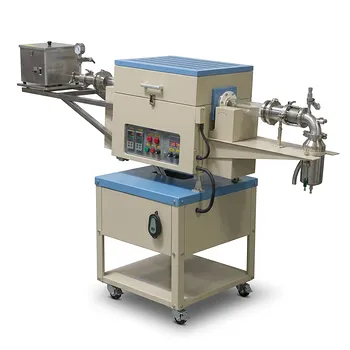
Why is a magnetic push rod system used to control the position of sulfur powder during WS2 growth experiments? Precise CVD
Updated 3 months ago
The magnetic push rod system acts as a precision "gatekeeper" for sulfur vapor during the chemical vapor deposition (CVD) process. By allowing the boat containing sulfur powder to remain in a cool zone until the furnace reaches its target temperature, researchers can trigger the introduction of sulfur vapor at the exact moment required for optimal growth. This prevents the uncontrolled, premature sublimation of sulfur that would otherwise occur during the furnace's ramp-up phase.
Core Takeaway: A magnetic push rod enables dynamic injection of sulfur precursors, ensuring that the chemical environment remains stable and the precursor concentration remains uniform throughout the $WS_2$ synthesis process.
The Challenge of Premature Sublimation
Decoupling Thermal Ramps
In standard tube furnace setups, all materials are often placed inside before heating begins. However, sulfur has a much lower sublimation temperature than the high-temperature reaction conditions required for Tungsten Disulfide ($WS_2$) growth.
Preventing Precursor Depletion
If sulfur is present while the furnace is still heating up, it will begin to vaporize and exhaust itself before the tungsten source is ready to react. This leads to non-uniform precursor concentration and inconsistent crystal quality across the substrate.
Eliminating Unwanted Side Reactions
Early-stage sulfur vapor can lead to intermediate chemical species or "side reactions" that interfere with the desired redox reaction. By withholding the sulfur until the system is thermally stable, you ensure a cleaner, more predictable chemical pathway.
Achieving Precision Through Dynamic Injection
The Role of Temperature Zones
The magnetic push rod allows the sulfur boat to be moved into a specific temperature zone—typically around 380°C—only when the furnace has reached its preset high-temp peak. This ensures that sulfur vaporization occurs at a constant, controlled rate rather than a fluctuating one.
Micro-scale Redox Regulation
Controlling the exact moment of sulfur introduction allows for micro-scale regulation of the $WS_2$ synthesis. This level of control is essential for achieving specific flake sizes, layer counts, and morphological consistency in two-dimensional materials.
Maintaining Atmospheric Integrity
Because the rod is manipulated magnetically from outside the quartz tube, the internal vacuum or controlled atmosphere remains sealed. This allows for mechanical movement without introducing oxygen or moisture contaminants that would degrade the $WS_2$ quality.
Understanding the Trade-offs
Mechanical Alignment Risks
The effectiveness of a push rod system depends heavily on the precise alignment of the magnetic coupling. If the boat is not positioned exactly within the 380°C zone, the sulfur vapor pressure will deviate from the experimental design.
Thermal Lag Considerations
Even when the boat is moved into the heat zone, there is a brief period of thermal lag as the ceramic boat and sulfur powder reach equilibrium. Researchers must account for this delay when timing the growth phase of the experiment.
Complexity of Manual Operation
While magnetic rods offer precision, they often require manual intervention at specific timestamps during the experiment. This introduces a margin for human error compared to fully automated mass-flow controller systems.
How to Apply This to Your Growth Protocol
Optimizing Your $WS_2$ Synthesis
- If your primary focus is crystal uniformity: Use the magnetic push rod to inject sulfur only after the furnace has stabilized at its peak temperature for at least 5-10 minutes.
- If your primary focus is controlling layer thickness: Experiment with the specific temperature zone (e.g., slightly above or below 380°C) to fine-tune the sulfur vapor pressure and deposition rate.
- If your primary focus is reducing defects: Ensure the sulfur boat is kept in the furthest possible "cool zone" during the ramp-up phase to prevent any trace amounts of vapor from reaching the substrate prematurely.
The magnetic push rod is an essential tool for transforming a static heating process into a dynamic, precisely timed chemical synthesis.
Summary Table:
| Key Feature | Functional Benefit | Impact on WS2 Quality |
|---|---|---|
| Dynamic Injection | Precise timing of sulfur entry | Uniform flake size and layer count |
| Thermal Decoupling | Prevents premature sublimation | Stable precursor concentration |
| Magnetic Coupling | External control of internal movement | Maintains vacuum/atmospheric integrity |
| Zonal Positioning | Controlled 380°C vaporization | Consistent morphological growth |
Elevate Your Material Synthesis with THERMUNITS
Achieving the perfect $WS_2$ crystal requires more than just high temperatures; it requires absolute precision. THERMUNITS is a leading manufacturer of high-temperature laboratory equipment, providing the advanced tools necessary for cutting-edge material science and industrial R&D.
Our comprehensive thermal processing solutions include:
- Advanced CVD/PECVD Systems: Designed for precise 2D material synthesis.
- Precision Furnaces: Tube, Atmosphere, Vacuum, Muffle, and Rotary furnaces.
- Specialized Equipment: Hot Press furnaces, Vacuum Induction Melting (VIM), Dental furnaces, and high-quality Thermal Elements.
Don't let precursor instability compromise your research. Contact our experts today to find the ideal high-temperature solution tailored to your laboratory's needs.
References
- Baojun Pan, Sui‐Dong Wang. Direct Selective Epitaxy of 2D Sb2Te3 onto Monolayer WS2 for Vertical p–n Heterojunction Photodetectors. DOI: 10.3390/nano14100884
Mentioned Products
People Also Ask
- What are the typical operating temperature ranges and mechanical specifications for rotary furnaces? A Complete Guide
- What parameters must operators control to maintain product quality in a rotary furnace? Master Your Heat Treatment.
- What is the primary function and operating principle of a rotary furnace? Maximize Thermal Processing Efficiency
- How do rotary furnaces contribute to effective hazardous waste management and thermal treatment? - High Efficiency Solutions
- How does the rotation speed of a rotary furnace affect the material processing? Optimize Residence Time & Heat Uniformity

Tech Team · ThermUnits
Last updated on Jun 03, 2026