The Architecture of Atmosphere: Why Precision Flow is the Pulse of Gasification
Jun 03, 2026
The Chaos of the Unseen
In high-temperature gasification, a reactor is rarely a quiet place. It is a violent intersection of phase changes, thermal gradients, and shifting pressures. For a researcher, the goal is to isolate a single chemical truth.
However, variables are often entangled. When temperature rises, gas expands. When pressure fluctuates, flow rates drift. Without a way to decouple these variables, you aren't measuring chemistry; you are measuring the noise of your environment.
This is where the Mass Flow Controller (MFC) moves from being a peripheral component to the foundational pulse of the system.
Decoupling Mass from Environment
The fundamental problem with volumetric flow is that it is a lie told by the environment. A liter of gas at 25°C is not the same amount of matter as a liter at 800°C.
The MFC operates on a different logic. By measuring the heat capacity of the gas as it moves through a sensor, it tracks the actual mass of the molecules.
- Kinetic Stability: It ensures the reactor receives a constant molecular count regardless of upstream pressure spikes.
- Atmospheric Control: it allows for the precise "steering" of the chemical environment, transforming a chaotic furnace into a high-fidelity laboratory.
Governing the Kinetic Borderline
In material science, the difference between a successful synthesis and a failed experiment is often measured in seconds—specifically, Residence Time.
The Ghost of Residence Time
If a carrier gas flows too slowly, the reaction products linger too long in the high-heat zone. They undergo "secondary cracking," breaking down into unwanted carbon or byproducts. An MFC maintains a rigid velocity, whisking products away to the catalytic zone at the exact microsecond required to preserve their chemical structure.
Distinguishing Physics from Chemistry
For a gas-solid reaction to be understood, the gas must reach the surface of the material consistently. If the flow is erratic, your data reflects "external diffusion"—the physical struggle of the gas to reach the target. A stable MFC output eliminates this physical noise, allowing researchers to observe the true chemical kinetics.
Engineering the Equilibrium
Many high-temperature reactions are reversible. They exist in a delicate tug-of-war between states. By using MFCs to manage the partial pressure of gases like $CO_2$ or $H_2$, an engineer can effectively tilt the scales of the universe.
| Feature | Functional Benefit | Research Impact |
|---|---|---|
| WHSV Regulation | Optimizes gas-solid contact time | Maximizes product yield and purity |
| Partial Pressure Control | Regulates reversible reactions | Drives reactions toward completion |
| Atmosphere Simulation | High-fidelity gas mixing | Replicates corrosive industrial flue gases |
| Diffusion Elimination | Uniform gas distribution | Isolate chemical truth from physical noise |
The Calibration Paradox
Precision requires honesty. An MFC is a specialist, not a generalist. Because it measures mass through thermal properties, a controller calibrated for Nitrogen will be inherently "wrong" if used for Carbon Dioxide.
The engineer’s romance with precision requires a respect for these boundaries. To achieve high-fidelity results, the device’s internal sensor must be meticulously configured for the specific heat capacity of the reactant. In dynamic environments, high-speed digital MFCs are the only way to prevent "overshoot" when the system attempts to correct itself.
The Foundation of Process Control
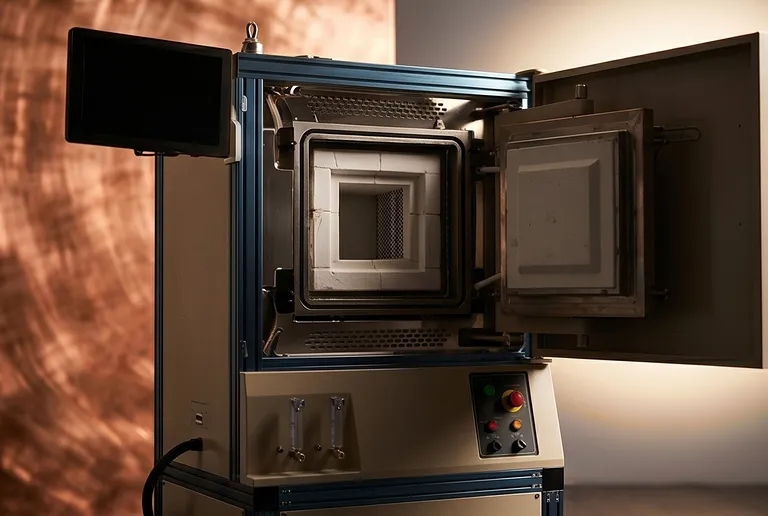
At THERMUNITS, we build the environments where these molecular dances take place. We understand that a furnace is only as good as the control systems that govern it.
Our range of Atmosphere, Tube, and CVD/PECVD systems are designed to integrate seamlessly with high-precision mass flow regulation. By providing the thermal stability required to complement MFC precision, we ensure that your R&D transitions from unpredictable observation to systematic discovery.
The future of material science isn't found in more heat; it is found in more control.
Quick Links
Suggested Products
High Temperature Compact Muffle Furnace 1700 C with 30 Segment Programmable Controller and 1.7L Cubic Chamber 1200C High Throughput Multi Channel Tube Furnace with 50mm Quartz Tubes for Annealing and Material Phase Diagram Research Compact 1000C Muffle Furnace with Programmable Controller and 2 Inch Top Port for Vacuum and Atmosphere Material Research Large Capacity 1200C Muffle Furnace 64 Liter Chamber with Digital PID Controller and Built In Venting Port 915MHz MPCVD Diamond Machine Microwave Plasma Chemical Vapor Deposition System ReactorFurther Reading
The Geometry of Heat: Forging the Structural DNA of Dicalcium Ferrite The Invisible Boundary: Mastering Chemistry within the Architecture of Sintering The Architecture of Atoms: Decoding the Thermal Divide Between Sintering and Firing The Invisible Architecture of a Smile: Engineering Dental Ceramics at 1700°C The Thermal Architect: Engineering the Nano-Geometry of Hard Carbon
ThermUnits
Last updated on Apr 14, 2026
Related Products
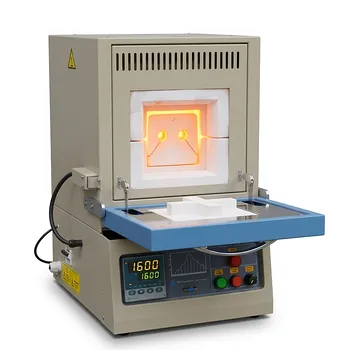
High Temperature Compact Muffle Furnace 1700 C with 30 Segment Programmable Controller and 1.7L Cubic Chamber

1200C High Throughput Multi Channel Tube Furnace with 50mm Quartz Tubes for Annealing and Material Phase Diagram Research
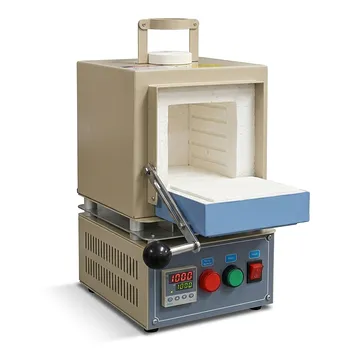
Compact 1000C Muffle Furnace with Programmable Controller and 2 Inch Top Port for Vacuum and Atmosphere Material Research
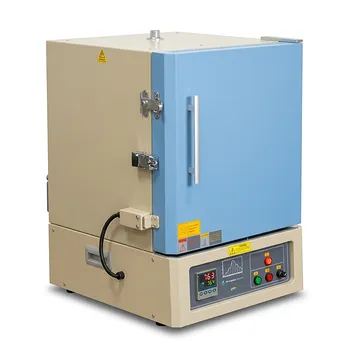
Large Capacity 1200C Muffle Furnace 64 Liter Chamber with Digital PID Controller and Built In Venting Port
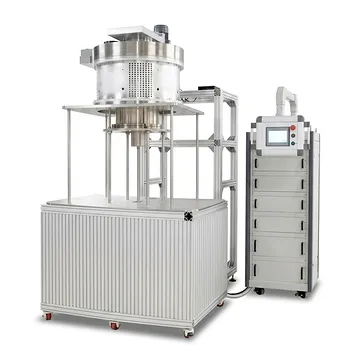
915MHz MPCVD Diamond Machine Microwave Plasma Chemical Vapor Deposition System Reactor
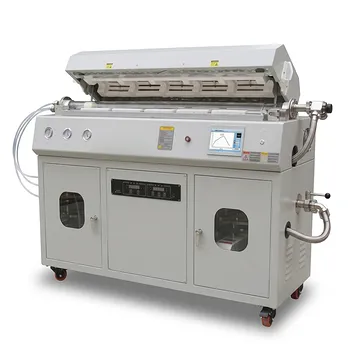
Multi Heating Zones CVD Tube Furnace System for Precision Chemical Vapor Deposition and Advanced Material Synthesis
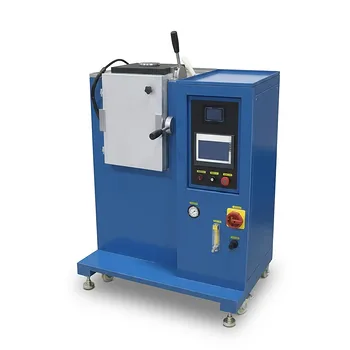
High Throughput Induction Melting and Casting Furnace for Superalloy Research 1700C Atmosphere Controlled Multi Sample System