How does a precision temperature control system assist in predicting failures during the re-oxidation of Ni-8YSZ electrodes?
Updated 6 months ago
Precision temperature control is the primary mechanism for mapping structural failure risks within Ni-8YSZ electrodes. By accurately simulating operating environments between 600 °C and 800 °C, these systems allow researchers to observe how thermal mismatch stress develops between the metallic nickel and the ceramic 8YSZ framework. This granular control is essential for identifying exactly when and where brittle fractures will occur as the nickel undergoes volume expansion during re-oxidation.
Core Takeaway: A precision temperature control system predicts failures by isolating the thermal mismatch stresses caused by the different expansion coefficients of Ni and 8YSZ. It enables the identification of localized fracture points, such as thin neck regions and sharp corners, under specific re-oxidation levels.
The Mechanics of Thermal Mismatch Stress
Managing Divergent Expansion Coefficients
Metallic nickel and the 8YSZ framework expand and contract at significantly different rates when heated. A precision control system maintains the exact temperature needed to quantify the resulting thermal mismatch stress that builds up at the material interface.
Simulating Extreme Operating Environments
Predicting failure requires simulating the high temperatures (600 °C to 800 °C) where fuel cells typically operate. Precise regulation ensures that the stresses observed in the lab accurately reflect the structural degradation encountered in real-world applications.
Locating Vulnerable Structural Points
Mapping Brittle Fracture Risks
Precision control allows researchers to hold the system at specific re-oxidation levels to see how the material reacts. This stability is necessary to observe the formation of micro-cracks before they lead to a total structural collapse of the electrode.
Identifying Geometric Stress Risers
Failures are rarely uniform; they tend to cluster at thin neck regions and sharp corner contact sites. By controlling the thermal environment with high resolution, engineers can see how these specific geometries act as "weak links" under thermal load.
Understanding the Trade-offs and Pitfalls
The Risk of Thermal Gradient Errors
While a system may be set to 700 °C, internal thermal gradients can cause different parts of the electrode to expand at different rates. If the control system does not account for these local variations, the prediction of failure points may be inaccurate.
Static vs. Dynamic Temperature Stress
Predicting failure during a steady state is different from predicting it during thermal cycling. A system that excels at maintaining a static temperature might miss "fatigue-style" failures that occur when the temperature fluctuates rapidly during start-up or shut-down.
Applying Precision Control to Electrode Design
The ultimate goal of using these systems is to refine the material composition to withstand the rigors of re-oxidation. By analyzing the data from precision tests, you can adjust the microstructure of the Ni-8YSZ to better distribute stress.
- If your primary focus is identifying early-stage cracking: Use the system to maintain a constant re-oxidation level at the lower end of the 600 °C range to observe slow-growth fractures.
- If your primary focus is testing maximum durability: Target the 800 °C threshold where the expansion gap between nickel and 8YSZ is most pronounced and failure is most likely.
- If your primary focus is geometric optimization: Focus the precision control on identifying which specific "neck" thicknesses consistently lead to brittle failure across all temperature points.
Refining your temperature control strategy transforms unpredictable material failure into a manageable engineering variable.
Summary Table:
| Key Feature | Role in Failure Prediction |
|---|---|
| Thermal Mismatch Management | Quantifies stress between metallic Ni and ceramic 8YSZ framework |
| Temperature Simulation | Accurately recreates 600°C to 800°C operating environments |
| Structural Mapping | Identifies brittle fractures at thin necks and sharp corner sites |
| Re-oxidation Stability | Holds specific levels to observe micro-crack formation timing |
Elevate Your Material Research with THERMUNITS
As a leader in high-temperature laboratory equipment, THERMUNITS provides the precision thermal solutions required for advanced material science and industrial R&D. Whether you are analyzing Ni-8YSZ electrode failure or developing new ceramics, our range of Muffle, Vacuum, Atmosphere, Tube, and Rotary furnaces, along with CVD/PECVD systems, Dental Furnaces, and Vacuum Induction Melting (VIM) equipment, ensures superior accuracy and reliability.
Don’t let unpredictable material failures stall your innovation. Contact THERMUNITS today to discuss how our heat treatment solutions can enhance your lab's efficiency and diagnostic capabilities.
References
- Sen Yang, Fenghui Wang. Failure Analysis of Ni-8YSZ Electrode under Reoxidation Based on the Real Microstructure. DOI: 10.3390/ma17184599
Mentioned Products
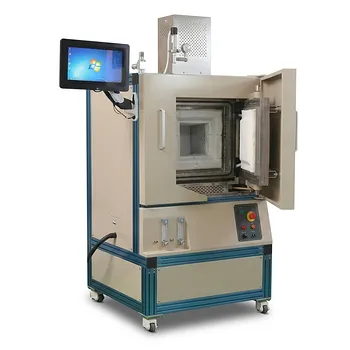
- High Temperature Oxygen and Inert Atmosphere Controlled Furnace 8 Liter 1700C Sintering System for Advanced Materials RD
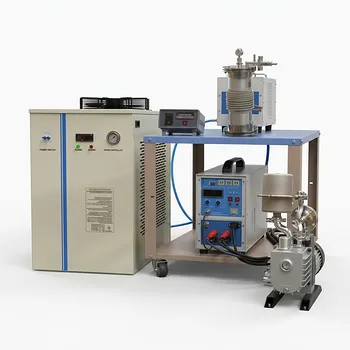
- Induction Heating System with Temperature Control for High Temperature Vacuum Sintering and Melting
People Also Ask
- What role does atmosphere control play in technical ceramics and glass? Master Material Purity and Precision
- What are the advantages of using an atmosphere-controlled high-temperature sintering furnace? Precise Oxygen Control
- Why is a tube furnace required for FGM-PhG structural color ceramics? Key to Carbon Preservation & Vibrant Color
- How does sintering furnace accuracy affect copper-graphene composites? Master Microstructure & Performance
- What role does an atmosphere furnace play in CN & Aux-CN preparation? Master Thermal Polycondensation & Stability.

Tech Team · ThermUnits
Last updated on Apr 14, 2026