Why is real-time monitoring essential for superalloy isothermal aging? Achieve Precise Phase & Microstructural Control
Updated 3 months ago
Real-time thermal monitoring is the cornerstone of metallurgical integrity during superalloy processing. It ensures that nickel-based superalloys follow specific, intended phase transformation paths by keeping furnace temperatures within strict tolerances, typically between 600°C and 1150°C. This level of precision is mandatory to prevent unintended shifts in precipitation kinetics and to provide the high-fidelity data required to construct accurate Time-Temperature-Precipitation (TTP) curves.
Core Takeaway: High-precision thermocouples eliminate the "thermal noise" that can compromise microstructural evolution. By maintaining a stable environment, they allow for the exact control of precipitate phases that define a superalloy's high-temperature strength and creep resistance.
Maintaining Phase Stability and Kinetics
Preventing Path Deviations
The precipitation kinetics of M6C and M23C6 carbides are exceptionally sensitive to even minor temperature fluctuations. High-precision instruments, such as K-type thermocouples, minimize the deviation between the actual furnace temperature and the set point.
If the temperature drifts, the phase transformation path can change entirely. This leads to the formation of unintended phases or the suppression of necessary ones, which compromises the reliability of the alloy's final properties.
Constructing Accurate TTP Curves
Reliable thermal data is the primary requirement for building Time-Temperature-Precipitation (TTP) curves. These curves act as the "roadmap" for heat treatment, defining when and at what temperature specific phases will appear.
Without real-time monitoring, the data points used to create these curves become "fuzzy." This lack of precision makes it impossible to predict how an alloy will behave during long-term service in high-stress environments like turbine engines.
Managing Long-Term Microstructural Evolution
The Challenge of Slow Growth Kinetics
Certain phases, such as the eta ($\eta$) phase, involve growth kinetics that are incredibly slow, often requiring 1,000 to 10,000 hours of continuous aging. Maintaining a stable thermal environment at 800°C for months at a time is a significant technical challenge.
High-performance aging furnaces must operate without failure for these durations. Precise monitoring ensures that the quantitative analysis of microstructure and subsequent creep property testing are based on a consistent thermal history.
Controlling Strengthening Precipitates
Precision laboratory furnaces are used to induce the precipitation of the gamma prime ($\gamma'$) strengthening phase. This phase is responsible for the "super" in superalloys, providing the primary resistance to deformation.
By precisely managing the aging temperature, engineers can control the size, volume fraction, and spatial distribution of these precipitates. This allows the microstructure to evolve from nanometer scales to specific target dimensions required for industrial applications.
Understanding the Potential Trade-offs
Sensor Drift and Degradation
During isothermal aging, particularly in runs lasting thousands of hours, thermocouple drift becomes a significant risk. The sensor materials themselves can oxidize or undergo subtle metallurgical changes, causing them to report inaccurate temperatures over time.
Feedback Loop Latency
Real-time monitoring is only as effective as the feedback loop it supports. If the furnace heating system has a slow response time, the thermocouple may detect a deviation, but the system may "overshoot" or "undershoot" the correction, leading to thermal cycling rather than true isothermal conditions.
How to Apply This to Your Project
Selecting the Right Monitoring Strategy
- If your primary focus is Phase Identification (TTP Mapping): Use high-precision K-type thermocouples to ensure data points are within $\pm 1$°C to capture the exact onset of carbide precipitation.
- If your primary focus is Long-Term Creep Resistance: Prioritize furnace stability and sensor longevity (armored thermocouples) to ensure the 1,000+ hour aging process remains truly isothermal.
- If your primary focus is Casting and Solidification: Utilize B-type thermocouples capable of exceeding 1700°C to accurately capture the liquidus plateau and verify heat transfer models.
The precision of your thermal monitoring directly determines the predictability and safety of the final superalloy component.
Summary Table:
| Application Focus | Thermocouple Type | Key Thermal Benefit | Target Phases/Metrics |
|---|---|---|---|
| Phase Identification | K-type (High Precision) | $\pm 1$°C accuracy for TTP mapping | $M_6C$, $M_{23}C_6$ Carbides |
| Long-term Aging | Armored K/N Type | Long-term stability (1,000h+) | Eta ($\eta$) phase evolution |
| Strengthening | Standard Industrial | Controlled precipitate distribution | Gamma prime ($\gamma'$) phase |
| Casting/Solidification | B-type | High-temp accuracy up to 1700°C | Liquidus/Solidus plateaus |
Elevate Your Metallurgical Research with THERMUNITS Precision
Precise microstructural evolution requires more than just heat; it demands absolute thermal stability. THERMUNITS provides the industry-leading high-temperature laboratory equipment necessary for advanced material science and industrial R&D.
Whether you are constructing TTP curves or conducting 10,000-hour aging studies, our comprehensive range of thermal solutions—including Muffle, Vacuum, Atmosphere, Tube, and Rotary furnaces, CVD/PECVD systems, and Vacuum Induction Melting (VIM) furnaces—ensures your nickel-based superalloys achieve their peak creep resistance and mechanical integrity.
Ready to eliminate thermal noise from your experiments? Contact our technical team today to find the perfect furnace for your R&D needs.
References
- R. Buerstmayr, Sophie Primig. Improved Thermodynamic Descriptions of Carbides in Ni-Based Superalloys. DOI: 10.1007/s11837-024-06484-8
Mentioned Products
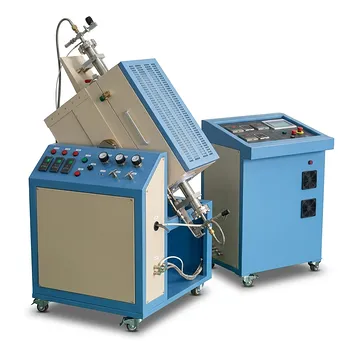
- 1100C High Pressure Rocking Tube Furnace with 2 Inch Super Alloy Processing Tube for Material Synthesis
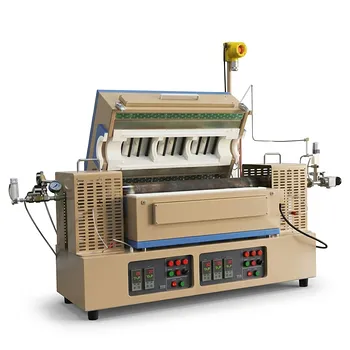
- Three Zone Hydrogen Gas Tube Furnace with 82mm Superalloy Tube and Dual Hydrogen Detectors 1200C High Temperature Material Processing System
- Three Temperature Zone Fast Heating Furnace 1500C Laboratory High Precision Thermal Processing System
People Also Ask
- Why is a high-pressure tube furnace required for the nitriding process of Fe-Cr-N alloys? Enhance Phase Stability
- What is the function of a high-temperature tube furnace in the synthesis of graphene oxide? Mastering LPCVD Processes
- Pt2CoM synthesis: High-temp tube furnace conditions (1000°C & 5% H2/Ar) for L10 intermetallic catalysts.
- What core conditions does a high-temperature tube furnace provide for rGO aerogels? Mastering Precision Synthesis.
- Why is it necessary to introduce steam into a high-temperature tube furnace during ACNN activation? Enhance Porosity.

Tech Team · ThermUnits
Last updated on Jun 03, 2026
Related Products
1100C High Pressure Rocking Tube Furnace with 2 Inch Super Alloy Processing Tube for Material Synthesis
Three Zone Hydrogen Gas Tube Furnace with 82mm Superalloy Tube and Dual Hydrogen Detectors 1200C High Temperature Material Processing System