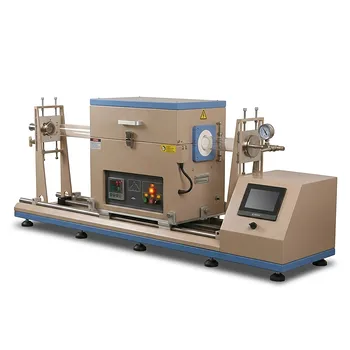
Why is a high-pressure tube furnace required for the nitriding process of Fe-Cr-N alloys? Enhance Phase Stability
Updated 3 months ago
The High-Temperature Solution Nitriding (HTSN) process relies on high-pressure environments to manipulate the thermodynamic laws of gas-metal interaction. A high-pressure tube furnace is necessary for Fe-Cr-N alloys because it provides the required nitrogen partial pressure (e.g., 460 kPa) to overcome the naturally low solubility of nitrogen in the metal. This specific equipment forces nitrogen atoms to diffuse into the solid austenite lattice, resulting in a uniform single-phase austenitic material with moderate nitrogen content and no brittle nitride precipitation.
Core Takeaway: A high-pressure tube furnace acts as a critical thermodynamic driver, using elevated pressure to bypass equilibrium limits and infuse the alloy with nitrogen. This enables the creation of high-nitrogen stainless steels with a stable, single-phase microstructure that cannot be achieved under standard atmospheric conditions.
Overcoming the Solubility Barrier
Driving Nitrogen into the Lattice
In standard environments, nitrogen has limited solubility in Fe-Cr alloys. The high-pressure tube furnace overcomes this physical limitation by maintaining a nitrogen partial pressure significantly higher than atmospheric levels. This pressure difference creates a strong chemical potential that drives nitrogen atoms to penetrate deep into the solid austenite lattice.
Avoiding Nitride Precipitation
One of the primary goals in Fe-Cr-N alloy production is achieving a single-phase austenitic structure. At lower pressures or improper temperatures, nitrogen may form chromium nitrides, which can lead to material brittleness and reduced corrosion resistance. The high-pressure environment ensures that nitrogen remains in solid solution, preventing these unwanted precipitates from forming.
Achieving Chemical Homogenization
Consistent material properties require a uniform distribution of nitrogen throughout the alloy. The controlled environment of a high-pressure furnace facilitates steady atomic diffusion. This results in a material where the nitrogen content is moderate and evenly distributed, rather than being concentrated only at the surface.
The Role of Atmosphere Integrity
Preventing Surface Oxidation
Just as vacuum furnaces prevent oxidation in Ni-Cr-Fe ingots, the sealed environment of a high-pressure tube furnace protects the alloy. By using high-purity nitrogen, the furnace eliminates oxygen from the chamber. This prevents the formation of surface oxides that would otherwise act as a barrier to nitrogen diffusion.
Sealing and Thermal Stability
Advanced tube furnaces are designed with superior atmosphere sealing to maintain constant high pressure throughout the treatment. The excellent heat transfer within the tube ensures a uniform thermal field. This stability is vital for maintaining the specific reaction kinetics required for High-Temperature Solution Nitriding.
Comparison to Other Nitriding Methods
Unlike ammonia-based nitriding which relies on chemical breakdown (pyrolysis), HTSN in a high-pressure furnace uses molecular nitrogen (N2) directly. This offers a cleaner, more direct path to enriching the alloy without the complexities of handling corrosive ammonia gas or dealing with gaseous byproducts.
Understanding the Trade-offs
Equipment Complexity and Cost
Operating at pressures like 460 kPa requires specialized furnace construction, including reinforced quartz or metallic tubes and high-pressure seals. This significantly increases the capital intensity compared to standard box or muffle furnaces used for general annealing.
Process Time and Cooling Rates
While high pressure accelerates nitrogen intake, the diffusion process remains a factor of time and temperature. Users must balance the duration of the heat treatment to ensure compositional uniformity without causing grain growth. Additionally, rapid cooling or quenching is often needed after the pressure treatment to "lock" the nitrogen in the supersaturated state.
Strategic Selection for Your Project
Recommendations Based on Material Goals
- If your primary focus is maximizing corrosion resistance: Utilize the high-pressure furnace to ensure a single-phase austenite structure, as this prevents the chromium depletion typically caused by nitride precipitation.
- If your primary focus is surface hardness and wear: Adjust the pressure and duration to create a nitrogen-rich gradient near the surface while maintaining a stable core.
- If your primary focus is structural uniformity: Prioritize furnaces with high thermal stability and precision-controlled gas flow to ensure the nitrogen distribution is identical across the entire batch.
By leveraging the thermodynamic advantages of a high-pressure environment, you can engineer Fe-Cr-N alloys with mechanical and chemical properties that far exceed those of traditionally processed stainless steels.
Summary Table:
| Factor | High-Pressure Furnace Role | Material Benefit |
|---|---|---|
| Nitrogen Solubility | Increases partial pressure (e.g., 460 kPa) | Forces diffusion into solid austenite lattice |
| Phase Control | Prevents chromium nitride formation | Achieves uniform single-phase microstructure |
| Atmosphere Integrity | Hermetic sealing and high-purity N2 | Prevents surface oxidation and brittleness |
| Thermal Field | Controlled heat transfer | Ensures chemical homogenization across batch |
Elevate Your Materials Research with THERMUNITS
As a leading manufacturer of high-temperature laboratory equipment, THERMUNITS provides advanced thermal processing solutions tailored for material science and industrial R&D. Our high-pressure tube furnaces are specifically engineered to handle the rigorous demands of High-Temperature Solution Nitriding (HTSN), ensuring precise control over nitrogen diffusion and phase stability.
Our comprehensive range includes:
- Tube & Atmosphere Furnaces for precise gas-metal interactions.
- Vacuum & Vacuum Induction Melting (VIM) for ultra-pure alloy production.
- Muffle, Rotary, & Hot Press Furnaces for diverse heat treatment needs.
- CVD/PECVD & Dental Furnaces for specialized material synthesis.
Ready to optimize your Fe-Cr-N alloy development? Contact our experts today to discover how THERMUNITS can enhance your lab's efficiency and material performance with our premium thermal elements and heat treatment solutions.
References
- Philip König, Sebastian Weber. Bainite Formation in a Carbon-Free Fe–Cr–N System. DOI: 10.1007/s11661-024-07365-0
Mentioned Products
- 1100C High Pressure Rocking Tube Furnace with 2 Inch Super Alloy Processing Tube for Material Synthesis
- 1100C Eight Zone High Pressure Super Alloy Tube Furnace with Integrated High Pressure Gas Control System
- High Temperature Tube Furnace 1500C with Sliding Flanges and 50mm OD for Rapid Thermal Processing Fast Heating and Cooling
- 1700C Hydrogen Gas Tube Furnace with 60mm Alumina Process Tube and Integrated Hydrogen Safety Detector
- Compact High Temperature 1600C Tube Furnace with 50mm Alumina Tube and Vacuum Flanges for Material Sintering
People Also Ask
- What is the function of a high-temperature tube furnace in the synthesis of graphene oxide? Mastering LPCVD Processes
- Pt2CoM synthesis: High-temp tube furnace conditions (1000°C & 5% H2/Ar) for L10 intermetallic catalysts.
- What core conditions does a high-temperature tube furnace provide for rGO aerogels? Mastering Precision Synthesis.
- Why is it necessary to introduce steam into a high-temperature tube furnace during ACNN activation? Enhance Porosity.
- Why is a high-temperature tube furnace essential for Ba0.5Ca0.5La2(MoO4)4 phosphors? Enhance Luminous Performance

Tech Team · ThermUnits
Last updated on Jun 02, 2026
Related Products
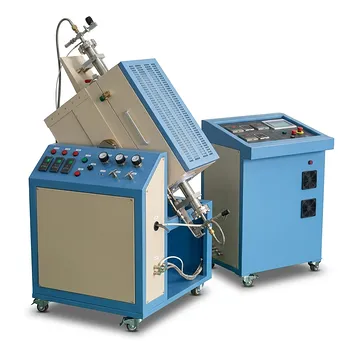
1100C High Pressure Rocking Tube Furnace with 2 Inch Super Alloy Processing Tube for Material Synthesis
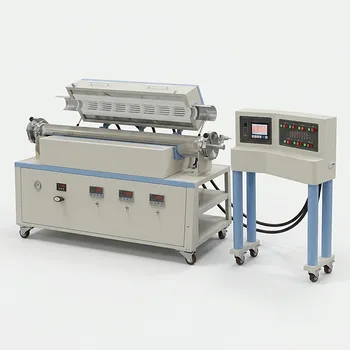
1100C Eight Zone High Pressure Super Alloy Tube Furnace with Integrated High Pressure Gas Control System

High Temperature Tube Furnace 1500C with Sliding Flanges and 50mm OD for Rapid Thermal Processing Fast Heating and Cooling
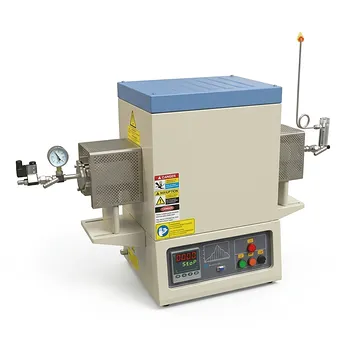
1700C Hydrogen Gas Tube Furnace with 60mm Alumina Process Tube and Integrated Hydrogen Safety Detector

Compact High Temperature 1600C Tube Furnace with 50mm Alumina Tube and Vacuum Flanges for Material Sintering
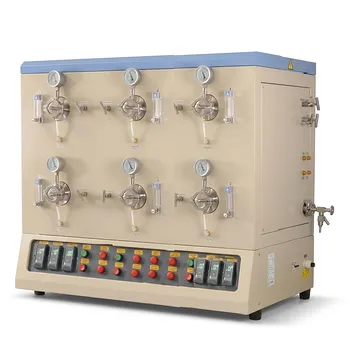
1200C High Throughput Multi Channel Tube Furnace with 50mm Quartz Tubes for Annealing and Material Phase Diagram Research
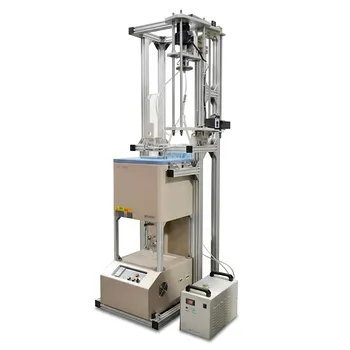
500C Vacuum Vertical Tube Furnace 84mm OD Sample Rotation Lifting System
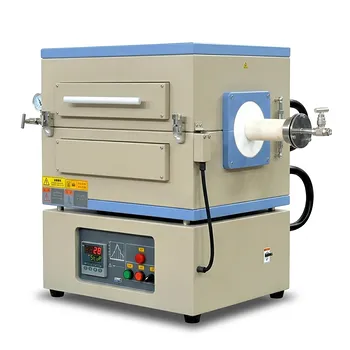
1500°C Split Tube Furnace with Alumina Tube and Vacuum Sealing Flanges for Material Research

Vertical 1700C Vacuum and Atmosphere Tube Furnace with 80mm Alumina Tube

High Temperature 1700C Tube Furnace with High Vacuum Turbomolecular Pump System and Multi Channel Mass Flow Controller Gas Mixer

High Temperature 1700C Vertical Tube Furnace for Powder Spherification and Material Sintering
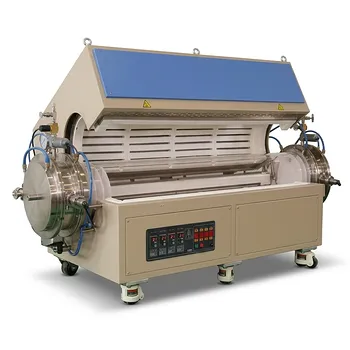
1200C Max Four Zone Split Tube Furnace with Optional Large Diameter Quartz Tubes
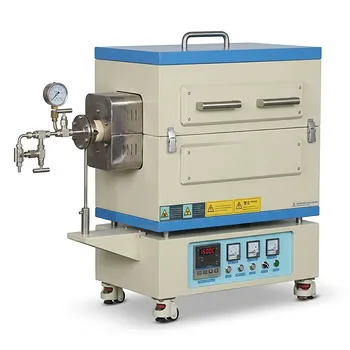
High Temperature Split Tube Furnace 1500C for Material Research Vacuum and Atmosphere Thermal Processing

High Temperature 1700C Six Zone Split Tube Furnace with Alumina Tube and Water Cooled Flanges

High Temperature 1700C Benchtop Tube Furnace with 5 Inch Heating Zone High Purity Alumina Tube and Vacuum Sealing Flanges

1750°C High Temperature Benchtop Vacuum Atmosphere Tube Furnace with Kanthal Super 1800 Heating Elements and 60mm Alumina Processing Tube

1200°C 5 Inch Vertical Quartz Tube Furnace with Stainless Steel Vacuum Flanges

1800C High Temperature Compact Vacuum Tube Furnace with 60mm OD Alumina Tube and Kanthal MoSi2 Heating Elements

High Temperature Automated 5 Inch Tube Furnace for Autonomous Material Research and Advanced Laboratory R&D