Why is testing conducted on FeCrAl heating wires wrapped in alumina ceramics to verify catalytic mechanisms? Decouple Heat
Updated 3 months ago
Testing FeCrAl wires wrapped in alumina is a definitive experimental control used to decouple thermal energy from surface-level electronic interactions. This setup allows researchers to prove that the reforming reaction requires direct physical contact with the wire's surface to proceed. By blocking this contact while maintaining a constant temperature, the experiment demonstrates that thermal energy alone is not the primary driver of the chemical transformation.
The central takeaway of this testing method is the verification that the reforming reaction is driven by direct electronic interaction (hot electrons) on the metal surface rather than a purely thermal process. By isolating the wire with alumina, you prove that "heat" and "catalysis" are distinct contributors in this system.
Distinguishing Heat from Catalysis
The Role of the Alumina Barrier
Alumina acts as a physical and electronic insulator that prevents gas molecules from reaching the FeCrAl wire surface. This creates a controlled environment where the reactants are exposed to the same ambient temperature but are denied access to the metal's active sites.
Maintaining Temperature Consistency
To ensure the experiment is valid, the system must maintain the same temperature as the unwrapped wire tests. When the reaction fails to proceed effectively despite the high temperature, it reveals that thermal energy is insufficient to break the chemical bonds of the reactants on its own.
Proving the "Hot Electron" Mechanism
Beyond Simple Thermal Effects
The primary goal of this test is to debunk the idea that the wire acts merely as a heater. If the reaction were purely thermal, the reforming process would occur regardless of whether the gas touches the wire, provided the kinetic energy (heat) is high enough.
The Necessity of Surface Interaction
The lack of reaction when the wire is wrapped confirms that direct interaction between the reactants and the wire's surface is mandatory. Specifically, it points to the role of hot electrons—energetic charge carriers on the wire surface—which interact with gas molecules to lower the activation energy of the reaction.
Validating the Electronic Driver
Because the reaction stalls when the surface is covered, researchers can confidently conclude that the catalytic effect is electronic. The alumina prevents the transfer of energy from these hot electrons to the reactants, effectively "turning off" the catalytic mechanism while leaving the thermal environment intact.
Understanding the Trade-offs and Pitfalls
Thermal Lag and Shielding
One challenge with using alumina is its inherent thermal resistance, which can create a slight temperature gradient between the wire and the surrounding gas. Scientists must use thin, high-conductivity ceramic layers to ensure the gas temperature remains truly identical to the "unwrapped" baseline.
Surface Passivation and Purity
If the alumina wrapping is not high-purity, it may introduce its own secondary catalytic effects or contaminants. This can lead to false positives, where a reaction appears to occur not because of the FeCrAl wire, but because of impurities in the ceramic barrier itself.
How to Apply This to Your Research
If you are designing experiments to verify catalytic mechanisms, consider the following goals:
- If your primary focus is isolating electronic effects: Use high-purity alumina wrapping to ensure that any observed drop in reaction rate is due to the loss of surface contact, not a change in temperature.
- If your primary focus is optimizing energy efficiency: Compare the reaction rates of wrapped vs. unwrapped wires to determine how much of your process is driven by expensive thermal heating versus efficient surface catalysis.
- If your primary focus is material durability: Use this testing method to see if surface oxides (which naturally form on FeCrAl) are acting as a barrier similar to the alumina, potentially hindering your reaction over time.
By utilizing an alumina barrier, you transform a simple heating element into a sophisticated tool for proving that surface electronics are the true engine of the chemical reaction.
Summary Table:
| Feature | Unwrapped FeCrAl Wire | Alumina-Wrapped FeCrAl Wire |
|---|---|---|
| Surface Interaction | Direct gas-to-metal contact | Physical/Electronic barrier |
| Energy Mechanism | Thermal + Hot Electrons | Thermal energy only |
| Reaction Driver | Electronic catalysis | Pure kinetic energy (heat) |
| Experimental Goal | Baseline reaction rate | Proving surface necessity |
Elevate Your Material Research with THERMUNITS Precision
Are you looking to isolate complex catalytic mechanisms or optimize high-temperature thermal processing? THERMUNITS is a leading manufacturer of high-temperature laboratory equipment tailored for material science and industrial R&D. We provide the high-purity environments and precise temperature control necessary to validate your most critical experiments.
Our comprehensive range of thermal solutions includes:
- Furnaces: Muffle, Vacuum, Atmosphere, Tube, Rotary, and Hot Press models.
- Advanced Systems: CVD/PECVD systems, Dental Furnaces, and Electric Rotary Kilns.
- Specialized Equipment: Vacuum Induction Melting (VIM) furnaces and high-quality Thermal Elements.
Don't let equipment limitations hinder your scientific breakthroughs. Contact us today to discuss your project requirements and discover how our advanced heat treatment solutions can enhance your lab's capabilities.
References
- Qing Ma, Ding Ma. Grave-to-cradle dry reforming of plastics via Joule heating. DOI: 10.1038/s41467-024-52515-y
Mentioned Products
- High Temperature Benchtop Muffle Furnace 1700C 10L Chamber Alumina Fiber Insulation MoSi2 Heating Elements
- 1800C High Temperature Compact Vacuum Tube Furnace with 60mm OD Alumina Tube and Kanthal MoSi2 Heating Elements
- High Temperature Vertical Hybrid Furnace with Alumina Tube and SiC Heating for SOFC Coin Cell Testing and Atmosphere Processing
People Also Ask
- What is the function of a high-temp muffle furnace in Ni-V oxide synthesis? Optimize your material's performance.
- What is the function of a high-temperature muffle furnace in phosphorus-modified zeolite catalyst preparation?
- What role does a high-temperature muffle furnace play in evaluating the mineral composition of rock samples? LOI & XRF Guide
- What is the purpose of using muffle or tube furnaces in glass synthesis? Achieve Precise Melt-Quenching & Homogeneity
- What is the function of a muffle furnace in aluminoborosilicate glass prep? Stabilize Raw Materials for Superior Purity

Tech Team · ThermUnits
Last updated on Jun 03, 2026
Related Products
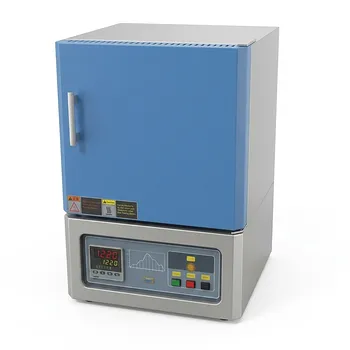
High Temperature Benchtop Muffle Furnace 1700C 10L Chamber Alumina Fiber Insulation MoSi2 Heating Elements

1800C High Temperature Compact Vacuum Tube Furnace with 60mm OD Alumina Tube and Kanthal MoSi2 Heating Elements