What are the key advantages of using a graphite crucible when sintering Rare Earth Hexaborides? Pure & Stable Results.
Updated 3 months ago
High-purity graphite crucibles provide the essential thermal stability and chemical inertness required to sinter Rare Earth Hexaborides at temperatures reaching 1600°C and beyond. By maintaining structural integrity and resisting chemical reactions under reducing atmospheres, these crucibles prevent sample contamination and ensure uniform heat distribution. This makes them far superior to standard ceramic vessels for high-temperature material synthesis.
Core Takeaway: Graphite crucibles act as both a stable carrier and a thermal mediator, ensuring Rare Earth Hexaboride samples remain pure and uniformly processed. Their unique resistance to chemical adhesion and thermal shock allows for reliable performance in extreme environments where other materials would fail or bond to the reactants.
Superior Thermal Performance and Stability
Exceptional High-Temperature Resistance
Graphite maintains its structural integrity at extreme temperatures, typically between 1400°C and 1600°C, and can even handle short-term peaks up to 2800°C in specialized furnace environments. Unlike many other materials, graphite does not soften or lose its shape under the intense heat required for boride sintering.
High Thermal Conductivity for Uniformity
The high thermal conductivity of graphite ensures that heat is transferred rapidly and uniformly from the heat source to the Rare Earth Hexaboride sample. This uniform heating is critical for achieving consistent density and phase purity throughout the sintered material.
Excellent Thermal Shock Stability
Graphite's ability to withstand rapid temperature changes without cracking or degrading is known as thermal shock stability. This property allows for more flexible heating and cooling cycles, reducing the risk of crucible failure during complex sintering processes.
Chemical Integrity and Contamination Control
Inertness in Reducing Atmospheres
High-purity graphite is specifically selected for its chemical inertness under reducing or inert atmospheres. At high temperatures, it does not react with the raw materials used to create Rare Earth Hexaborides, which is vital for maintaining the high compositional purity of the final product.
Prevention of Material Adhesion
A common failure point for standard ceramic vessels is the chemical interference or adhesion between the sample and the container. Graphite resists these interactions, ensuring that the sintered hexaboride samples can be easily removed without damage or crucible infiltration.
Micro-Environment Regulation
When used with a covered design, graphite crucibles help create an enclosed micro-zone that stabilizes internal gas pressures. This environment helps maintain a balance of volatile components, which can be critical for the deposition efficiency and quality of the materials being processed.
Understanding the Trade-offs
Atmosphere Sensitivity
Graphite is highly susceptible to oxidation if exposed to oxygen at high temperatures, typically beginning to degrade above 400°C in air. Consequently, its use is strictly limited to vacuum, inert (argon/nitrogen), or reducing atmospheres.
Mechanical Fragility
While thermally robust, graphite is a brittle material that can be damaged by physical impact or improper handling. It also possesses a degree of porosity that, if not properly managed through high-purity manufacturing, could potentially trap trace gases.
How to Apply This to Your Project
When selecting a material carrier for high-temperature sintering, your choice should align with your specific atmospheric and purity requirements.
- If your primary focus is Maximum Chemical Purity: Utilize high-purity graphite crucibles in a vacuum or argon atmosphere to eliminate the risk of crucible-to-sample reaction.
- If your primary focus is Thermal Uniformity in Large Batches: Leverage graphite’s superior thermal conductivity to ensure consistent sintering across the entire volume of the material.
- If your primary focus is Operating in an Oxidizing Environment: Avoid graphite entirely and instead consider corundum or alumina-based crucibles, as graphite will oxidize and fail.
Ultimately, high-purity graphite remains the definitive choice for Rare Earth Hexaboride sintering due to its unmatched ability to protect sample integrity in high-heat, reducing environments.
Summary Table:
| Key Advantage | Technical Benefit | Ideal Environment |
|---|---|---|
| Extreme Heat Resistance | Maintains integrity at 1600°C+ | Vacuum / Inert Atmosphere |
| High Thermal Conductivity | Ensures uniform sintering density | Rapid Heat Transfer |
| Chemical Inertness | Prevents sample contamination | Reducing Atmospheres |
| Thermal Shock Stability | Resists cracking during rapid cycles | Variable Temp Profiles |
| Non-Adhesion | Easy sample removal without damage | High-Purity Synthesis |
Elevate Your Material Research with THERMUNITS
Are you looking to optimize your high-temperature sintering processes? THERMUNITS is a leading manufacturer of high-temperature laboratory equipment for material science and industrial R&D. We offer a comprehensive range of thermal processing solutions, including Vacuum, Atmosphere, Tube, and Muffle furnaces, specifically designed to handle advanced materials like Rare Earth Hexaborides.
From high-purity graphite integration to advanced CVD/PECVD and Hot Press systems, our equipment ensures the precision and durability your research demands.
Ready to enhance your lab’s capabilities? Contact our engineering experts today to find the perfect furnace solution for your specific heat treatment requirements!
References
- Hongye Wang, Heng Chen. Medium- and High-Entropy Rare Earth Hexaborides with Enhanced Solar Energy Absorption and Infrared Emissivity. DOI: 10.3390/ma17081789
Mentioned Products
- Automatic 10 Crucible Induction Melting and Casting System with Stirring Function and Glovebox Integration 2000C
- 1100C High Temperature Vacuum Crucible Furnace with Quartz Chamber for Thermal Processing and Sintering
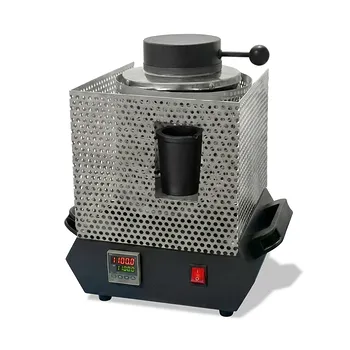
- Compact Crucible Melting Furnace 1100C Programmable Temperature Controller Metal Sintering Equipment
People Also Ask
- Why must high-purity argon gas be used as a protective atmosphere during high-temperature reduction smelting experiments?
- How should the choice between a Quartz crucible and an Alumina crucible be made for La2O2S? Optimize Material Purity
- How does Vacuum Induction Melting mitigate hydrogen embrittlement? Ensure Structural Integrity for Critical Alloys
- What role does Vacuum Induction Melting play in medical implants? Ensure High-Purity Alloys for Superior Performance
- Why is Vacuum Induction Melting preferred for manufacturing corrosion-resistant alloys? Ensure Ultra-High Purity

Tech Team · ThermUnits
Last updated on Jun 02, 2026
Related Products
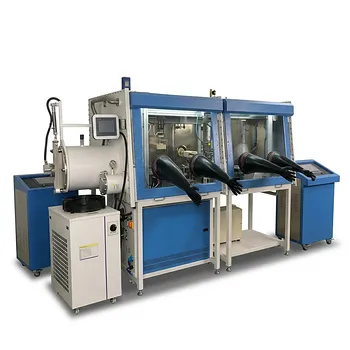
Automatic 10 Crucible Induction Melting and Casting System with Stirring Function and Glovebox Integration 2000C
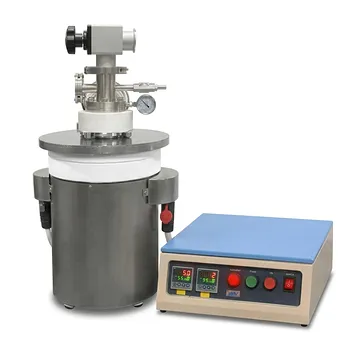
1100C High Temperature Vacuum Crucible Furnace with Quartz Chamber for Thermal Processing and Sintering