What is the primary function of the Precision Pressure Controller in a Hy-MOCVD system? Master Uniform Film Growth.
Updated 3 months ago
The Precision Pressure Controller (PPC) serves as the primary regulator of the internal environment within a Hybrid Metal-Organic Chemical Vapor Deposition (Hy-MOCVD) system. Its fundamental job is to strictly maintain the stability of the total pressure inside the reaction chamber, typically a quartz tube, by precisely modulating the back pressure. This constant pressure environment ensures that precursor vapors are transported at a predictable rate and that the gas follows a stable, laminar flow path.
Core Takeaway: The Precision Pressure Controller is the linchpin of growth stability; it eliminates pressure-induced fluctuations to ensure uniform film thickness and high crystalline quality in 2D semiconductor materials.
The Role of Pressure in Vapor Dynamics
Maintaining Constant Precursor Transport
In Hy-MOCVD, the delivery of metal-organic precursors depends heavily on the pressure differential between the source and the chamber. The Precision Pressure Controller ensures that this transport rate remains fixed throughout the growth process. If the pressure deviates, the concentration of precursors reaching the substrate changes, leading to unpredictable growth rates.
Regulating Back Pressure
The controller functions by actively monitoring and adjusting the back pressure at the exhaust side of the reaction chamber. By fine-tuning the resistance against the vacuum pump or exhaust flow, it creates a stable "buffer" of pressure. This mechanism allows the system to compensate for minor fluctuations in gas input or temperature changes.
Impact on Material Morphology and Quality
Preserving Stable Laminar Flow
For high-quality 2D semiconductor growth, gases must move in smooth, parallel layers known as laminar flow. The PPC prevents the turbulence that often accompanies pressure spikes or drops. Without this stability, irregular gas patterns can cause uneven chemical reactions across the surface of the wafer.
Eliminating Film Non-Uniformity
Film thickness non-uniformity is often a direct result of an unstable reaction environment. By keeping the pressure constant, the PPC ensures that the boundary layer—the region where the chemical reaction occurs near the substrate—remains consistent. This results in a perfectly leveled film across the entire growth area.
Protecting Crystalline Integrity
Fluctuations in pressure can introduce defects or secondary phases into the atomic lattice of the semiconductor. A steady pressure environment provided by the PPC allows atoms to arrange themselves into a high-quality crystalline structure without interruption. This is critical for the electronic performance of the final device.
Understanding the Trade-offs and Challenges
Sensitivity vs. Response Time
A high-precision controller must balance sensitivity with the speed of its mechanical response. If the controller is too aggressive, it may cause "hunting," where the pressure oscillates around the setpoint. Conversely, a sluggish response may fail to catch rapid spikes caused by switching gas lines.
Maintenance of the Sensing Element
Because the PPC is often located downstream of the reaction, it can be exposed to residual precursor vapors or byproducts. Over time, these materials can accumulate on the control valve or sensor. This buildup can lead to "drift," where the actual pressure in the chamber slowly deviates from the digital setpoint.
Applying Precise Control to Your Growth Goals
To achieve the best results in your Hy-MOCVD process, the implementation of the pressure controller should align with your specific material requirements.
- If your primary focus is atomic-layer uniformity: Prioritize a controller with a high-speed piezoelectric valve to instantly counteract pressure shifts during precursor switching.
- If your primary focus is high crystalline purity: Ensure the PPC is integrated with a high-accuracy capacitance manometer to maintain absolute pressure stability over long growth cycles.
- If your primary focus is system longevity: Implement a heated pressure control valve to prevent the condensation of reaction byproducts within the controller assembly.
By mastering the stability of the reaction chamber through precise pressure regulation, you secure the repeatability and quality necessary for advanced 2D semiconductor fabrication.
Summary Table:
| Feature | Primary Function | Impact on Growth Quality |
|---|---|---|
| Pressure Regulation | Modulates back pressure in the reaction chamber | Ensures predictable precursor transport rates |
| Flow Stabilization | Maintains stable laminar gas flow | Prevents turbulence and uneven chemical reactions |
| Boundary Layer Control | Keeps reaction environment consistent | Guarantees uniform film thickness across the wafer |
| Crystal Integrity | Eliminates pressure-induced fluctuations | Reduces lattice defects and improves electronic performance |
Elevate Your Material Research with THERMUNITS Precision
Are you looking to achieve atomic-layer precision in your 2D semiconductor fabrication? THERMUNITS is a leading manufacturer of high-temperature laboratory equipment for material science and industrial R&D. We provide the advanced thermal processing solutions required for high-stakes research and production.
Our Comprehensive Product Range Includes:
- CVD/PECVD Systems: Optimized for precise film growth and Hy-MOCVD applications.
- Versatile Furnaces: Muffle, Vacuum, Atmosphere, Tube, Rotary, and Hot Press furnaces.
- Specialized Equipment: Dental Furnaces, Electric Rotary Kilns, and Vacuum Induction Melting (VIM) furnaces.
- High-Performance Components: Premium thermal elements and precision control systems.
Whether you are scaling up industrial R&D or perfecting lab-scale experiments, our equipment is designed to deliver the stability and repeatability your materials demand.
Ready to optimize your thermal processing?
Contact us today to discuss your specific requirements and see how THERMUNITS can empower your next breakthrough!
References
- Zhepeng Zhang, Andrew J. Mannix. Chemically Tailored Growth of 2D Semiconductors via Hybrid Metal–Organic Chemical Vapor Deposition. DOI: 10.1021/acsnano.4c02164
Mentioned Products
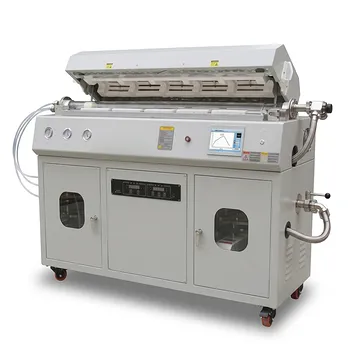
- Multi Heating Zones CVD Tube Furnace System for Precision Chemical Vapor Deposition and Advanced Material Synthesis
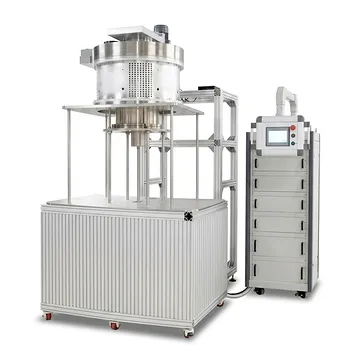
- 915MHz MPCVD Diamond Machine Microwave Plasma Chemical Vapor Deposition System Reactor
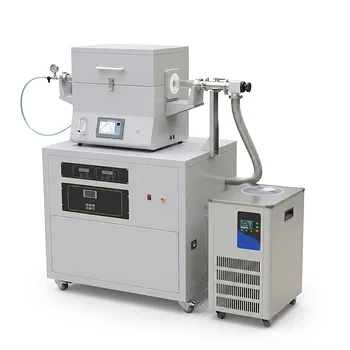
- Split Chamber CVD Tube Furnace with Vacuum Station Chemical Vapor Deposition System Machine
People Also Ask
- How does a sliding rail design benefit the CVD process within a furnace ventilation hood? Enhance Control & Quenching
- How does the deposition process occur within a Chemical Vapor Deposition (CVD) reactor? Explore the 5-Stage Growth Cycle
- What are the primary differences between hot-wall and cold-wall CVD reactors? Choose the Best System for High Purity
- What is the primary function of a CVD system in the synthesis of Bi2O2Se thin films? Master High-Quality Crystal Growth
- What is the core function of a CVD system in FG-FET fabrication? High-Quality Graphene Synthesis for Research

Tech Team · ThermUnits
Last updated on Jun 03, 2026