How do high-precision flow meters and gas mixing systems facilitate oxygen partial pressure control in open-system slag experiments?
Updated 3 months ago
High-precision flow meters and gas mixing systems facilitate oxygen partial pressure ($p\text{O}_2$) control by regulating the exact volumetric ratios of reactive gases. In open-system slag experiments, these systems introduce a continuous flow of a gas mixture—typically carbon monoxide (CO) and carbon dioxide ($\text{CO}_2$)—into a high-temperature reaction tube. By maintaining a constant ratio of these gases, researchers can fix the chemical potential of oxygen, allowing for the precise study of how metals like copper partition between slag and metallic phases.
High-precision gas mixing transforms the furnace environment into a thermodynamically defined "buffer" where the $p\text{O}_2$ is dictated by the ratio of the input gases. This level of control is essential for isolating the effects of oxygen potential on the distribution laws of copper and its oxides during slag-metal equilibrium studies.
The Mechanism of Gas-Phase Redox Control
Thermodynamic Buffering via CO/$\text{CO}_2$ Ratios
In metallurgical experiments, the oxygen partial pressure is governed by the equilibrium reaction between CO and $\text{CO}_2$. By adjusting the ratio of these two gases, the system follows predictable thermodynamic laws to reach a specific $p\text{O}_2$ at a given temperature.
The Role of High-Purity Gases
The use of high-purity gases is critical to prevent contamination from trace oxygen or moisture. Even minute impurities can cause significant deviations in the intended redox environment, leading to inaccurate data regarding metal-slag distribution.
Establishing the Reaction Environment
High-precision systems ensure that the gas mixture is thoroughly blended before it enters the reaction tube. This constant stream of gas flushes the system, ensuring that the local atmosphere around the slag sample remains consistent throughout the duration of the experiment.
Hardware Precision in Open-System Experiments
Calibrated Capillary Flow Meters
Calibrated capillary flow meters are the gold standard for achieving the necessary precision in these experiments. These devices provide a stable and repeatable flow rate, which is necessary to maintain the delicate ratio of gases required for subtle $p\text{O}_2$ adjustments.
Dynamic Control in Open Systems
Unlike closed systems, open-system architectures allow for the continuous introduction of fresh gas and the removal of reaction byproducts. The mixing system acts as the "brain" of this setup, responding to the need for varying redox conditions without requiring the experiment to be restarted.
High-Temperature Stability
Because $p\text{O}_2$ is highly sensitive to temperature, the flow meters must work in tandem with the furnace's thermal controllers. The gas mixing system ensures that even as temperatures fluctuate, the chemical input remains constant, allowing researchers to isolate temperature as a single variable.
Understanding the Trade-offs
Calibration and Drift
Even the most precise flow meters are subject to calibration drift over time or due to changes in ambient pressure. Regular recalibration is necessary to ensure that the "commanded" gas ratio matches the "actual" ratio delivered to the slag.
Thermal Expansion and Flow Rates
Gas volume changes with temperature, meaning the flow rate measured at the meter may differ from the velocity within the hot zone. Failure to account for the thermal expansion of gases can lead to inconsistencies in the residence time of the gas over the slag sample.
Potential for Incomplete Mixing
If the gas mixing chamber is poorly designed, the CO and $\text{CO}_2$ may not be homogeneously blended before reaching the sample. This can result in "pockets" of varying oxygen potential, which compromises the equilibrium of the slag-metal interface.
Applying Precise Control to Your Slag Research
To achieve the highest level of accuracy in your metallurgical experiments, the integration of gas mixing and flow control must be handled with technical rigor.
- If your primary focus is slag-metal equilibrium: Prioritize the use of high-purity CO and $\text{CO}_2$ cylinders and verify your flow meter calibration before every major run.
- If your primary focus is copper partitioning laws: Focus on the precise ratio control provided by capillary meters to map the distribution of copper oxides across a wide range of oxygen partial pressures.
- If your primary focus is experimental repeatability: Implement an automated gas mixing system that can log flow rates in real-time, ensuring that every data point is backed by verifiable atmospheric conditions.
By mastering the precision of gas-phase delivery, you ensure that the chemical environment of your experiment is a known constant rather than an uncontrolled variable.
Summary Table:
| Component | Role in Experiment | Key Benefit |
|---|---|---|
| CO/CO2 Gas Mixture | Thermodynamic Buffer | Establishes precise oxygen partial pressure ($p\text{O}_2$) |
| Capillary Flow Meters | Volumetric Regulation | Ensures stable, repeatable gas ratios for redox control |
| Open-System Design | Continuous Atmosphere | Flushes byproducts and maintains constant chemical potential |
| High-Purity Gases | Contamination Control | Prevents data deviations caused by moisture or trace oxygen |
Precision Thermal Solutions for Advanced Slag Research
At THERMUNITS, we specialize in providing the technical foundation for high-stakes material science and industrial R&D. Controlling oxygen partial pressure requires more than just gas; it requires a furnace environment built for stability and precision.
As a leading manufacturer of high-temperature laboratory equipment, we offer a comprehensive range of solutions to optimize your heat treatment workflows:
- Atmosphere & Vacuum Furnaces for controlled redox environments.
- Tube & Rotary Furnaces for continuous or batch slag-metal studies.
- CVD/PECVD & Hot Press Systems for advanced material synthesis.
- High-Temperature Elements and specialized laboratory equipment for custom R&D setups.
Whether you are mapping copper partitioning laws or refining slag-metal equilibrium models, our expert-engineered solutions ensure your variables remain constant.
Ready to elevate your experimental accuracy? Contact THERMUNITS today to discuss your thermal processing needs
References
- Georgii Khartcyzov, Evgueni Jak. Distribution of Pb, Zn, Fe, As, Sn, Sb, Bi, and Ni Between Oxide Liquid and Metal in the ‘CuO0.5’-CaO-AlO1.5 System in Equilibrium with Cu Metal at 1400 °C. DOI: 10.1007/s40831-024-00952-w
Mentioned Products
- Dual Zone Quartz Tube Furnace with 80mm Diameter 1200C Max Temperature 3 Channel Gas Mixer and Vacuum Pump System
- Dual Tube 100mm 80mm CVD Sliding Furnace with 4 Channel Gas Mixing and Vacuum System
- Three Zone Quartz Tube Furnace with 3 Channel Gas Mixer Vacuum Pump and Anti Corrosive Vacuum Gauge
- Automatic 10 Crucible Induction Melting and Casting System with Stirring Function and Glovebox Integration 2000C
- Flammable Gas Control and Disposal Device with H2 Gas Leaking Detector and Safety Interlock System
People Also Ask
- How do dual-zone quartz tube furnaces achieve controllable material preparation? Optimize Perovskite VD Processes
- What are the technical advantages of using a dual-zone tube furnace for growing large PdCoO2 crystals via CVT? Expert Tips
- Purpose of the reverse gradient step in CVT growth? Master Crystal Purity with Dual-Zone Furnaces
- Why is it necessary to place MoS2 devices in a dual-zone tube furnace for annealing? Optimize Lattice Repair & Doping
- Why is a dual-zone tube furnace necessary for ReO3-doped Cu2Te CVD? Essential for precise precursor synchronization.

Tech Team · ThermUnits
Last updated on Jun 03, 2026
Related Products
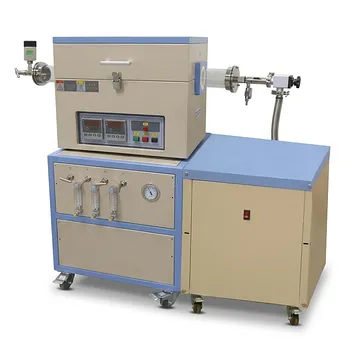
Dual Zone Quartz Tube Furnace with 80mm Diameter 1200C Max Temperature 3 Channel Gas Mixer and Vacuum Pump System
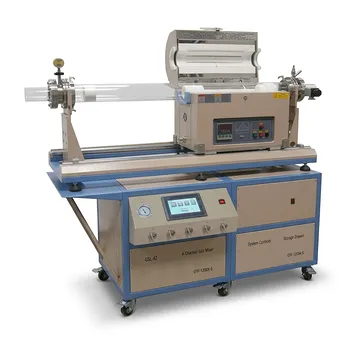
Dual Tube 100mm 80mm CVD Sliding Furnace with 4 Channel Gas Mixing and Vacuum System
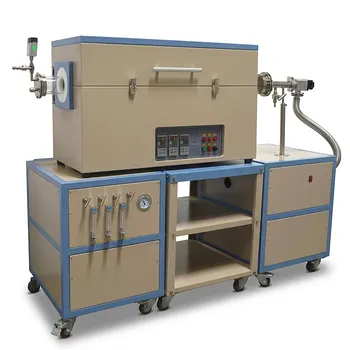
Three Zone Quartz Tube Furnace with 3 Channel Gas Mixer Vacuum Pump and Anti Corrosive Vacuum Gauge
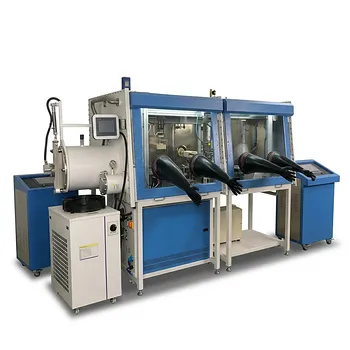
Automatic 10 Crucible Induction Melting and Casting System with Stirring Function and Glovebox Integration 2000C
Flammable Gas Control and Disposal Device with H2 Gas Leaking Detector and Safety Interlock System
Automatic Flammable Gas Control and Disposal Device for Hydrogen Atmosphere Furnaces
