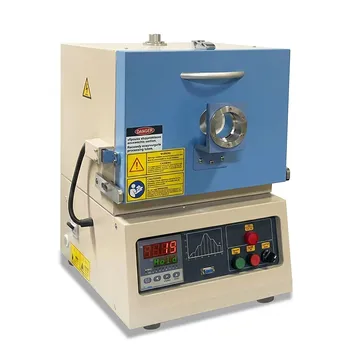
Why is a laboratory tube furnace required for catalyst calcination? Achieve Precise Phase & Structural Stability.
Updated 3 months ago
The use of a laboratory tube furnace is essential for providing the controlled high-temperature environment required to induce the thermal decomposition of catalyst precursors. This process specifically triggers the collapse of Layered Double Hydroxide (LDH) structures, transforming them into stable mixed metal oxide phases while ensuring the uniform dispersion of manganese and the total removal of structural impurities like carbonates and crystalline water.
Core Takeaway: A laboratory furnace acts as a thermal reactor that converts unstable precursors into a highly active, stable catalyst by precisely managing the phase transformation from layered structures to complex mixed oxides.
Driving Phase Transformation and Structural Collapse
Converting Precursors to Mixed Oxides
The primary role of the furnace is to facilitate the transition of Layered Double Hydroxide (LDH) precursors into $Mn_3O_4/ZnO-Al_2O_3-CeO_2$ mixed oxides. Through sustained thermal energy, the original layered framework undergoes intentional distortion and collapse, reorganizing into a stable mixed-metal oxide matrix.
Eliminating Structural Impurities
High-temperature calcination, typically conducted at $500\text{ }^\circ\text{C}$, is necessary to purge the material of interlayer carbonates and crystalline water. This decontamination is vital because residual impurities can block active sites or destabilize the catalyst during chemical reactions.
Achieving High Chemical Stability
The furnace environment provides the energy required to reach a state of high chemical stability and photocatalytic activity. Without this specific thermal treatment, the catalyst would remain in a precursor state, lacking the robust crystalline structure needed to survive industrial operating conditions.
Optimizing Active Site Dispersion and Morphology
Uniform Manganese Distribution
A constant temperature field ensures the uniform dispersion of doped manganese throughout the catalyst support. This homogeneity prevents the formation of inactive clusters and ensures that the manganese species are effectively integrated into the $ZnO-Al_2O_3-CeO_2$ matrix.
Formation of Crystalline Phases
The furnace allows for the perfection of the lattice structure of $Mn_3O_4$ (hausmannite) and the generation of heterojunctions like $ZnMn_2O_4$. Precise control over the heating environment facilitates these specific phase transformations, which are critical for maximizing the number of active catalytic sites.
Developing Mesoporous Networks
Thermal treatment helps facilitate the formation of mesoporous structures, which are conducive to the diffusion of reactant molecules. By removing volatile ligands and organic impurities, the furnace clears the internal pore pathways, significantly improving the catalyst's interaction with substrates.
Understanding the Trade-offs
Risks of Sintering and Surface Area Loss
Excessive temperature or prolonged residence time in the furnace can lead to sintering, where small particles fuse together. This reduces the total surface area and can bury active manganese sites, effectively lowering the catalyst's overall efficiency despite achieving high crystallinity.
Sensitivity to Heating Rates
The rate at which the furnace reaches its target temperature (e.g., $1\text{ }^\circ\text{C/min}$ vs. $7\text{ }^\circ\text{C/min}$) profoundly impacts the final structure. Rapid heating can cause uneven thermal expansion and structural defects, while overly slow heating may lead to phase separation instead of the desired mixed oxide integration.
How to Apply This to Your Project
Recommendations for Catalyst Preparation
- If your primary focus is Maximum Catalytic Activity: Utilize a high-precision furnace to maintain a literal "isothermal" environment, ensuring the complete formation of specific active phases like $ZnMn_2O_4$.
- If your primary focus is High Surface Area: Implement a slow, controlled heating rate (e.g., $1\text{ }–\text{ }2\text{ }^\circ\text{C/min}$) to prevent the premature sintering of metal oxide particles during the decomposition phase.
- If your primary focus is Thermal Stability: Opt for higher calcination temperatures (near $500\text{ }^\circ\text{C}$) to ensure the total removal of nitrates and carbonates, creating a more chemically inert and robust support.
The laboratory tube furnace is the definitive tool for transitioning from a chemical mixture to a high-performance, structured catalytic material.
Summary Table:
| Process Variable | Furnace Role in Catalyst Synthesis | Impact on Performance |
|---|---|---|
| Phase Transformation | Induces collapse of LDH into mixed metal oxides | Creates stable, active crystal phases |
| Impurity Removal | Eliminates interlayer carbonates & crystalline water | Clears active sites for better reactivity |
| Dispersion Control | Provides constant temperature field for Mn doping | Prevents inactive clusters/agglomeration |
| Heating Rate | Precise control (e.g., 1-2°C/min) | Prevents sintering and maintains surface area |
Elevate Your Material Research with THERMUNITS
THERMUNITS is a leading manufacturer of high-temperature laboratory equipment for material science and industrial R&D. We understand that precise thermal control is the difference between a failed precursor and a high-performance catalyst.
We offer a comprehensive range of thermal processing solutions, including:
- Tube, Muffle, Vacuum, and Atmosphere Furnaces
- CVD/PECVD Systems and Rotary Kilns
- Vacuum Induction Melting (VIM) and Hot Press Furnaces
- Dental Furnaces and High-Quality Thermal Elements
Whether you are developing mesoporous catalysts or advanced alloys, our equipment ensures the uniformity and stability your research demands. Contact us today to discuss your thermal processing needs!
References
- Fatima Zahra Janani, Noureddine Barka. Mn3O4/ZnO-Al2O3-CeO2 mixed oxide catalyst derived from Mn-doped Zn-(Al/Ce)-LDHs: efficient visible light photodegradation of clofibric acid in water. DOI: 10.1007/s11356-024-32841-w
Mentioned Products
- Dual Zone Rotary Tube Furnace for Uniform Powder Calcination 1000C 2 Inch Quartz Tube
- 900°C Max Rotary Tube Furnace with 8 Inch 310S Alloy Tube and Optional Multi Zone Heating for Industrial Material Calcination
- 5 Inch Three Zone Rotary Tube Furnace with Integrated Gas Delivery System and 1200C Capability for Advanced Material CVD Processing
- 5 Inch Rotary Tube Furnace with Automatic Feeding and Receiving System 1200C Three Zone CVD Powder Processing
- 1200C High Throughput Multi Channel Tube Furnace with 50mm Quartz Tubes for Annealing and Material Phase Diagram Research
People Also Ask
- How does a high-precision dual-zone furnace control the structure of nickel-telluride nanoparticles during VS reactions?
- How do internal alternating plates guide particle movement in a rotary furnace? Optimize Heat Exchange & Flow Control
- How does rotational angular velocity impact rotary furnace performance? Optimize Throughput and Thermal Accuracy
- How does the baffle angle affect particle flow in a rotary calcination furnace? Master Flow & Heat Efficiency
- What is the primary function and operating principle of a rotary furnace? Maximize Thermal Processing Efficiency

Tech Team · ThermUnits
Last updated on Jun 03, 2026
Related Products
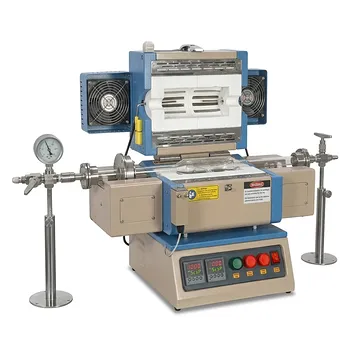
Dual Zone Rotary Tube Furnace for Uniform Powder Calcination 1000C 2 Inch Quartz Tube
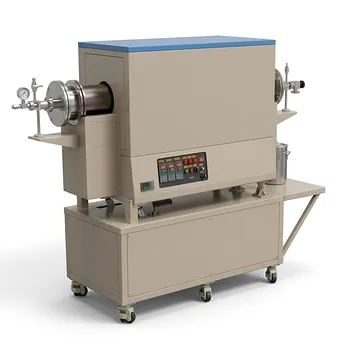
900°C Max Rotary Tube Furnace with 8 Inch 310S Alloy Tube and Optional Multi Zone Heating for Industrial Material Calcination
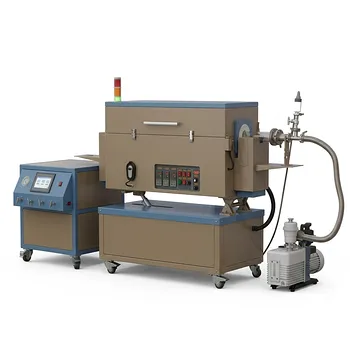
5 Inch Three Zone Rotary Tube Furnace with Integrated Gas Delivery System and 1200C Capability for Advanced Material CVD Processing
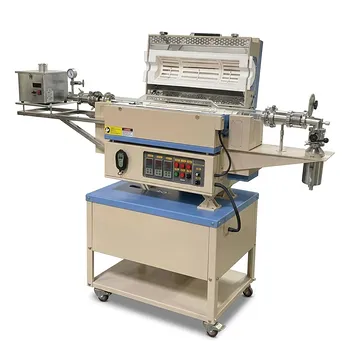
5 Inch Rotary Tube Furnace with Automatic Feeding and Receiving System 1200C Three Zone CVD Powder Processing

1200C High Throughput Multi Channel Tube Furnace with 50mm Quartz Tubes for Annealing and Material Phase Diagram Research

Compact High Temperature 1600C Tube Furnace with 50mm Alumina Tube and Vacuum Flanges for Material Sintering
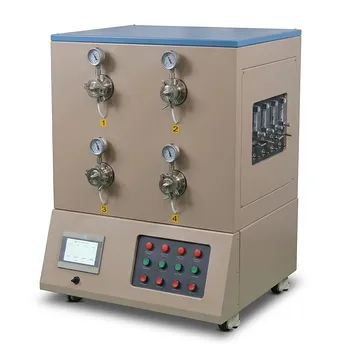
High Throughput 1200C Four Channel Tube Furnace with 3 Inch Quartz Tubes for Multi Zone Annealing and Material Research

High Temperature 1700C Vertical Tube Furnace for Powder Spherification and Material Sintering
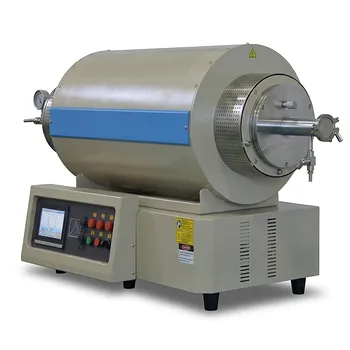
1200C Max Three Zone Tube Furnace 6 Inch OD Max with Tube and Flange
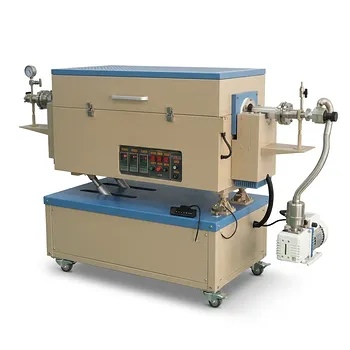
Three Zone Rotary Tube Furnace for High Temperature Powder Processing and Material Research
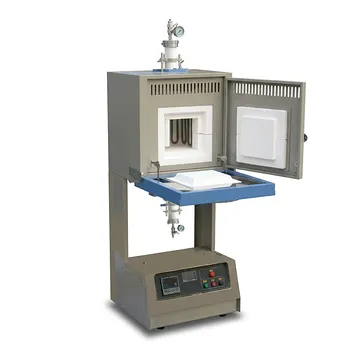
Vertical Hybrid High Temperature Furnace 1500C Alumina Tube SOFC Fuel Cell Testing Laboratory Heat Treatment Research Equipment
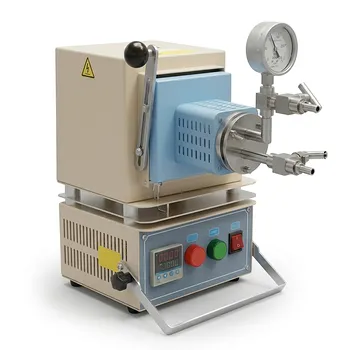
Compact Hybrid Muffle and Tube Furnace for 1000C Controlled Atmosphere Laboratory Material Sintering
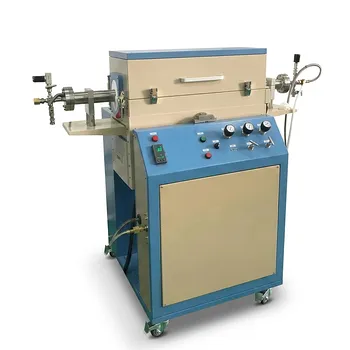
High Temperature Rocking Tube Furnace 1700°C Alumina Processing Tube with Precision Oscillation for Material Synthesis
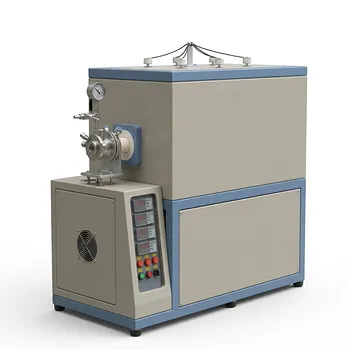
High Temperature 1700C Three Zone Tube Furnace with Alumina Tube 50mm 60mm 80mm OD for Material Research and Industrial Heat Treatment
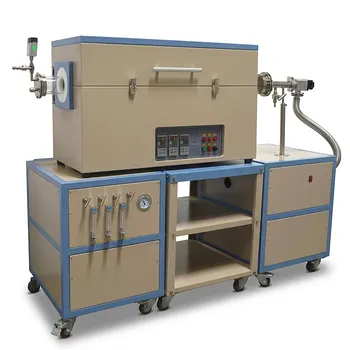
Three Zone Quartz Tube Furnace with 3 Channel Gas Mixer Vacuum Pump and Anti Corrosive Vacuum Gauge

1800C High Temperature Compact Vacuum Tube Furnace with 60mm OD Alumina Tube and Kanthal MoSi2 Heating Elements
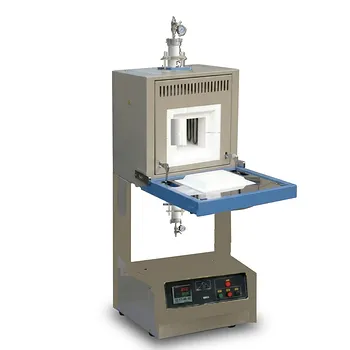
High Temperature Vertical Hybrid Furnace with Alumina Tube and SiC Heating for SOFC Coin Cell Testing and Atmosphere Processing
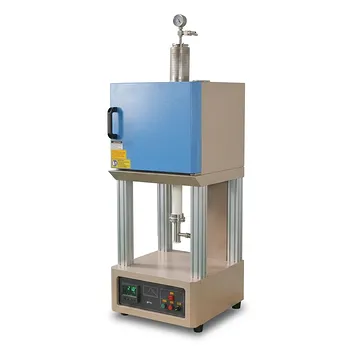
Hybrid High Temperature Tube and Box Furnace 1700C with 2 Inch Alumina Tube for Material Research

High Temperature 1700C Benchtop Tube Furnace with 5 Inch Heating Zone High Purity Alumina Tube and Vacuum Sealing Flanges