The Architecture of Heat: Why Atmosphere Control Defines the TiO2@NC Precursor
Aug 11, 2026
The Invisible Crucible
In material science, we often focus on the "before" and "after." We obsess over the elegant geometry of a Metal-Organic Framework (MOF) like $NH_2$-MIL-125 and the final electrochemical performance of its derivative.
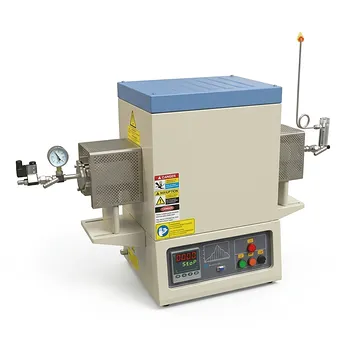
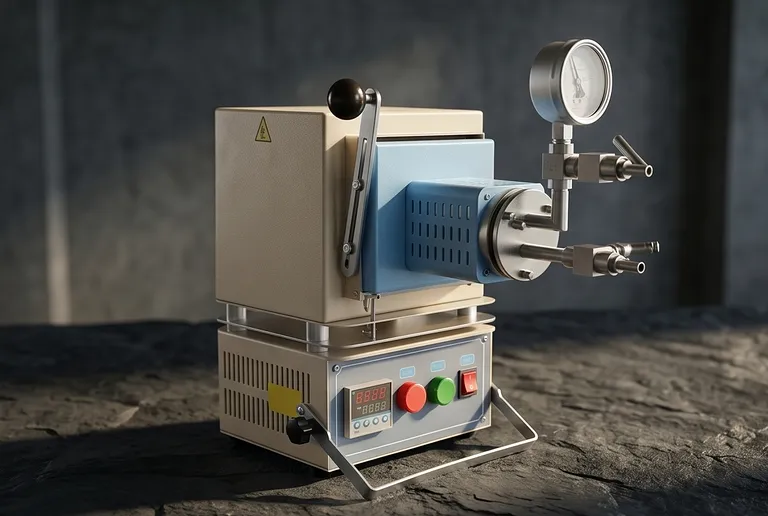
But the most critical part of the story happens in the middle. It happens inside the dark, silent chamber of a high-temperature atmosphere tube furnace.
This is not just heating; it is a controlled demolition. To create the $TiO_2@NC$ precursor, we must break down a complex organic architecture to build a functional carbon skeleton. If the temperature fluctuates by a few degrees or the argon flow wavers, the masterpiece becomes ash.
The Alchemy of Controlled Pyrolysis
The transformation of $NH_2$-MIL-125 into a nitrogen-doped carbon (NC) composite is a delicate dance of thermodynamics.
Under an inert atmosphere, the organic ligands don't burn—they carbonize.
- Structural Legacy: The furnace provides the thermal energy to snap chemical bonds, leaving behind a conductive carbon lattice.
- Atomic Integration: Nitrogen atoms are woven into this lattice, creating quaternary nitrogen (N-Q) groups that act as active sites for future reactions.
- The Guard Rail: Without a perfect argon shield, oxygen would invade, turning your precious precursor into $CO_2$ and leaving you with nothing but a ruined sample.
Managing the Phase: The Birth of TiO2
As the organic "scaffolding" of the MOF falls away, the titanium nodes undergo a rite of passage. They crystallize into $TiO_2$ nanoparticles.
The furnace acts as a choreographer here. By maintaining a steady $600^\circ C$, it ensures the $TiO_2$ settles into the anatase phase—the gold standard for catalytic activity.
If the heat is too low, the crystals are sluggish and amorphous. If it is too high, they agglomerate, losing the high surface area that makes nano-materials valuable in the first place.
The Margin of Error: Why Systems Fail
In the lab, we like to think of "temperature" as a single number on a screen. In reality, heat is a landscape.
Morgan Housel often notes that "room for error is the only way to safely navigate a world governed by odds." In thermal processing, that room for error is provided by the furnace's engineering.
The Problem of Gradients
In a substandard tube furnace, the center might be at $600^\circ C$ while the edges are at $580^\circ C$. This gradient creates a "mixed" product—partly crystallized, partly amorphous, and entirely inconsistent.
The Paradox of Flow
Gas flow is a double-edged sword.
- Too slow: Volatile impurities linger, poisoning the interface between the $TiO_2$ and the carbon.
- Too fast: The gas strips away the very active species you are trying to preserve, or creates "cold spots" that disrupt the phase transformation.
Engineering the Solution

Precision in the synthesis of $TiO_2@NC$ precursors requires a system that respects the physics of the process.
| Parameter | Impact on Precursor | Requirement |
|---|---|---|
| Atmospheric Purity | Prevents oxidation of the NC skeleton | High-integrity vacuum seals & Mass Flow Control |
| Thermal Uniformity | Ensures consistent $TiO_2$ grain size | Multi-zone heating & precision PID control |
| Cooling Rate | Prevents micro-cracking and stress | Programmable ramp-down cycles |
Beyond the Heating Element
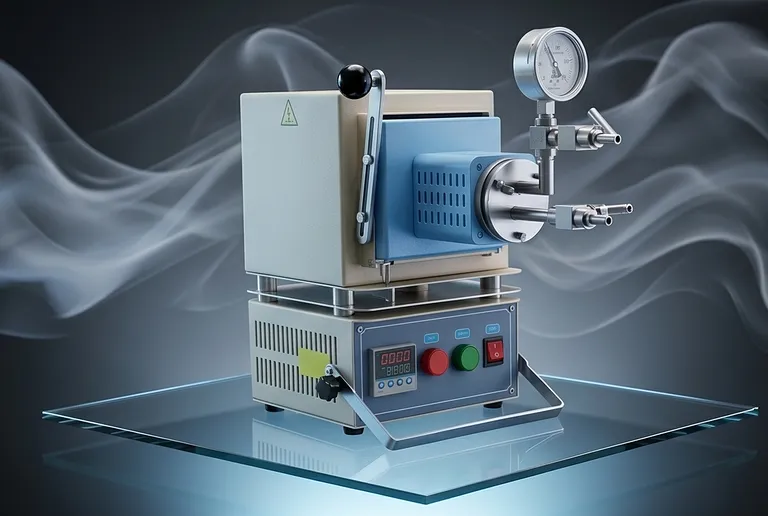
At THERMUNITS, we understand that a furnace is more than a tool—it is the environment where your breakthrough happens. Our atmosphere and tube furnaces are engineered to eliminate the "invisible" variables that lead to experimental failure.
Whether you are performing the delicate pyrolysis of MOFs or scaling up industrial R&D, we provide the thermal stability and atmospheric integrity required for world-class material science.
Our suite of solutions includes:
- High-Precision Tube Furnaces: Designed for the rigorous demands of $TiO_2@NC$ synthesis.
- Atmosphere & Vacuum Systems: For reactions where oxygen is the enemy.
- Advanced CVD/PECVD & VIM Systems: For cutting-edge vapor deposition and induction melting.
The difference between a failed batch and a breakthrough is often the equipment that stands between your sample and the outside world.
Quick Links
Suggested Products
Vertical 1700C Vacuum and Atmosphere Tube Furnace with 80mm Alumina Tube 1200C Hybrid Muffle and Tube Furnace for Material Research with Dual Atmosphere Control Quartz Tubes 1200°C Atmosphere Controlled Automatic Bottom Loading Furnace with 6 Inch Quartz Tube Compact Hybrid Muffle and Tube Furnace for 1000C Controlled Atmosphere Laboratory Material Sintering Compact Vertical Split Quartz Tube Furnace with Stainless Steel Vacuum Flanges for Rapid Thermal Quenching and Controlled Atmosphere Material ProcessingFurther Reading
The Silent Guardian of Kinetics: The Engineering Logic Behind Stable Molten Salt Environments The Architecture of Isolation: Why Atmosphere Defines Material Destiny The Invisible Architect: Precision Thermal Oxidation in NiO@Ni Synthesis The Architecture of Thrifty Precision: Why Tube Furnaces Define the R&D Continuity The Architect of Atoms: Why Precision is the Only Currency in TMD Synthesis
ThermUnits
Last updated on Apr 14, 2026
Related Products

Vertical 1700C Vacuum and Atmosphere Tube Furnace with 80mm Alumina Tube
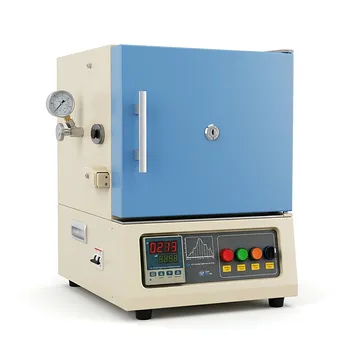
1200C Hybrid Muffle and Tube Furnace for Material Research with Dual Atmosphere Control Quartz Tubes
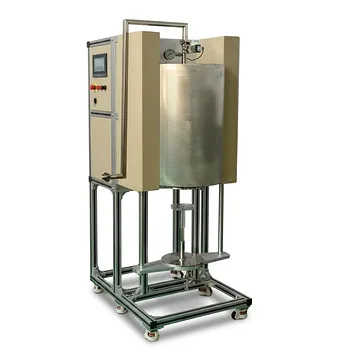
1200°C Atmosphere Controlled Automatic Bottom Loading Furnace with 6 Inch Quartz Tube
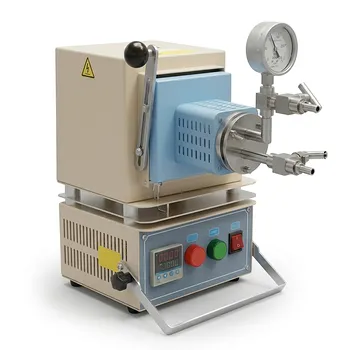
Compact Hybrid Muffle and Tube Furnace for 1000C Controlled Atmosphere Laboratory Material Sintering

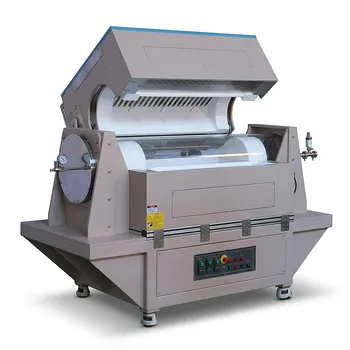
Compact Vertical Split Quartz Tube Furnace with Stainless Steel Vacuum Flanges for Rapid Thermal Quenching and Controlled Atmosphere Material Processing
Three Zone Tube Furnace with 11 Inch or 15 Inch Quartz Tube and Hinged Flanges for Vacuum Atmosphere Heat Treatment
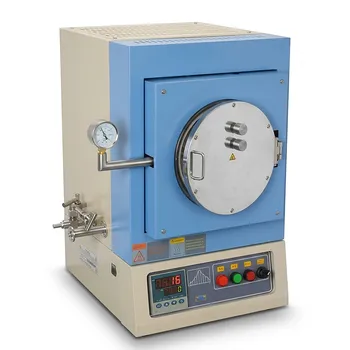
1100°C High Temperature Quartz Chamber Furnace 8 Inch OD with 7.6 Liter Capacity and Vacuum Atmosphere Capability
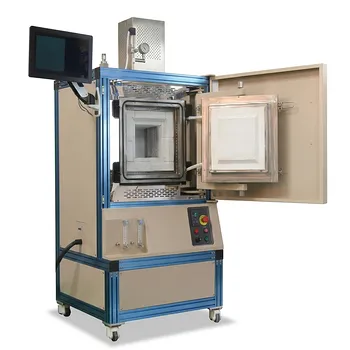
High Temperature Hydrogen Atmosphere Box Furnace 1650C Max Reducing Environment Material Synthesis System 8x8x8 Chamber

High Temperature 1700C Vertical Tube Furnace for Powder Spherification and Material Sintering

Compact High Temperature 1600C Tube Furnace with 50mm Alumina Tube and Vacuum Flanges for Material Sintering

High Temperature 1700C Tube Furnace with High Vacuum Turbomolecular Pump System and Multi Channel Mass Flow Controller Gas Mixer
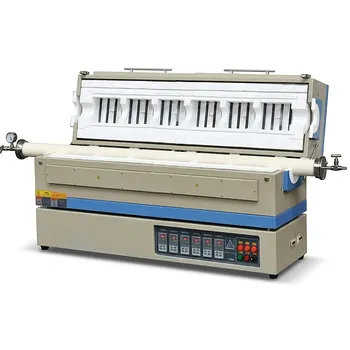
High Temperature 1700C Six Zone Split Tube Furnace with Alumina Tube and Water Cooled Flanges

1800C High Temperature Compact Vacuum Tube Furnace with 60mm OD Alumina Tube and Kanthal MoSi2 Heating Elements

1100C Tube Furnace with Vacuum Flange and Programmable Temperature Controller for Material Science and Industrial Heat Treatment
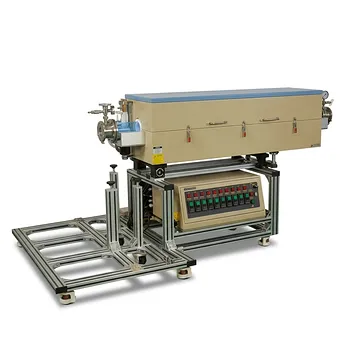
Ten Zone Multi Orientation Laboratory Tube Furnace for 1200C High Temperature Gradient Thermal Processing

High Temperature 1700C Benchtop Tube Furnace with 5 Inch Heating Zone High Purity Alumina Tube and Vacuum Sealing Flanges
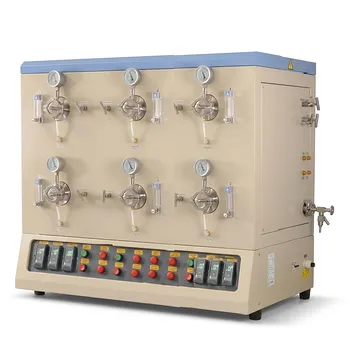
1200C High Throughput Multi Channel Tube Furnace with 50mm Quartz Tubes for Annealing and Material Phase Diagram Research

High Temperature Automated 5 Inch Tube Furnace for Autonomous Material Research and Advanced Laboratory R&D
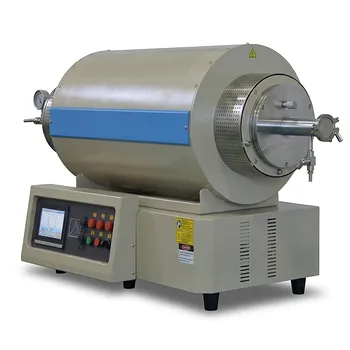
1200C Max Three Zone Tube Furnace 6 Inch OD Max with Tube and Flange