The Architecture of Light: Managing Entropy in High-Temperature Phosphor Synthesis
Apr 17, 2026
The Fragile Order of Crystals
In the world of materials science, light is an architectural achievement. To create a high-performance phosphor like $CaLa_4(SiO_4)_3O$, an engineer must act as both a builder and a guardian.
You start with chaos—a mixture of raw precursors. You end with a precise, tetragonal crystalline lattice capable of converting energy into visible light.
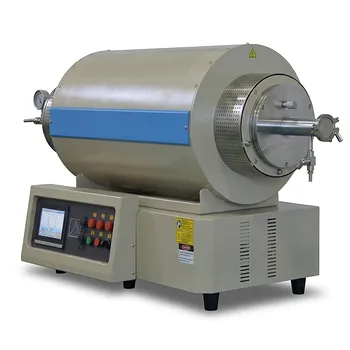
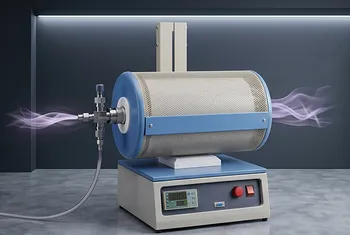
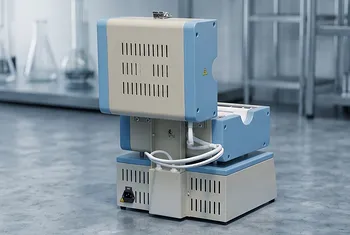
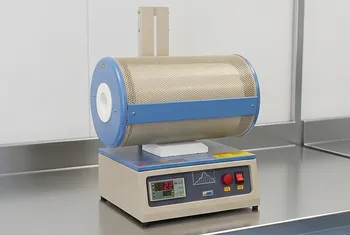
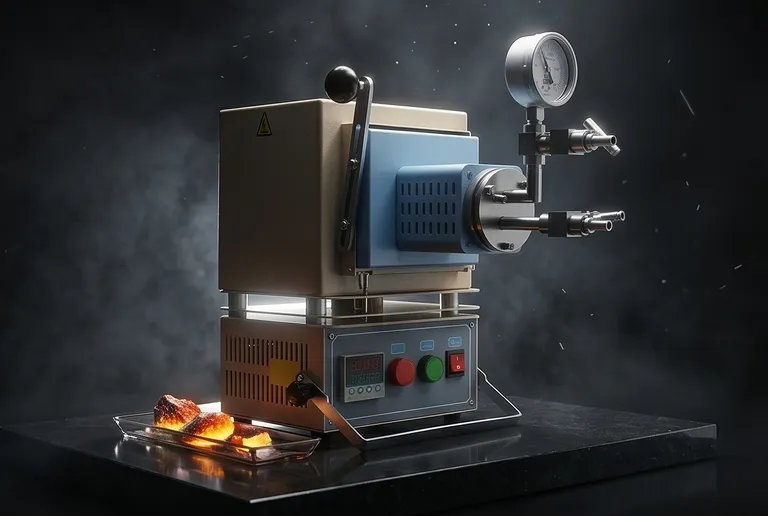
The bridge between these two states is the high-temperature atmosphere tube furnace. It is not merely a heater; it is a controlled environment where entropy is fought and structural order is enforced.
The Thermal Engine: Driving Atomic Migration
At 1500°C, the world inside the tube looks different. At this kinetic threshold, solid-state diffusion begins. Atoms gain enough energy to break their existing bonds and migrate across grain boundaries.
The furnace performs three critical structural roles:
- Triggering Diffusion: It provides the "activation energy" required for atoms to find their designated seats in the $CaLa_4(SiO_4)_3O$ host lattice.
- Precursor Decomposition: It facilitates the shedding of the old. For instance, $CaCO_3$ must release $CO_2$ to leave behind the pure oxides necessary for the final phase.
- Eliminating Defects: By maintaining a precise thermal plateau, the furnace allows the lattice to "heal" itself, reducing the structural flaws that would otherwise trap energy and kill luminosity.
Consistency here is everything. A fluctuation of a few degrees isn't just a technical error; it is a structural deformity in the material's DNA.
The Chemistry of Protection: Atmosphere as a Shield
If temperature builds the house, the atmosphere protects the inhabitants. In phosphor synthesis, the "inhabitants" are often activator ions like $Ce^{3+}$.
The challenge is a psychological one for the engineer: Nature wants to oxidize. In a standard oxygen-rich environment, the luminescent $Ce^{3+}$ will inevitably transform into the non-fluorescent $Ce^{4+}$.
A sealed atmosphere furnace solves this through systematic exclusion:
- Valence Maintenance: By introducing a reducing $N_2/H_2$ mixture, the furnace creates a chemical pressure that prevents oxidation.
- The Sweep Action: A continuous flow of high-purity gas acts as a mechanical broom, sweeping away volatile impurities and reaction byproducts that could "poison" the crystal.
- Lattice Site Integrity: By shielding the material from ambient oxygen, the furnace ensures metal ions occupy the correct coordinates within the lattice, preserving the material's optical signature.
The Hidden Risks: Where Systems Fail
In engineering, there is no such thing as a free lunch. Every high-temperature process carries systemic risks that require rigorous management.
| Risk Factor | Physical Consequence | Mitigation Strategy |
|---|---|---|
| Thermal Gradient | Inconsistent phase purity across the batch | Use of long "constant temperature zones" |
| Rapid Cooling | Internal micro-cracks and lattice stress | Programmable, linear cooling rates (e.g., 3°C/min) |
| Oxygen Leaks | "Poisoning" of luminescent centers | High-integrity vacuum seals and precision flow meters |
The most common failure isn't a lack of heat; it is a lack of uniformity. If the center of your sample is at 1500°C but the edges are at 1480°C, you are effectively producing two different materials in the same batch.
Strategy Over Hardware: Aligning Tools with Goals
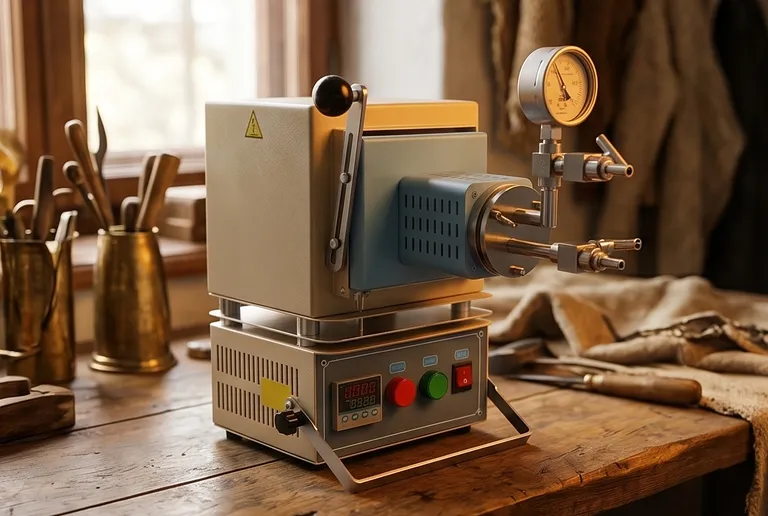
The choice of a furnace should be dictated by the specific "failure mode" you are trying to avoid.
- Focusing on Luminous Efficiency? Prioritize atmosphere integrity. The system must be airtight to ensure total conversion of dopant ions.
- Focusing on Phase Purity? Prioritize thermal stability. You need a furnace that can hold a setpoint for hours without drifting a single degree.
- Focusing on Throughput? Prioritize the "Constant Temperature Zone." A larger uniform hot zone translates directly to more consistent yields.
Precision Engineering for Material Scientists
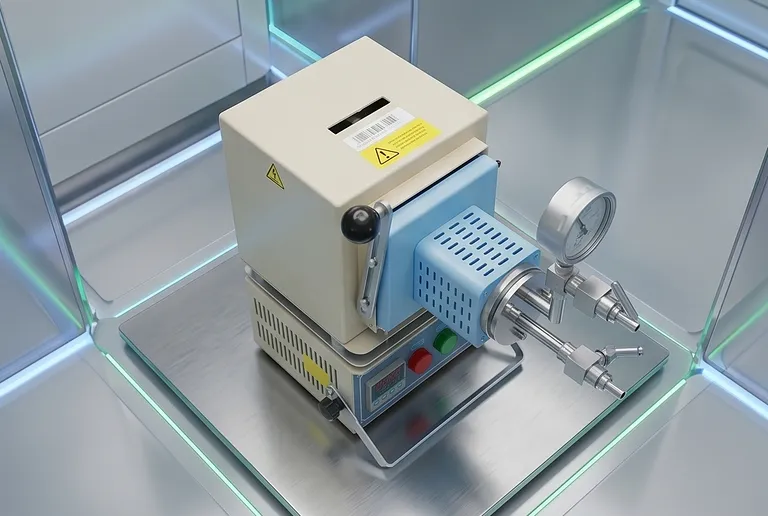
At THERMUNITS, we understand that a furnace is the foundation of your research. We design our systems with the "engineer’s romance" in mind—the belief that with enough precision, we can master the behavior of atoms.
From our high-purity Atmosphere Tube Furnaces to our specialized Vacuum Induction Melting (VIM) systems, we provide the thermal stability and chemical control necessary to transform raw chemistry into high-performance technology.
Whether you are synthesizing next-generation phosphors or exploring advanced ceramics, your results are only as reliable as your thermal environment.
Quick Links
Suggested Products
Vertical 1700C Vacuum and Atmosphere Tube Furnace with 80mm Alumina Tube 1200C Hybrid Muffle and Tube Furnace for Material Research with Dual Atmosphere Control Quartz Tubes 1200°C Atmosphere Controlled Automatic Bottom Loading Furnace with 6 Inch Quartz Tube Compact Hybrid Muffle and Tube Furnace for 1000C Controlled Atmosphere Laboratory Material Sintering Compact Vertical Split Quartz Tube Furnace with Stainless Steel Vacuum Flanges for Rapid Thermal Quenching and Controlled Atmosphere Material ProcessingFurther Reading
The Silent Guardian of Kinetics: The Engineering Logic Behind Stable Molten Salt Environments The Architecture of Isolation: Why Atmosphere Defines Material Destiny The Invisible Architect: Precision Thermal Oxidation in NiO@Ni Synthesis The Architecture of Thrifty Precision: Why Tube Furnaces Define the R&D Continuity The Architect of Atoms: Why Precision is the Only Currency in TMD Synthesis
ThermUnits
Last updated on Apr 15, 2026
Related Products

Vertical 1700C Vacuum and Atmosphere Tube Furnace with 80mm Alumina Tube
1200C Hybrid Muffle and Tube Furnace for Material Research with Dual Atmosphere Control Quartz Tubes
1200°C Atmosphere Controlled Automatic Bottom Loading Furnace with 6 Inch Quartz Tube
Compact Hybrid Muffle and Tube Furnace for 1000C Controlled Atmosphere Laboratory Material Sintering

Compact Vertical Split Quartz Tube Furnace with Stainless Steel Vacuum Flanges for Rapid Thermal Quenching and Controlled Atmosphere Material Processing

Three Zone Tube Furnace with 11 Inch or 15 Inch Quartz Tube and Hinged Flanges for Vacuum Atmosphere Heat Treatment
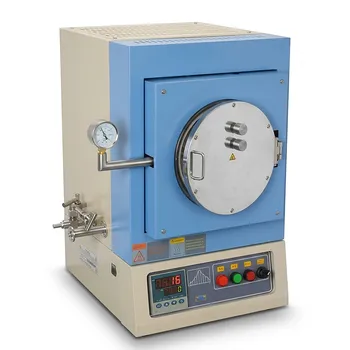
1100°C High Temperature Quartz Chamber Furnace 8 Inch OD with 7.6 Liter Capacity and Vacuum Atmosphere Capability
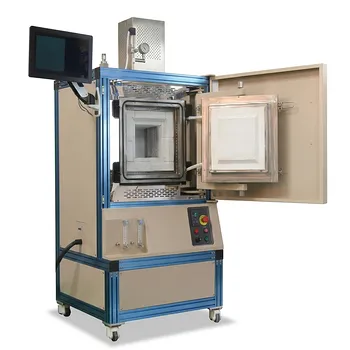
High Temperature Hydrogen Atmosphere Box Furnace 1650C Max Reducing Environment Material Synthesis System 8x8x8 Chamber

High Temperature 1700C Vertical Tube Furnace for Powder Spherification and Material Sintering

Compact High Temperature 1600C Tube Furnace with 50mm Alumina Tube and Vacuum Flanges for Material Sintering

High Temperature 1700C Tube Furnace with High Vacuum Turbomolecular Pump System and Multi Channel Mass Flow Controller Gas Mixer

High Temperature 1700C Six Zone Split Tube Furnace with Alumina Tube and Water Cooled Flanges

1800C High Temperature Compact Vacuum Tube Furnace with 60mm OD Alumina Tube and Kanthal MoSi2 Heating Elements

1100C Tube Furnace with Vacuum Flange and Programmable Temperature Controller for Material Science and Industrial Heat Treatment
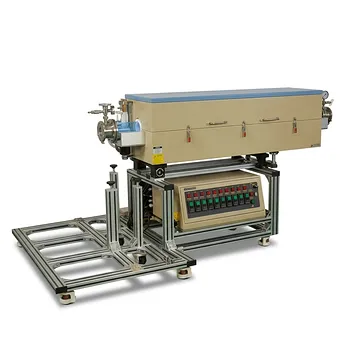
Ten Zone Multi Orientation Laboratory Tube Furnace for 1200C High Temperature Gradient Thermal Processing

High Temperature 1700C Benchtop Tube Furnace with 5 Inch Heating Zone High Purity Alumina Tube and Vacuum Sealing Flanges

1200C High Throughput Multi Channel Tube Furnace with 50mm Quartz Tubes for Annealing and Material Phase Diagram Research

High Temperature Automated 5 Inch Tube Furnace for Autonomous Material Research and Advanced Laboratory R&D

1700C Hydrogen Gas Tube Furnace with 60mm Alumina Process Tube and Integrated Hydrogen Safety Detector