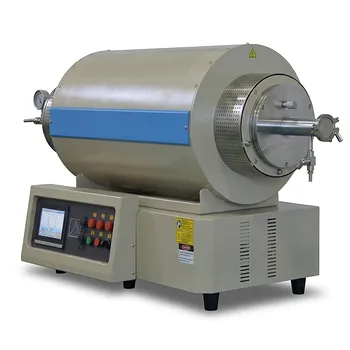
What are the key functions of an Atmosphere Tube Furnace in the ammonolysis synthesis of Ni2Mo3N? Optimize Phase Purity
Updated 5 months ago
The synthesis of $Ni_2Mo_3N$ via ammonolysis requires a highly specialized thermal environment to transform precursor oxides into pure nitrides. The Atmosphere Tube Furnace serves as the critical reactor for this process, providing precise thermal stability at 875 °C and a regulated ammonia ($NH_3$) flow of 9 L/h over a 20-hour duration. This equipment ensures the necessary gas-solid contact for the phase transition while preventing atmospheric contamination, ultimately determining the phase purity and catalytic effectiveness of the final nitride.
The core function of an Atmosphere Tube Furnace in this context is to facilitate the reductive nitridation of $NiMoO_4$ precursors. It achieves this by creating a strictly controlled, oxygen-free environment where temperature and gas flow are synchronized to drive the transition from oxide to an interstitial ternary nitride.
Facilitating Precise Phase Transformation
Maintaining Thermal Stability for Extended Durations
The furnace provides a constant temperature zone at 875 °C, which is the specific energy threshold required to drive the ammonolysis of $NiMoO_4$. This thermal energy is necessary to break metal-oxygen bonds within the precursor lattice, allowing nitrogen atoms to take their place.
Because the reaction lasts for 20 hours, the furnace's ability to maintain high-precision, multi-stage temperature control is vital. Any significant fluctuation in temperature could result in incomplete nitridation or the formation of undesired secondary phases.
Regulating the Chemical Potential of Ammonia
By maintaining a steady ammonia flow rate of 9 L/h, the furnace ensures a constant chemical potential of the reactive gas. The furnace acts as a flow-controlled reactor that keeps the precursor in full contact with the reducing agent throughout the long reaction period.
This continuous supply of $NH_3$ is critical because it serves a dual purpose: it acts as the reducing agent to remove oxygen and the nitrogen source to form the $Ni_2Mo_3N$ structure. The tube furnace’s design ensures that the exhaust gases are moved away, preventing the buildup of reaction by-products that could inhibit the synthesis.
Ensuring Material Purity and Structural Integrity
Isolation from Atmospheric Contaminants
One of the primary functions of the atmosphere furnace is its rigorous sealing performance, which isolates the material from oxygen and moisture. Even trace amounts of oxygen at 875 °C would lead to the unwanted oxidation of the nickel or molybdenum components.
By creating a controlled atmosphere, the furnace prevents the hydrolysis of raw materials. This ensures that the final chemical composition and phase purity of the $Ni_2Mo_3N$ meet strict research and industrial requirements for high-performance catalysts.
Promoting Uniform Gas-Solid Interaction
The furnace provides high temperature field uniformity, ensuring that the powder bed of the precursor is heated evenly. This uniformity is essential for gas-solid phase reactions where the $NH_3$ must penetrate the crystal lattice of the $NiMoO_4$ uniformly.
Without this even heat distribution, the final product might exhibit a multiphase heterostructure rather than a pure ternary nitride. The furnace's internal geometry is optimized to allow the gas to flow over the precursor surface consistently, facilitating a complete transition to the interstitial phase.
Understanding the Trade-offs and Limitations
Balancing Gas Flow and Thermal Efficiency
While a high flow rate of ammonia ensures complete nitridation, it can also lead to thermal gradients within the tube. If the gas enters the hot zone too quickly without being pre-heated, it can lower the local temperature of the precursor, potentially leading to inhomogeneous reaction rates.
Managing Material Degradation
The combination of high temperatures (875 °C) and corrosive ammonia gas places significant stress on the furnace components. Over time, the quartz or alumina tubes can become brittle or experience surface reactions, which may eventually compromise the seal or introduce trace impurities into the sample.
How to Apply This to Your Project
The success of your synthesis depends on the synergy between the furnace's physical capabilities and the chemical requirements of the precursor.
- If your primary focus is Phase Purity: Ensure your furnace has a validated "constant temperature zone" that covers the entire length of your precursor boat to avoid mixed-oxide remnants.
- If your primary focus is Repeatability: Utilize the multi-stage programmable controllers to standardize the heating and cooling ramps, as the rate of temperature change can influence the final grain size of the $Ni_2Mo_3N$.
- If your primary focus is Material Stability: Regularly inspect the tube seals and gas delivery lines for leaks, as even a minor ingress of air during the 20-hour window will result in significant oxide contamination.
By mastering the control of the atmosphere tube furnace, you ensure the stable transformation of simple oxides into high-performance, pure-phase ternary nitrides.
Summary Table:
| Parameter/Function | Synthesis Requirement | Impact on Final Nitride |
|---|---|---|
| Temperature Control | 875 °C for 20 Hours | Drives reductive nitridation; ensures complete phase transition. |
| Gas Flow Regulation | 9 L/h Ammonia ($NH_3$) | Provides constant chemical potential; acts as nitrogen source. |
| Atmosphere Integrity | Oxygen-free sealing | Prevents unwanted oxidation and ensures high material purity. |
| Thermal Uniformity | Constant hot zone | Ensures homogeneous reaction rates and structural integrity. |
Elevate Your R&D Precision with THERMUNITS
Are you looking to achieve superior phase purity in your material synthesis? THERMUNITS is a leading manufacturer of high-temperature laboratory equipment specifically designed for material science and industrial R&D. Our specialized thermal processing solutions ensure the rigorous control required for complex reactions like ammonolysis and reductive nitridation.
Our Comprehensive Product Range Includes:
- Furnaces: Atmosphere, Tube, Muffle, Vacuum, Rotary, and Hot Press Furnaces.
- Advanced Systems: CVD/PECVD systems and Vacuum Induction Melting (VIM) furnaces.
- Specialized Equipment: Dental Furnaces, Electric Rotary Kilns, and high-quality Thermal Elements.
Whether you are developing high-performance catalysts or advanced alloys, our expert team is ready to provide the custom thermal solutions your project demands.
Contact THERMUNITS Today to discuss your equipment needs and enhance your lab's efficiency!
References
- Sophie Hund, Martin Lerch. Ni<sub>2</sub>Mo<sub>3</sub>N: crystal structure, thermal properties, and catalytic activity for ammonia decomposition. DOI: 10.1515/znb-2023-0071
Mentioned Products
- Vertical 1700C Vacuum and Atmosphere Tube Furnace with 80mm Alumina Tube
- 1200C Hybrid Muffle and Tube Furnace for Material Research with Dual Atmosphere Control Quartz Tubes
- 1200°C Atmosphere Controlled Automatic Bottom Loading Furnace with 6 Inch Quartz Tube
- Compact Hybrid Muffle and Tube Furnace for 1000C Controlled Atmosphere Laboratory Material Sintering
- Compact Vertical Split Quartz Tube Furnace with Stainless Steel Vacuum Flanges for Rapid Thermal Quenching and Controlled Atmosphere Material Processing
People Also Ask
- How is an industrial-grade vertical tube furnace utilized in smelting leaching residues? Enhance Metal Recovery Efficiency
- What is the function of a laboratory-grade vertical tube furnace in fast pyrolysis? Optimize Composite Research.
- How does a vertical tube furnace facilitate thermoelectric alloy melting? Precision synthesis for material homogeneity.
- Why is a thermocouple sensor indispensable for monitoring the vertical tube furnace during gallium oxide nanowire production? Optimize VLS Growth
- What are the advantages of using a vertical tube furnace for crucible experiments simulating steel-slag interactions?

Tech Team · ThermUnits
Last updated on Apr 14, 2026
Related Products

Vertical 1700C Vacuum and Atmosphere Tube Furnace with 80mm Alumina Tube
1200C Hybrid Muffle and Tube Furnace for Material Research with Dual Atmosphere Control Quartz Tubes
1200°C Atmosphere Controlled Automatic Bottom Loading Furnace with 6 Inch Quartz Tube
Compact Hybrid Muffle and Tube Furnace for 1000C Controlled Atmosphere Laboratory Material Sintering

Compact Vertical Split Quartz Tube Furnace with Stainless Steel Vacuum Flanges for Rapid Thermal Quenching and Controlled Atmosphere Material Processing
Three Zone Tube Furnace with 11 Inch or 15 Inch Quartz Tube and Hinged Flanges for Vacuum Atmosphere Heat Treatment
1100°C High Temperature Quartz Chamber Furnace 8 Inch OD with 7.6 Liter Capacity and Vacuum Atmosphere Capability
High Temperature Hydrogen Atmosphere Box Furnace 1650C Max Reducing Environment Material Synthesis System 8x8x8 Chamber

High Temperature 1700C Vertical Tube Furnace for Powder Spherification and Material Sintering

Compact High Temperature 1600C Tube Furnace with 50mm Alumina Tube and Vacuum Flanges for Material Sintering

High Temperature 1700C Tube Furnace with High Vacuum Turbomolecular Pump System and Multi Channel Mass Flow Controller Gas Mixer

High Temperature 1700C Six Zone Split Tube Furnace with Alumina Tube and Water Cooled Flanges

1800C High Temperature Compact Vacuum Tube Furnace with 60mm OD Alumina Tube and Kanthal MoSi2 Heating Elements

1100C Tube Furnace with Vacuum Flange and Programmable Temperature Controller for Material Science and Industrial Heat Treatment
Ten Zone Multi Orientation Laboratory Tube Furnace for 1200C High Temperature Gradient Thermal Processing

High Temperature 1700C Benchtop Tube Furnace with 5 Inch Heating Zone High Purity Alumina Tube and Vacuum Sealing Flanges

1200C High Throughput Multi Channel Tube Furnace with 50mm Quartz Tubes for Annealing and Material Phase Diagram Research

High Temperature Automated 5 Inch Tube Furnace for Autonomous Material Research and Advanced Laboratory R&D

1700C Hydrogen Gas Tube Furnace with 60mm Alumina Process Tube and Integrated Hydrogen Safety Detector