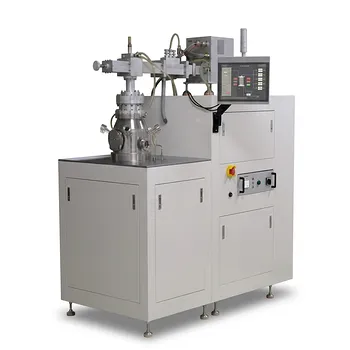
What are the technical advantages of CO2 in CVD for vanadium oxide? Improved Adhesion & Phase Purity
Updated 3 months ago
Introducing $CO_2$ into the chemical vapor deposition (CVD) process acts as a precision chemical modifier for vanadium oxide composites. It functions by generating oxygen in situ to pre-functionalize carbon substrates and serving as a protective oxidant to maintain the desired chemical state of the vanadium. This dual-action approach significantly improves the structural integrity, adhesion, and phase purity of the resulting composite material.
The use of $CO_2$ solves the twin challenges of poor interfacial bonding and unwanted chemical reduction during high-temperature synthesis. It creates a more reactive substrate surface for better particle distribution while ensuring the vanadium oxide maintains its target stoichiometry.
Surface Engineering and Enhanced Adhesion
Increasing Defect Density for Anchoring
At high temperatures, $CO_2$ undergoes a reaction to produce oxygen locally on the substrate surface. This process increases the defect density, often measured by a higher D/G ratio in carbon nanotubes. These defects serve as essential anchoring points, allowing vanadium oxide particles to bind more securely to the carbon framework.
Improving Substrate Coverage
By increasing the number of reactive sites, $CO_2$ ensures that the vanadium oxide is not just sporadically attached but is distributed more uniformly. This leads to improved coverage across the carbon nanotubes. Enhanced coverage is critical for maximizing the surface area available for electrochemical or catalytic reactions.
Phase Stability and Stoichiometric Integrity
Neutralizing Reducing Byproducts
The CVD environment often contains decomposition products like CO and $H_2$, which are potent reducing agents. Without a counter-acting oxidant, these gases can strip oxygen from the vanadium oxide during formation. The presence of $CO_2$ provides an oxidizing environment that effectively neutralizes these reducing effects.
Preservation of the $V^{4+}$ Oxidation State
Maintaining a specific oxidation state, such as $V^{4+}$, is often vital for the electronic and chemical properties of the composite. $CO_2$ prevents the unwanted reduction of these ions, ensuring the correct stoichiometry of the vanadium oxide phase. This chemical stability is what allows the material to perform reliably in its intended application.
Understanding the Trade-offs
Risk of Structural Degradation
While increasing defect density is beneficial for particle anchoring, excessive oxidation can lead to structural damage of the carbon nanotubes. If the $CO_2$ concentration or reaction temperature is too high, the carbon framework may lose its mechanical strength and electrical conductivity.
Thermal Requirements
The benefits of $CO_2$ are temperature-dependent, as the disproportionation reaction requires high thermal energy to produce in situ oxygen. This limits the process to high-temperature CVD setups and may not be compatible with temperature-sensitive substrates. Balancing the gas flow rate with the thermal budget is essential to avoid over-processing.
How to Apply This to Your Project
Recommendations for Implementation
When integrating $CO_2$ into your CVD workflow, the specific parameters should be tuned based on your primary performance metric.
- If your primary focus is mechanical stability and adhesion: Prioritize the pre-functionalization phase by monitoring the D/G ratio via Raman spectroscopy to ensure sufficient anchoring points without destroying the CNT backbone.
- If your primary focus is electrochemical phase purity: Adjust $CO_2$ flow rates to specifically counter the concentration of reducing byproducts ($H_2$ and $CO$) detected in your exhaust stream.
- If your primary focus is uniform thin-film coverage: Use a diluted $CO_2$ mixture to provide a slow, controlled increase in surface defects, allowing for a more homogeneous nucleation of vanadium oxide particles.
Mastering the concentration of $CO_2$ allows you to transition from simple mechanical mixtures to highly engineered, stoichiometrically precise vanadium oxide composites.
Summary Table:
| Feature | Mechanism of $CO_2$ | Key Technical Benefit |
|---|---|---|
| Surface Adhesion | Increases defect density (D/G ratio) | Stronger particle anchoring on substrates |
| Phase Stability | Neutralizes reducing agents ($CO, H_2$) | Preserves target $V^{4+}$ stoichiometry |
| Substrate Coverage | Creates reactive oxygen in situ | Uniform vanadium oxide distribution |
| Material Integrity | Balanced oxidation environment | Optimized electronic & chemical properties |
Elevate Your Material Research with THERMUNITS
Achieving precise stoichiometry and uniform substrate coverage in vanadium oxide composites requires high-performance thermal control. THERMUNITS is a leading manufacturer of advanced high-temperature laboratory equipment specifically designed for material science and industrial R&D.
Whether you are optimizing CVD/PECVD systems for functionalizing nanostructures or require high-precision Vacuum, Atmosphere, or Tube furnaces, our solutions provide the stability and atmosphere control necessary for cutting-edge chemical vapor deposition.
Our Comprehensive Thermal Solutions Include:
- Advanced Furnaces: Muffle, Vacuum, Tube, Rotary, and Hot Press systems.
- Specialized Equipment: CVD/PECVD systems, Dental Furnaces, and Electric Rotary Kilns.
- Industrial R&D: Vacuum Induction Melting (VIM) furnaces and high-quality Thermal Elements.
Ready to enhance your laboratory's efficiency and material performance? Contact us today to discuss your specific heat treatment needs with our technical experts!
References
- Inga Dönges, Jörg J. Schneider. Selective Synthesis of 3D Aligned VO<sub>2</sub> and V<sub>2</sub>O<sub>5</sub> Carbon Nanotube Hybrid Materials by Chemical Vapor Deposition. DOI: 10.1002/chem.202402024
Mentioned Products
- Versatile Chemical Vapor Deposition Tube Furnace System for Advanced Material Research and Industrial Coating Processes
- Chemical Vapor Deposition CVD System Slide PECVD Tube Furnace with Liquid Gasifier PECVD Machine
- Multi Heating Zones CVD Tube Furnace System for Precision Chemical Vapor Deposition and Advanced Material Synthesis
- Inclined Rotary Plasma Enhanced Chemical Vapor Deposition PECVD System for Thin Film Deposition and Nanomaterial Synthesis
- Split Chamber CVD Tube Furnace with Vacuum Station Chemical Vapor Deposition System Machine
People Also Ask
- How does a sliding rail design benefit the CVD process within a furnace ventilation hood? Enhance Control & Quenching
- What role do by-product desorption and evacuation play in CVD film quality? Key Factors for High-Purity Films
- How does the deposition process occur within a Chemical Vapor Deposition (CVD) reactor? Explore the 5-Stage Growth Cycle
- Why is CVD preferred over PVD for high-aspect-ratio features? Superior Conformality for Semiconductor Fabrication
- How do temperature regimes influence the growth rate of films in a CVD system? Master CVD Kinetics for Superior Thin Films

Tech Team · ThermUnits
Last updated on Jun 03, 2026
Related Products
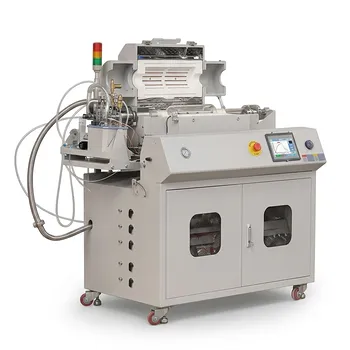
Versatile Chemical Vapor Deposition Tube Furnace System for Advanced Material Research and Industrial Coating Processes
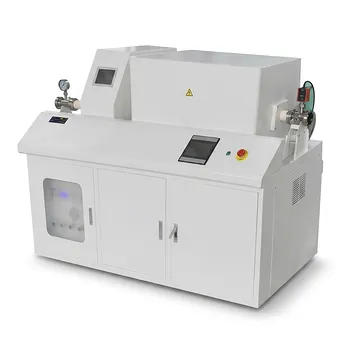
Chemical Vapor Deposition CVD System Slide PECVD Tube Furnace with Liquid Gasifier PECVD Machine
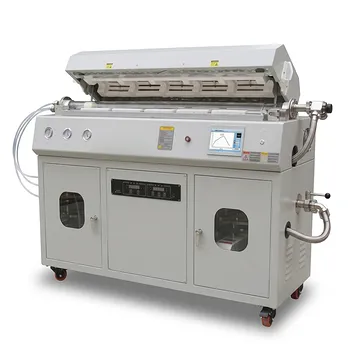
Multi Heating Zones CVD Tube Furnace System for Precision Chemical Vapor Deposition and Advanced Material Synthesis
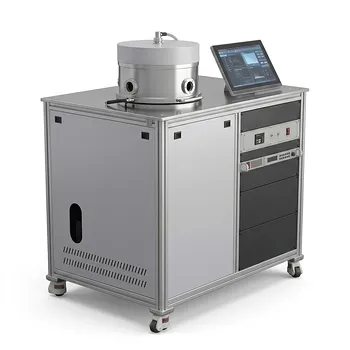
Inclined Rotary Plasma Enhanced Chemical Vapor Deposition PECVD System for Thin Film Deposition and Nanomaterial Synthesis
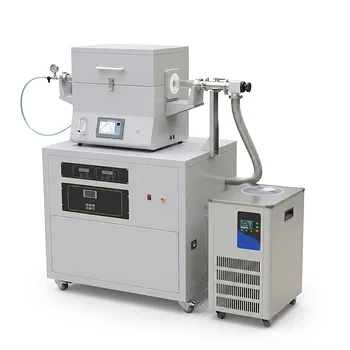
Split Chamber CVD Tube Furnace with Vacuum Station Chemical Vapor Deposition System Machine
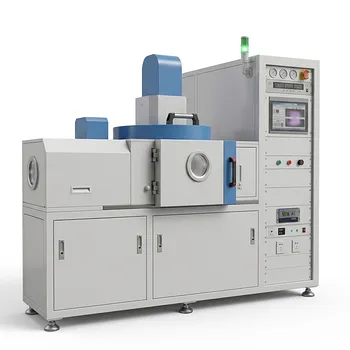
Radio Frequency Plasma Enhanced Chemical Vapor Deposition RF PECVD System for Laboratory and Industrial Thin Film Growth
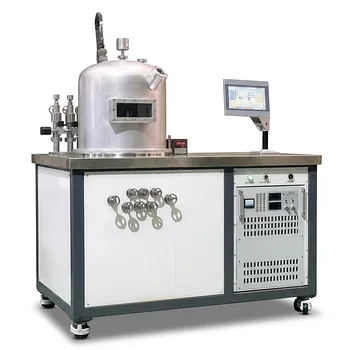
HFCVD Machine System for Nano Diamond Coating on Drawing Dies and Industrial Tools
915MHz MPCVD Diamond Machine Microwave Plasma Chemical Vapor Deposition System Reactor
Two Zone Rotary CVD Furnace with Automatic Feeding and Receiving System for Powder Processing