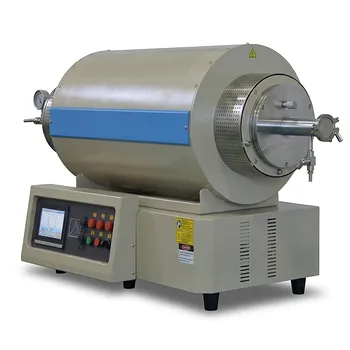
What are the advantages of an Atmosphere Tube Furnace for catalyst reduction? Achieve Precision and High Dispersion.
Updated 3 months ago
Atmosphere tube furnaces provide the critical environmental isolation and thermal precision necessary to transform catalyst precursors into active metallic sites. By maintaining a strictly controlled reducing atmosphere (such as hydrogen mixtures) and a highly uniform thermal field, these furnaces ensure the complete reduction of metal ions while preventing the particle sintering that typically occurs with standard, less-controlled heating methods.
Core Takeaway: The fundamental advantage of an atmosphere tube furnace is its ability to decouple chemical reduction from thermal degradation, allowing for the creation of highly dispersed, sub-nanometer metallic clusters that are impossible to achieve in standard air-exposed or non-uniform heating environments.
Superior Atmospheric Integrity and Control
Precise Gas Composition and Flow
Atmosphere tube furnaces allow for the introduction of specific gas mixtures, such as 5% Hydrogen in Nitrogen or Argon, at controlled flow rates. This environment is essential for reducing oxidized precursors, such as Platinum or Ruthenium, into their active metallic states without interference from ambient oxygen.
Prevention of Unintended Oxidation
The excellent sealing properties of quartz or ceramic tubes ensure a contamination-free environment. This prevents unintended oxidation during the cooling phase and ensures that volatile chemical components are removed without triggering secondary reactions that could poison the catalyst.
Regulation of Metal Valence States
By strictly regulating the reduction atmosphere, researchers can achieve specific valence distributions (e.g., the ratio of Cu0 to Cu+). This level of chemical tuning is critical for reaction-specific catalyst performance and cannot be replicated in standard ovens or muffle furnaces.
Precision Thermal Field Management
High-Precision Temperature Stability
Unlike standard heating equipment, tube furnaces offer high-precision temperature control that maintains a constant thermal field during the reduction process. This stability ensures that the reduction reaction occurs uniformly throughout the entire sample, leading to consistent batch quality.
Control Over Heating Rates
These furnaces allow for specific programmed heating rates (e.g., 5 °C/min), which is vital for the gradual thermal decomposition of precursors. Controlling the ramp-up speed prevents "thermal shock" to the catalyst structure and manages the rate of gas evolution from the precursor salts.
Elimination of Center Heat Lag
In traditional static furnaces, the "center heat lag effect" often results in an uneven reaction where the core of the material remains unreduced while the exterior over-heats. Continuous or specialized tube furnaces provide superior temperature field uniformity, ensuring every particle experiences the same thermal history.
Optimization of Catalyst Structural Properties
Prevention of Over-Sintering
The primary enemy of catalyst activity is sintering, where active metal particles fuse together at high temperatures. Atmosphere tube furnaces mitigate this by allowing reduction to occur at the lowest possible temperature required, thereby preserving a high number of active sites.
Maximizing Metal Dispersion
By preventing agglomeration, these furnaces ensure high dispersion of metallic components, often resulting in sub-nanometer clusters. This increased surface area-to-volume ratio significantly enhances the catalytic activity and efficiency of the final material.
Tuning of Band Structure and Crystallinity
For specialized catalysts like Cadmium Sulfide, the controlled environment allows for precise annealing that promotes grain growth and crystallinity. This allows for the fine-tuning of the material’s resistivity and band structure, which is essential for photocatalytic applications.
Understanding the Trade-offs
Equipment Complexity and Cost
Atmosphere tube furnaces require significant infrastructure, including gas delivery systems, mass flow controllers, and exhaust treatment. The initial investment and operational complexity are substantially higher than standard laboratory ovens or muffle furnaces.
Throughput and Batch Limitations
Static tube furnaces are often limited by the diameter of the tube, making them less suitable for massive industrial volumes. While rotary or continuous tube furnaces can address this, they introduce further mechanical complexity and require more intensive maintenance.
Strict Safety Protocols
The use of reducing gases like Hydrogen at high temperatures presents flammability and explosion risks. Operating these furnaces requires rigorous leak testing, gas sensing equipment, and specialized ventilation that standard heating processes do not demand.
Making the Right Choice for Your Goal
Achieving the perfect catalyst requires balancing thermal energy with atmospheric chemistry.
- If your primary focus is maximizing active surface area: Use an atmosphere tube furnace to provide a low-temperature hydrogen reduction environment that prevents particle sintering.
- If your primary focus is precise chemical valence (e.g., Cu0/Cu+): Utilize a tube furnace with high-precision gas mixing and flow control to stabilize specific oxidation states.
- If your primary focus is large-scale production stability: Opt for a continuous or rotary tube furnace to eliminate heat lag and ensure every particle receives uniform atmospheric contact.
- If your primary focus is structural tuning (e.g., bandgap or porosity): Rely on the furnace's ability to maintain high-temperature stability (up to 1000°C) under inert nitrogen to promote grain growth without oxidation.
The atmosphere tube furnace is an indispensable tool for any researcher or engineer who requires total control over the nanostructure and chemical state of a catalyst.
Summary Table:
| Feature | Atmosphere Tube Furnace Benefit | Impact on Catalyst |
|---|---|---|
| Atmospheric Control | Precise gas mixtures (e.g., H2/Ar) and oxygen-free sealing | Ensures complete reduction and prevents unintended oxidation |
| Thermal Precision | Programmed heating rates and uniform thermal field | Prevents thermal shock and eliminates "center heat lag" |
| Structural Control | Low-temperature reduction capability | Minimizes sintering and maximizes active metal dispersion |
| Valence Tuning | Regulation of chemical environment | Allows precise control over specific metal valence states (e.g., Cu0/Cu+) |
Elevate Your Catalyst Research with THERMUNITS
As a leading manufacturer of high-temperature laboratory equipment, THERMUNITS provides the thermal precision required for cutting-edge material science and industrial R&D. Whether you are developing sub-nanometer metallic clusters or scaling up production, our comprehensive range of solutions—including Atmosphere Tube Furnaces, Rotary Kilns, CVD/PECVD systems, and Vacuum Induction Melting (VIM) furnaces—is designed to deliver unmatched atmospheric integrity and temperature uniformity.
Don't let sintering or non-uniform heating compromise your catalyst activity. Explore how our advanced heat treatment equipment, from Muffle and Hot Press furnaces to specialized Dental and Atmosphere furnaces, can enhance your laboratory's efficiency and results.
Ready to optimize your thermal processing? Contact us today to find the perfect solution for your R&D needs!
References
- S. Wilmes, Olaf Hinrichsen. Influencing Factors on the Wet Impregnation of Additive‐Manufactured Catalyst Support Structures. DOI: 10.1002/cite.202400090
Mentioned Products
- Vertical 1700C Vacuum and Atmosphere Tube Furnace with 80mm Alumina Tube
- 1200C Hybrid Muffle and Tube Furnace for Material Research with Dual Atmosphere Control Quartz Tubes
- 1200°C Atmosphere Controlled Automatic Bottom Loading Furnace with 6 Inch Quartz Tube
- Compact Hybrid Muffle and Tube Furnace for 1000C Controlled Atmosphere Laboratory Material Sintering
- Compact Vertical Split Quartz Tube Furnace with Stainless Steel Vacuum Flanges for Rapid Thermal Quenching and Controlled Atmosphere Material Processing
People Also Ask
- How is an industrial-grade vertical tube furnace utilized in smelting leaching residues? Enhance Metal Recovery Efficiency
- What is the function of a laboratory-grade vertical tube furnace in fast pyrolysis? Optimize Composite Research.
- How does a vertical tube furnace facilitate thermoelectric alloy melting? Precision synthesis for material homogeneity.
- Why is a thermocouple sensor indispensable for monitoring the vertical tube furnace during gallium oxide nanowire production? Optimize VLS Growth
- What are the advantages of using a vertical tube furnace for crucible experiments simulating steel-slag interactions?

Tech Team · ThermUnits
Last updated on Jun 03, 2026
Related Products

Vertical 1700C Vacuum and Atmosphere Tube Furnace with 80mm Alumina Tube
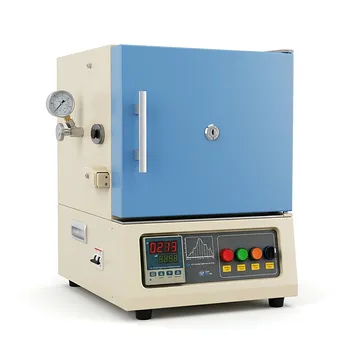
1200C Hybrid Muffle and Tube Furnace for Material Research with Dual Atmosphere Control Quartz Tubes
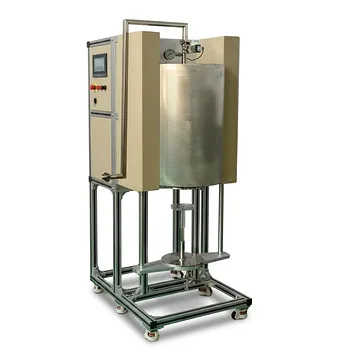
1200°C Atmosphere Controlled Automatic Bottom Loading Furnace with 6 Inch Quartz Tube
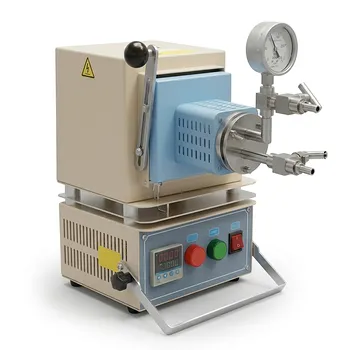
Compact Hybrid Muffle and Tube Furnace for 1000C Controlled Atmosphere Laboratory Material Sintering

Compact Vertical Split Quartz Tube Furnace with Stainless Steel Vacuum Flanges for Rapid Thermal Quenching and Controlled Atmosphere Material Processing
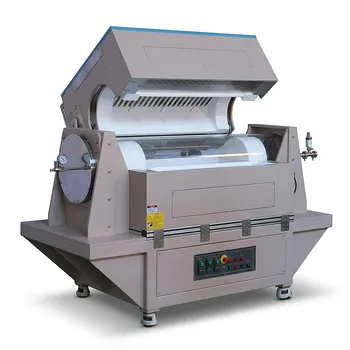
Three Zone Tube Furnace with 11 Inch or 15 Inch Quartz Tube and Hinged Flanges for Vacuum Atmosphere Heat Treatment
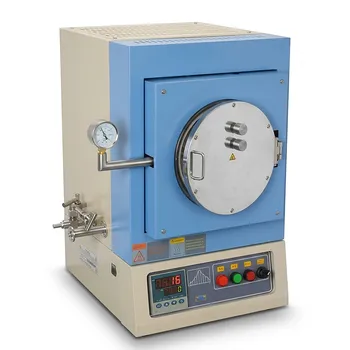
1100°C High Temperature Quartz Chamber Furnace 8 Inch OD with 7.6 Liter Capacity and Vacuum Atmosphere Capability
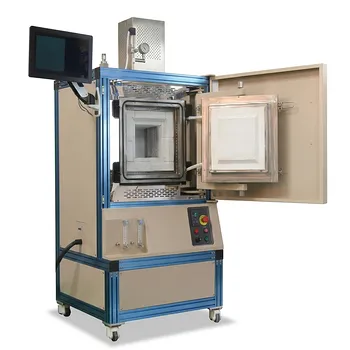
High Temperature Hydrogen Atmosphere Box Furnace 1650C Max Reducing Environment Material Synthesis System 8x8x8 Chamber

High Temperature 1700C Vertical Tube Furnace for Powder Spherification and Material Sintering

Compact High Temperature 1600C Tube Furnace with 50mm Alumina Tube and Vacuum Flanges for Material Sintering

High Temperature 1700C Six Zone Split Tube Furnace with Alumina Tube and Water Cooled Flanges

High Temperature 1700C Tube Furnace with High Vacuum Turbomolecular Pump System and Multi Channel Mass Flow Controller Gas Mixer

1800C High Temperature Compact Vacuum Tube Furnace with 60mm OD Alumina Tube and Kanthal MoSi2 Heating Elements

1100C Tube Furnace with Vacuum Flange and Programmable Temperature Controller for Material Science and Industrial Heat Treatment

High Temperature 1700C Benchtop Tube Furnace with 5 Inch Heating Zone High Purity Alumina Tube and Vacuum Sealing Flanges
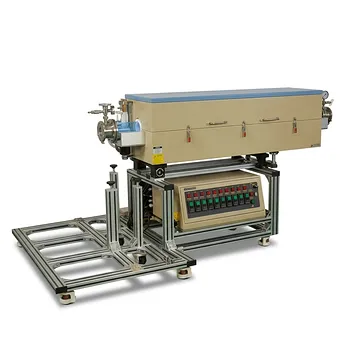
Ten Zone Multi Orientation Laboratory Tube Furnace for 1200C High Temperature Gradient Thermal Processing
1200C High Throughput Multi Channel Tube Furnace with 50mm Quartz Tubes for Annealing and Material Phase Diagram Research

High Temperature Automated 5 Inch Tube Furnace for Autonomous Material Research and Advanced Laboratory R&D
1700C Hydrogen Gas Tube Furnace with 60mm Alumina Process Tube and Integrated Hydrogen Safety Detector