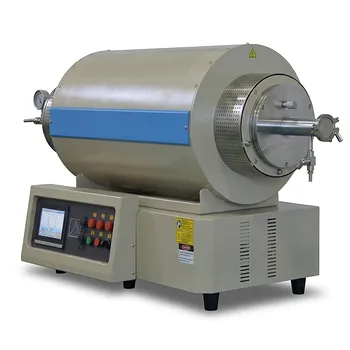
What critical role does an atmosphere tube furnace play in converting hydroxide precursors into ZnxNi1-xO? Synthesis Tips
Updated 3 months ago
The atmosphere tube furnace is the essential instrument for the thermal conversion of hydroxide precursors into $Zn_xNi_{1-x}O$ by providing a strictly controlled, inert environment. Specifically, it facilitates the annealing of $Zn_xNi_{1-x}(OH)_2$ at 500°C under a nitrogen ($N_2$) atmosphere, ensuring the material undergoes complete phase transformation into a stable oxide while preventing unwanted oxidation of active components or the introduction of external impurities.
Core Takeaway: The atmosphere tube furnace acts as a precision reactor that isolates the sample from the ambient environment, allowing for the synthesis of high-purity $Zn_xNi_{1-x}O$ with the crystal integrity and electrochemical stability required for high-performance electrode materials.
The Mechanics of Controlled Phase Transformation
Precise Atmosphere Regulation
The primary role of the furnace is to establish a flowing nitrogen ($N_2$) protection environment. This inert atmosphere is critical because it displaces oxygen and moisture, which could otherwise cause uncontrolled oxidation of the nickel or zinc components at high temperatures.
Thermal Uniformity at 500°C
The furnace provides a stable and uniform temperature field necessary for the complete dehydration and decomposition of the hydroxide precursor. By maintaining a steady 500°C, the equipment ensures that the transition from $Zn_xNi_{1-x}(OH)2$ to $Zn_xNi{1-x}O$ occurs evenly throughout the entire sample volume.
Removal of Volatile Byproducts
As the hydroxide precursors decompose, they release water vapor and other volatile species. The enclosed but flowing system of the tube furnace effectively eliminates these byproduct gases, preventing them from re-reacting with the sample or creating localized pressure imbalances that could disrupt the crystal structure.
Strategic Impact on Material Integrity
Ensuring Crystal Purity
By sealing the reaction within a high-purity quartz or ceramic tube, the furnace avoids the introduction of external contaminants. This isolation is vital for maintaining the precise stoichiometric ratio of Zinc to Nickel ($x$ to $1-x$) intended during the precursor synthesis.
Optimizing Electrochemical Stability
The controlled cooling and heating cycles (heating curves) provided by the furnace allow for the optimization of grain size and crystallinity. These structural parameters directly dictate the electrochemical stability and longevity of the resulting $Zn_xNi_{1-x}O$ electrode material.
Facilitating Precursor Anchoring
In complex catalyst systems, the furnace treatment doesn't just change the phase; it strengthens the interaction between the active metal oxides and their underlying supports. This process ensures that the active components remain firmly anchored during subsequent electrochemical cycling.
Understanding the Trade-offs
The Risk of Atmosphere Fluctuations
Even a minor leak in the tube seals can introduce oxygen, leading to the formation of unwanted secondary phases or the degradation of the nitrogen-doped carbon frameworks often used as supports. Maintaining vacuum integrity before introducing the inert gas is a non-negotiable step for repeatable results.
Balancing Temperature and Time
While 500°C is effective for $Zn_xNi_{1-x}O$, excessive residence time or higher temperatures can lead to grain growth and sintering. This reduces the surface area of the material, which can negatively impact the catalytic or electrochemical activity despite achieving high crystal purity.
How to Apply This to Your Project
Recommendations for Material Synthesis
- If your primary focus is maximum crystal purity: Ensure the furnace tube is purged with at least three vacuum-nitrogen cycles prior to heating to eliminate all residual oxygen.
- If your primary focus is high surface area: Optimize the heating ramp rate and minimize the dwell time at 500°C to prevent excessive grain coarsening.
- If your primary focus is supporting active phases on substrates: Utilize the furnace to establish a specific heating curve that promotes strong interfacial bonding between the $Zn_xNi_{1-x}O$ and the support material.
By mastering the precise control of the furnace's thermal and chemical environment, you ensure the successful transition from a labile hydroxide precursor to a robust, high-performance oxide material.
Summary Table:
| Feature | Impact on $Zn_xNi_{1-x}O$ Synthesis |
|---|---|
| Inert $N_2$ Atmosphere | Prevents uncontrolled oxidation & ensures chemical purity |
| 500°C Uniform Heat | Drives complete phase transformation from hydroxide to oxide |
| Flowing Gas System | Efficiently removes water vapor & volatile byproducts |
| Quartz/Ceramic Isolation | Prevents external contamination & maintains stoichiometry |
| Controlled Cooling | Optimizes grain size for high electrochemical stability |
Elevate Your Material Research with THERMUNITS Precision
Achieving high-purity crystals like $Zn_xNi_{1-x}O$ requires more than just heat—it requires absolute control. As a leading manufacturer of high-temperature laboratory equipment, THERMUNITS provides the advanced thermal processing solutions needed for cutting-edge material science and industrial R&D.
From Atmosphere and Vacuum Tube Furnaces to specialized CVD/PECVD systems, Rotary Kilns, and Vacuum Induction Melting (VIM) Furnaces, our equipment is designed for precision, durability, and repeatability. Whether you are working on electrode materials, dental applications, or complex catalysts, we offer the technical expertise and high-quality Thermal Elements to support your success.
Ready to optimize your heat treatment process? Contact THERMUNITS Today to find the perfect furnace solution for your laboratory’s unique requirements.
References
- Jie Ma, Fei Yu. Kinetic-Thermodynamic Promotion Engineering toward High-Density Hierarchical and Zn-Doping Activity-Enhancing ZnNiO@CF for High-Capacity Desalination. DOI: 10.1007/s40820-024-01371-y
Mentioned Products
- Vertical 1700C Vacuum and Atmosphere Tube Furnace with 80mm Alumina Tube
- 1200C Hybrid Muffle and Tube Furnace for Material Research with Dual Atmosphere Control Quartz Tubes
- 1200°C Atmosphere Controlled Automatic Bottom Loading Furnace with 6 Inch Quartz Tube
- Compact Hybrid Muffle and Tube Furnace for 1000C Controlled Atmosphere Laboratory Material Sintering
- Compact Vertical Split Quartz Tube Furnace with Stainless Steel Vacuum Flanges for Rapid Thermal Quenching and Controlled Atmosphere Material Processing
People Also Ask
- How is an industrial-grade vertical tube furnace utilized in smelting leaching residues? Enhance Metal Recovery Efficiency
- What is the function of a laboratory-grade vertical tube furnace in fast pyrolysis? Optimize Composite Research.
- How does a vertical tube furnace facilitate thermoelectric alloy melting? Precision synthesis for material homogeneity.
- Why is a thermocouple sensor indispensable for monitoring the vertical tube furnace during gallium oxide nanowire production? Optimize VLS Growth
- What are the advantages of using a vertical tube furnace for crucible experiments simulating steel-slag interactions?

Tech Team · ThermUnits
Last updated on Jun 03, 2026
Related Products

Vertical 1700C Vacuum and Atmosphere Tube Furnace with 80mm Alumina Tube
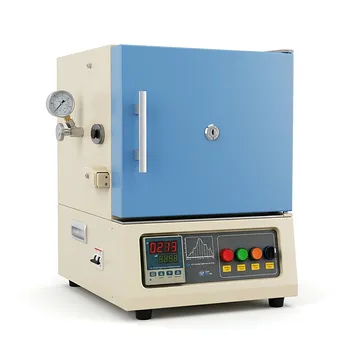
1200C Hybrid Muffle and Tube Furnace for Material Research with Dual Atmosphere Control Quartz Tubes
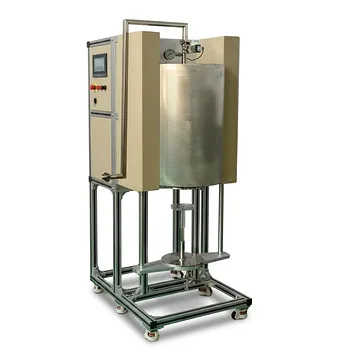
1200°C Atmosphere Controlled Automatic Bottom Loading Furnace with 6 Inch Quartz Tube
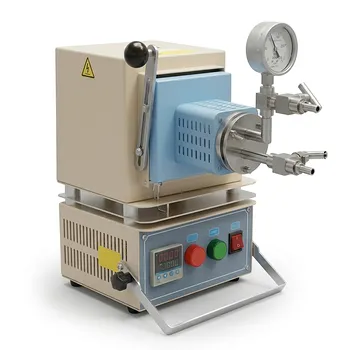
Compact Hybrid Muffle and Tube Furnace for 1000C Controlled Atmosphere Laboratory Material Sintering

Compact Vertical Split Quartz Tube Furnace with Stainless Steel Vacuum Flanges for Rapid Thermal Quenching and Controlled Atmosphere Material Processing
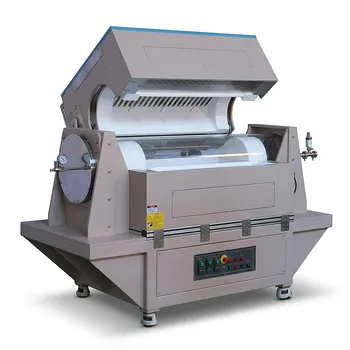
Three Zone Tube Furnace with 11 Inch or 15 Inch Quartz Tube and Hinged Flanges for Vacuum Atmosphere Heat Treatment

1100°C High Temperature Quartz Chamber Furnace 8 Inch OD with 7.6 Liter Capacity and Vacuum Atmosphere Capability
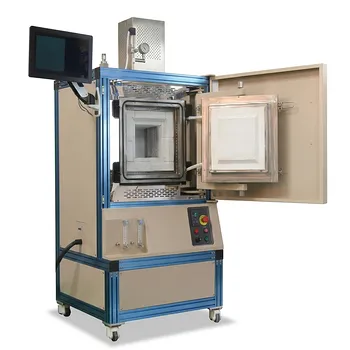
High Temperature Hydrogen Atmosphere Box Furnace 1650C Max Reducing Environment Material Synthesis System 8x8x8 Chamber

High Temperature 1700C Vertical Tube Furnace for Powder Spherification and Material Sintering

Compact High Temperature 1600C Tube Furnace with 50mm Alumina Tube and Vacuum Flanges for Material Sintering

High Temperature 1700C Tube Furnace with High Vacuum Turbomolecular Pump System and Multi Channel Mass Flow Controller Gas Mixer
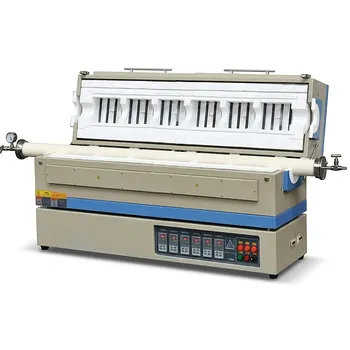
High Temperature 1700C Six Zone Split Tube Furnace with Alumina Tube and Water Cooled Flanges

1800C High Temperature Compact Vacuum Tube Furnace with 60mm OD Alumina Tube and Kanthal MoSi2 Heating Elements
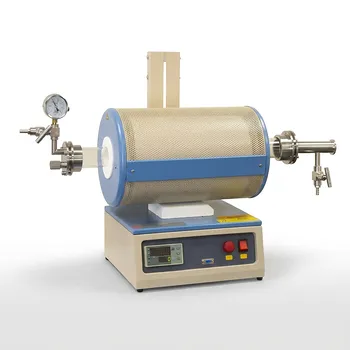
1100C Tube Furnace with Vacuum Flange and Programmable Temperature Controller for Material Science and Industrial Heat Treatment
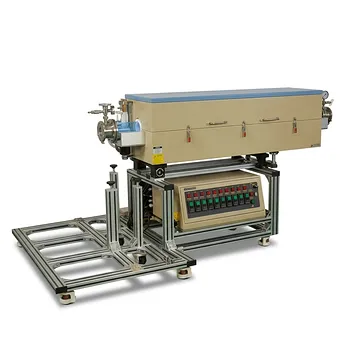
Ten Zone Multi Orientation Laboratory Tube Furnace for 1200C High Temperature Gradient Thermal Processing

High Temperature 1700C Benchtop Tube Furnace with 5 Inch Heating Zone High Purity Alumina Tube and Vacuum Sealing Flanges
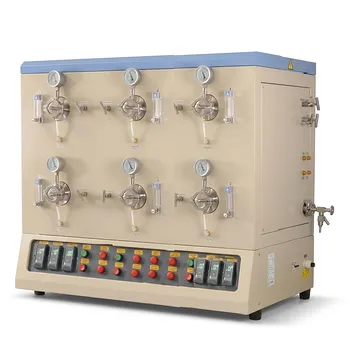
1200C High Throughput Multi Channel Tube Furnace with 50mm Quartz Tubes for Annealing and Material Phase Diagram Research

High Temperature Automated 5 Inch Tube Furnace for Autonomous Material Research and Advanced Laboratory R&D
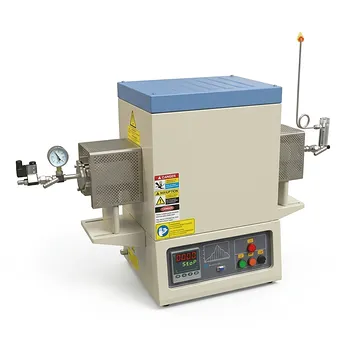
1700C Hydrogen Gas Tube Furnace with 60mm Alumina Process Tube and Integrated Hydrogen Safety Detector