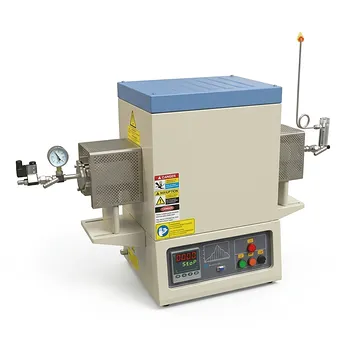
What function does an atmosphere tube furnace serve during catalyst activation? Engineering High-Performance Sites
Updated 3 months ago
The atmosphere tube furnace acts as the primary reactor for the "activation" of a catalyst, transitioning it from an inert precursor state to a catalytically active one. By providing a hermetically sealed environment with precise temperature and gas flow control, the furnace facilitates chemical transformations—such as the reduction of metal oxides into metallic nanoparticles—that are essential for the catalyst to function during performance testing.
The atmosphere tube furnace is the critical tool used to engineer the active sites of a catalyst through controlled thermal and chemical exposure. It ensures that the catalyst's surface chemistry, phase composition, and particle size are optimized and stable before the performance evaluation begins.
Chemical Transformation and Active Site Engineering
Facilitating the Reduction of Metal Precursors
The furnace provides a controlled reducing environment, often using hydrogen-based mixtures (e.g., 3% H2 in He), to convert inactive metal precursors or oxides into metallic particles. This process is essential for metals like platinum (Pt), silver (Ag), and nickel (Ni), transforming them into the active metallic nanoparticles required for catalysis.
Inducing Phase Evolution and Exsolution
Beyond simple reduction, the furnace can induce the exsolution of elements from a support lattice to form high-efficiency alloys. For instance, in high-entropy supports, the thermal environment can cause copper to migrate and alloy with platinum, creating more effective active sites than standard methods.
Creating Electronic Interactions and Vacancies
The precise atmosphere allows for the formation of oxygen vacancies and partially reduced species. These features are core to activating the Electronic Metal-Support Interaction (EMSI), which is necessary for complex reactions like carbon dioxide hydrogenation.
Specialized Activation via Sulfidation
In some cases, the furnace facilitates presulfiding, where a sulfur-rich atmosphere (like H2S/H2) converts iron oxides into highly active iron disulfide (FeS2). This specific phase evolution is required for catalysts designed to reduce sulfur dioxide or perform hydrotreating tasks.
Structural Preservation and Morphology Control
Preventing Sintering and Agglomeration
Precise, programmed temperature control prevents the sintering or "clumping" of active metallic particles. By maintaining an optimal thermal window, the furnace ensures that active sites remain uniformly distributed and do not lose surface area through excessive heat exposure.
Protecting the Catalyst Support
When working with carbon-based supports, the furnace provides an inert atmosphere (such as Nitrogen or Argon) to prevent the support from combusting. This protection allows for high-temperature treatment that fixes active sites within carbon pores without destroying the structural framework.
Facilitating Carbonization and Graphitization
For biochar or carbon-sphere catalysts, the furnace enables pyrolysis and bond rearrangement. This secondary high-temperature process removes unstable functional groups and increases mechanical strength and thermal stability, providing a robust framework for subsequent chemical loading.
Understanding the Trade-offs and Pitfalls
The Risk of Over-Reduction
While reduction is necessary for activity, excessive exposure to reducing gases or high temperatures can lead to over-reduction. This may result in the loss of necessary surface oxides or the collapse of the catalyst's delicate pore structure.
Thermal Inhomogeneity
In larger tube furnaces, temperature gradients can occur between the center and the edges of the tube. If not managed, this leads to non-uniform activation, where one portion of the catalyst batch may be perfectly active while another remains under-processed or sintered.
Atmospheric Contamination
The presence of even trace amounts of oxygen or moisture in a nominally inert or reducing atmosphere can poison sensitive catalysts. Achieving a truly "pure" environment requires high-quality seals and rigorous gas purging protocols before the heating cycle begins.
How to Apply This to Your Project
Recommendations for Effective Activation
To ensure your catalyst is properly prepared for performance evaluation, tailor your furnace parameters to your specific material goals.
- If your primary focus is maximizing metallic active sites: Utilize a dilute hydrogen mixture (e.g., 3-10% H2) and a ramped heating profile to reduce metal oxides while preventing particle agglomeration.
- If your primary focus is enhancing support stability: Conduct a secondary carbonization step in a strictly inert nitrogen or argon environment to increase graphitization and remove unstable surface groups.
- If your primary focus is engineering metal-support interactions: Carefully control the heating duration and atmosphere to induce the formation of oxygen vacancies or specific alloy phases through exsolution.
Mastering the atmosphere tube furnace allows you to transition from mere material synthesis to the precise engineering of a high-performance catalytic system.
Summary Table:
| Function | Key Chemical/Physical Process | Target Outcome |
|---|---|---|
| Metal Reduction | Converting oxides via $H_2$ mixtures | Formation of active metallic nanoparticles (Pt, Ag, Ni) |
| Phase Evolution | Exsolution and Sulfidation ($H_2S$) | Engineered alloy sites and active phases like $FeS_2$ |
| Surface Engineering | Creating oxygen vacancies | Enhanced Electronic Metal-Support Interaction (EMSI) |
| Structural Preservation | Precise PID temperature control | Prevention of sintering and particle agglomeration |
| Support Protection | Inert gas blanketing ($N_2$/Ar) | Prevents combustion of carbon-based catalyst supports |
Maximize Your Catalytic Efficiency with THERMUNITS
In the world of material science, the difference between a mediocre catalyst and a high-performance system lies in the precision of the activation stage. THERMUNITS provides the advanced thermal technology required to master these critical chemical transformations.
As a leading manufacturer of high-temperature laboratory equipment, we offer a comprehensive range of solutions including Atmosphere and Vacuum Tube Furnaces, CVD/PECVD systems, Rotary Kilns, and Vacuum Induction Melting (VIM) furnaces. Our equipment is engineered to provide the hermetic sealing and thermal uniformity essential for preventing sintering and ensuring high-purity active sites.
Ready to elevate your industrial R&D or material research?
Contact THERMUNITS today to request a quote or technical consultation and discover how our thermal processing solutions can optimize your catalyst performance.
References
- Christopher Riley, Stanley S. Chou. Platinum on High-Entropy Aluminate Spinels as Thermally Stable CO Oxidation Catalysts. DOI: 10.3390/catal14030211
Mentioned Products
- Vertical 1700C Vacuum and Atmosphere Tube Furnace with 80mm Alumina Tube
- 1200C Hybrid Muffle and Tube Furnace for Material Research with Dual Atmosphere Control Quartz Tubes
- 1200°C Atmosphere Controlled Automatic Bottom Loading Furnace with 6 Inch Quartz Tube
- Compact Hybrid Muffle and Tube Furnace for 1000C Controlled Atmosphere Laboratory Material Sintering
- Compact Vertical Split Quartz Tube Furnace with Stainless Steel Vacuum Flanges for Rapid Thermal Quenching and Controlled Atmosphere Material Processing
People Also Ask
- How is an industrial-grade vertical tube furnace utilized in smelting leaching residues? Enhance Metal Recovery Efficiency
- What is the function of a laboratory-grade vertical tube furnace in fast pyrolysis? Optimize Composite Research.
- How does a vertical tube furnace facilitate thermoelectric alloy melting? Precision synthesis for material homogeneity.
- Why is a thermocouple sensor indispensable for monitoring the vertical tube furnace during gallium oxide nanowire production? Optimize VLS Growth
- What are the advantages of using a vertical tube furnace for crucible experiments simulating steel-slag interactions?

Tech Team · ThermUnits
Last updated on Jun 03, 2026
Related Products

Vertical 1700C Vacuum and Atmosphere Tube Furnace with 80mm Alumina Tube
1200C Hybrid Muffle and Tube Furnace for Material Research with Dual Atmosphere Control Quartz Tubes
1200°C Atmosphere Controlled Automatic Bottom Loading Furnace with 6 Inch Quartz Tube
Compact Hybrid Muffle and Tube Furnace for 1000C Controlled Atmosphere Laboratory Material Sintering

Compact Vertical Split Quartz Tube Furnace with Stainless Steel Vacuum Flanges for Rapid Thermal Quenching and Controlled Atmosphere Material Processing
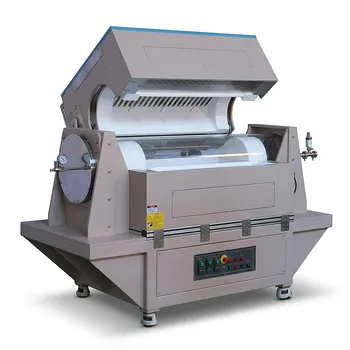
Three Zone Tube Furnace with 11 Inch or 15 Inch Quartz Tube and Hinged Flanges for Vacuum Atmosphere Heat Treatment
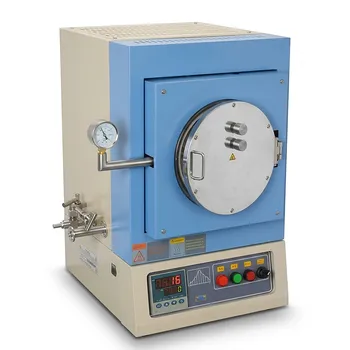
1100°C High Temperature Quartz Chamber Furnace 8 Inch OD with 7.6 Liter Capacity and Vacuum Atmosphere Capability
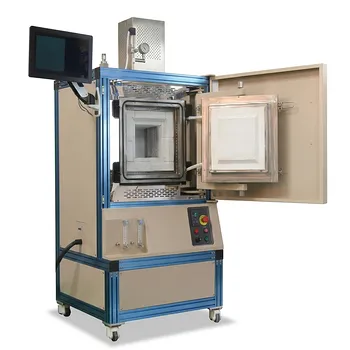
High Temperature Hydrogen Atmosphere Box Furnace 1650C Max Reducing Environment Material Synthesis System 8x8x8 Chamber

High Temperature 1700C Vertical Tube Furnace for Powder Spherification and Material Sintering

Compact High Temperature 1600C Tube Furnace with 50mm Alumina Tube and Vacuum Flanges for Material Sintering

High Temperature 1700C Tube Furnace with High Vacuum Turbomolecular Pump System and Multi Channel Mass Flow Controller Gas Mixer

High Temperature 1700C Six Zone Split Tube Furnace with Alumina Tube and Water Cooled Flanges

1800C High Temperature Compact Vacuum Tube Furnace with 60mm OD Alumina Tube and Kanthal MoSi2 Heating Elements

1100C Tube Furnace with Vacuum Flange and Programmable Temperature Controller for Material Science and Industrial Heat Treatment
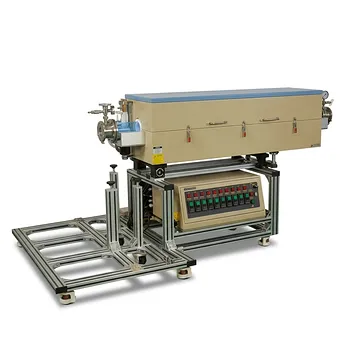
Ten Zone Multi Orientation Laboratory Tube Furnace for 1200C High Temperature Gradient Thermal Processing

High Temperature 1700C Benchtop Tube Furnace with 5 Inch Heating Zone High Purity Alumina Tube and Vacuum Sealing Flanges
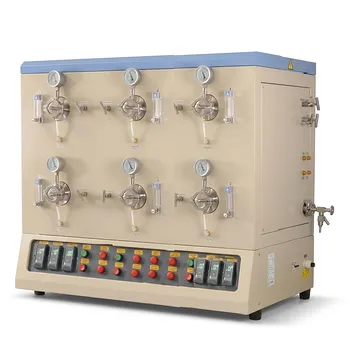
1200C High Throughput Multi Channel Tube Furnace with 50mm Quartz Tubes for Annealing and Material Phase Diagram Research

High Temperature Automated 5 Inch Tube Furnace for Autonomous Material Research and Advanced Laboratory R&D
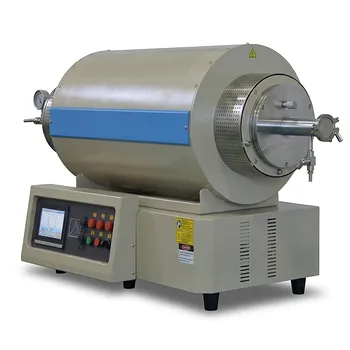
1200C Max Three Zone Tube Furnace 6 Inch OD Max with Tube and Flange