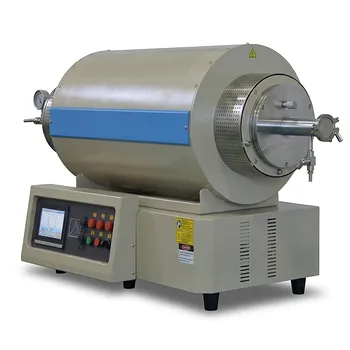
What is the function of an atmosphere tube furnace in biomass carbonization? Optimize Material Purity and Yield
Updated 3 months ago
The atmosphere tube furnace is the primary vessel for the controlled pyrolysis of biomass precursors. By providing a precisely regulated, oxygen-free environment—typically through a nitrogen shield—it facilitates the thermal degradation of organic matter without combustion. This process removes volatile impurities, enriches elemental carbon content, and establishes the foundational microporous structure necessary for advanced material applications.
Core Takeaway: An atmosphere tube furnace enables the transformation of raw biomass into structured carbon by providing an airtight, inert thermal field. This ensures that the precursor undergoes chemical reorganization rather than oxidative loss, allowing for precise control over the resulting carbon’s porosity and density.
The Vital Role of Oxygen Exclusion
Prevention of Oxidative Loss
The furnace's most critical function is maintaining a strictly airtight environment to prevent the biomass from burning. By injecting high-purity nitrogen (N2), the furnace displaces oxygen, ensuring that the carbon material is not lost to aerobic combustion at high temperatures.
Preservation of Carbon Yield
In an oxygen-free chamber, biomass undergoes pyrolysis rather than incineration. This anaerobic condition allows for the maximum retention of carbon elements, converting the precursor into a solid skeletal structure instead of ash.
Retention of Functional Elements
A controlled inert atmosphere is essential for retaining specific elements within the carbon matrix, such as nitrogen. This is particularly important when the goal is to create doped carbon materials for specialized electrochemical applications.
Driving Chemical Transformation via Precise Heat
Dehydrogenation and Deoxygenation
The furnace provides the thermal energy required for deep dehydrogenation and deoxygenation. As the temperature rises, organic molecules like proteins and polysaccharides release hydrogen and oxygen as volatile gases, leaving behind a carbon-rich residue.
Carbon Skeleton Reorganization
At temperatures ranging from 400°C to 1600°C, the furnace facilitates the reorganization of biomass molecules. This structural evolution leads to the formation of "hard carbon," characterized by an amorphous structure and wide graphene layer spacing.
Control over Graphitization
The high-precision temperature control of the tube furnace directly dictates the degree of graphitization. By adjusting the heating program, researchers can tune the density of sodium-ion storage sites or the conductivity of the final product.
Establishing the Material’s Internal Architecture
Formation of Preliminary Micropores
As the furnace removes volatile impurities and organic volatiles, it leaves behind a preliminary microporous structure. This step is vital for setting the foundation for subsequent chemical activation and increasing the surface area.
Thermal Stability and Density
The uniform thermal field ensures that the biomass is treated consistently, resulting in an activated carbon carrier with high thermal stability. This consistency is required for industrial-scale performance and reliability in filtration or energy storage.
Influence on Sodium-Ion Storage
For advanced battery materials, the furnace’s ability to reach extreme temperatures (up to 1600°C) allows for the creation of optimized storage sites. The precise thermal treatment determines the porosity and site density required for efficient ion intercalation.
Understanding the Trade-offs
Heating Rate vs. Structural Integrity
While rapid heating can increase throughput, it may lead to uneven pore distribution or structural collapse. A slower, programmed temperature increase is often necessary to allow gases to escape without damaging the emerging carbon skeleton.
Inert Gas Consumption and Cost
Maintaining a continuous flow of high-purity nitrogen or argon ensures a clean environment but increases operational costs. If the flow rate is too low, residual oxygen or back-flow can contaminate the sample and reduce carbon yield.
Temperature Limits and Equipment Longevity
Operating at the upper limits of the furnace (e.g., 1600°C) accelerates the wear on heating elements and the alumina or quartz tubes. Users must balance the need for high-degree graphitization with the maintenance lifecycle of the furnace components.
How to Apply This to Your Project
Recommendations for Biomass Carbonization
Successfully converting biomass requires aligning your furnace settings with your specific material goals.
- If your primary focus is maximizing carbon yield: Maintain a high flow of high-purity nitrogen and use a moderate temperature (e.g., 400°C to 500°C) to prevent the loss of carbon to volatile gases.
- If your primary focus is developing high porosity: Use a programmed heating cycle with specific dwell times at 600°C to 800°C to ensure the thorough removal of organic volatiles.
- If your primary focus is sodium-ion battery anodes: Prioritize high-temperature treatment (up to 1600°C) to achieve the necessary graphene layer spacing and hard carbon reorganization.
By mastering the atmosphere and thermal gradient within the tube furnace, you can precisely engineer the physical and chemical properties of biomass-derived carbon.
Summary Table:
| Key Function | Primary Benefit | Material Impact |
|---|---|---|
| Oxygen Exclusion | Prevents combustion | Maximizes carbon yield and solid skeletal retention |
| Precise Pyrolysis | Controlled degradation | Removes impurities while preserving functional elements |
| Thermal Regulation | Structural reorganization | Determines graphitization degree and pore density |
| Atmosphere Shielding | Inert environment (N2/Ar) | Enables elemental doping for electrochemical use |
Elevate Your Carbon Research with THERMUNITS Precision
As a leading manufacturer of high-temperature laboratory equipment, THERMUNITS provides specialized thermal solutions for material science and industrial R&D. Our Atmosphere Tube Furnaces and CVD/PECVD systems are specifically engineered to provide the airtight, inert environments necessary for high-yield biomass carbonization and precise structural control.
From Muffle, Vacuum, and Rotary furnaces to Hot Press, Dental, and Vacuum Induction Melting (VIM) furnaces, our comprehensive range of heat treatment equipment ensures your research achieves maximum thermal stability and optimized material architecture.
Ready to optimize your carbonization process? Contact our technical experts today to discover how THERMUNITS can provide the perfect thermal field for your advanced material applications.
References
- Yuttapong Dumpan, Kittinan Maliwan. Synthesis and Characterization of Activated Carbon from Giant Sour Tamarind Fruit Shell by KOH Activation. DOI: 10.37934/armne.20.1.5158
Mentioned Products
- Vertical 1700C Vacuum and Atmosphere Tube Furnace with 80mm Alumina Tube
- 1200C Hybrid Muffle and Tube Furnace for Material Research with Dual Atmosphere Control Quartz Tubes
- 1200°C Atmosphere Controlled Automatic Bottom Loading Furnace with 6 Inch Quartz Tube
- Compact Hybrid Muffle and Tube Furnace for 1000C Controlled Atmosphere Laboratory Material Sintering
- Compact Vertical Split Quartz Tube Furnace with Stainless Steel Vacuum Flanges for Rapid Thermal Quenching and Controlled Atmosphere Material Processing
People Also Ask
- How is an industrial-grade vertical tube furnace utilized in smelting leaching residues? Enhance Metal Recovery Efficiency
- What is the function of a laboratory-grade vertical tube furnace in fast pyrolysis? Optimize Composite Research.
- How does a vertical tube furnace facilitate thermoelectric alloy melting? Precision synthesis for material homogeneity.
- Why is a thermocouple sensor indispensable for monitoring the vertical tube furnace during gallium oxide nanowire production? Optimize VLS Growth
- What are the advantages of using a vertical tube furnace for crucible experiments simulating steel-slag interactions?

Tech Team · ThermUnits
Last updated on Jun 03, 2026
Related Products

Vertical 1700C Vacuum and Atmosphere Tube Furnace with 80mm Alumina Tube
1200C Hybrid Muffle and Tube Furnace for Material Research with Dual Atmosphere Control Quartz Tubes
1200°C Atmosphere Controlled Automatic Bottom Loading Furnace with 6 Inch Quartz Tube
Compact Hybrid Muffle and Tube Furnace for 1000C Controlled Atmosphere Laboratory Material Sintering

Compact Vertical Split Quartz Tube Furnace with Stainless Steel Vacuum Flanges for Rapid Thermal Quenching and Controlled Atmosphere Material Processing

Three Zone Tube Furnace with 11 Inch or 15 Inch Quartz Tube and Hinged Flanges for Vacuum Atmosphere Heat Treatment
1100°C High Temperature Quartz Chamber Furnace 8 Inch OD with 7.6 Liter Capacity and Vacuum Atmosphere Capability
High Temperature Hydrogen Atmosphere Box Furnace 1650C Max Reducing Environment Material Synthesis System 8x8x8 Chamber

High Temperature 1700C Vertical Tube Furnace for Powder Spherification and Material Sintering

Compact High Temperature 1600C Tube Furnace with 50mm Alumina Tube and Vacuum Flanges for Material Sintering

High Temperature 1700C Tube Furnace with High Vacuum Turbomolecular Pump System and Multi Channel Mass Flow Controller Gas Mixer

High Temperature 1700C Six Zone Split Tube Furnace with Alumina Tube and Water Cooled Flanges

1800C High Temperature Compact Vacuum Tube Furnace with 60mm OD Alumina Tube and Kanthal MoSi2 Heating Elements

1100C Tube Furnace with Vacuum Flange and Programmable Temperature Controller for Material Science and Industrial Heat Treatment
Ten Zone Multi Orientation Laboratory Tube Furnace for 1200C High Temperature Gradient Thermal Processing

High Temperature 1700C Benchtop Tube Furnace with 5 Inch Heating Zone High Purity Alumina Tube and Vacuum Sealing Flanges

1200C High Throughput Multi Channel Tube Furnace with 50mm Quartz Tubes for Annealing and Material Phase Diagram Research

High Temperature Automated 5 Inch Tube Furnace for Autonomous Material Research and Advanced Laboratory R&D

1700C Hydrogen Gas Tube Furnace with 60mm Alumina Process Tube and Integrated Hydrogen Safety Detector