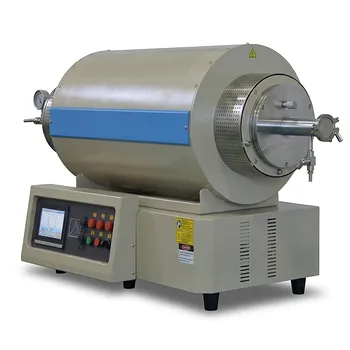
What is the function of an atmosphere tube furnace in iron-based catalyst carbonization? Optimize Phase Evolution
Updated 3 months ago
Atmosphere tube furnaces serve as the critical environment for converting iron precursors into stable, active catalytic sites while shielding the carbon support from thermal degradation. In the carbonization of iron-based catalysts, the furnace facilitates the thermal decomposition of iron salts (such as iron nitrate) into active species like magnetite ($Fe_3O_4$) at temperatures typically around 550°C. By maintaining a strictly controlled inert atmosphere—usually high-purity nitrogen or argon—the furnace ensures that the iron is effectively fixed within the carbon pores without the oxygen-induced combustion of the carbon matrix.
The atmosphere tube furnace is the primary tool for "phase evolution," enabling the precise thermal conversion of unstable precursors into high-performance catalytic species within a shielded, oxygen-free environment.
Phase Evolution and Catalytic Site Fixation
Conversion of Iron Precursors
The primary function of the furnace is to drive the chemical transformation of iron nitrate or Metal-Organic Framework (MOF) precursors into active metallic or oxide phases. Under specific temperature profiles, these precursors evolve into stable species like $Fe_3O_4$ or carbon-encapsulated iron nanoparticles.
Anchoring Within Carbon Pores
At high temperatures, the furnace allows the iron-based species to migrate and fix themselves within the microporous structure of the carbon support. This ensures that the active sites are evenly distributed and physically stabilized, preventing them from leaching or shifting during later applications.
Enhancement of Electrical Conductivity
Thermal treatment within the furnace facilitates the preliminary carbonization of the support material, which may include MOFs or biomass. This process removes volatile impurities and non-carbon components, significantly increasing the electrical conductivity and chemical stability of the final catalyst.
Atmospheric Isolation and Structural Protection
Prevention of Parasitic Oxidation
Without the strictly controlled environment of an atmosphere furnace, carbon supports would oxidize and burn away at typical treatment temperatures (above 400°C). The furnace uses a continuous purge of high-purity nitrogen ($N_2$) or argon (Ar) to displace oxygen and protect the structural integrity of the material.
Precise Reduction Environments
In some configurations, the furnace introduces reducing gases, such as a hydrogen-helium mixture ($H_2/He$), to activate the catalyst. This environment can reduce oxidized metal species into their active metallic states or induce the exsolution of metals to form highly efficient alloy active sites.
Sealing and Environment Purity
The superior sealing performance of a tube furnace is essential for maintaining an oxygen-free zone. Even trace amounts of oxygen can disrupt the phase evolution of the iron or result in the loss of fine carbon nanofibers, making the furnace’s airtight integrity a non-negotiable requirement.
Precision Thermal Engineering
Controlled Heating Profiles
Modern atmosphere furnaces utilize PID (Proportional-Integral-Derivative) control systems to manage heating rates and holding times. This precision prevents thermal overshoot, ensuring that the precursors undergo uniform pyrolysis rather than rapid, uncontrolled decomposition.
Managing Metal Aggregation
By maintaining relatively low but precise temperatures during the initial pyrolysis steps, the furnace prevents the excessive aggregation of metal atoms. This control is vital for keeping the iron particles small and highly dispersed, which maximizes the available catalytic surface area.
Multi-Stage Processing
The furnace allows for complex, multi-step heating programs where the material is stabilized at a lower temperature before reaching the final carbonization peak. This two-step process facilitates the self-assembly of stable three-dimensional carbon structures and ensures a more uniform end product.
Understanding the Trade-offs
Temperature vs. Particle Size
While higher temperatures often improve the crystallinity and conductivity of the carbon support, they also increase the risk of metal sintering. If the temperature is too high, iron nanoparticles will merge, significantly reducing the active surface area of the catalyst.
Atmosphere Purity vs. Cost
Using high-purity argon provides a more inert environment than nitrogen but at a significantly higher operational cost. Furthermore, any failure in the gas delivery system or a minor leak in the tube seals can result in the total "ashing" of the carbon sample.
Throughput vs. Uniformity
Atmosphere tube furnaces are excellent for precision but generally offer lower throughput compared to batch furnaces. The narrow diameter of the tube ensures excellent atmosphere control but limits the volume of catalyst that can be treated in a single cycle.
How to Apply This to Your Project
Recommendations Based on Your Goal
- If your primary focus is maximizing catalytic activity: Use a multi-stage heating profile with a long dwell time at a lower temperature (550°C) to ensure $Fe_3O_4$ phase evolution without particle aggregation.
- If your primary focus is high electrical conductivity: Optimize the carbonization temperature toward the higher end of the range (up to 1000°C) while using high-purity nitrogen to protect the carbon fiber structure.
- If your primary focus is structural complexed MOFs: Utilize a strictly controlled argon environment and a slow ramp rate to prevent the collapse of the delicate porous framework during pyrolysis.
- If your primary focus is activating oxidized catalysts: Employ a controlled reduction atmosphere using a dilute hydrogen mixture ($3% H_2$ in inert gas) at a constant, lower temperature.
The atmosphere tube furnace is the indispensable foundation for engineering the precise chemical and physical properties required for high-performance iron-based catalysts.
Summary Table:
| Key Function | Role in Catalyst Carbonization |
|---|---|
| Phase Evolution | Converts iron salts into active sites like Magnetite ($Fe_3O_4$) or encapsulated nanoparticles. |
| Atmospheric Control | Uses high-purity $N_2$ or Ar to prevent carbon support oxidation and enable reduction ($H_2$). |
| Active Site Fixation | Facilitates migration and anchoring of iron species within microporous carbon structures. |
| Thermal Precision | Utilizes PID control to manage heating rates, preventing metal aggregation and sintering. |
| Conductivity Enhancement | Removes volatile impurities to increase the electrical conductivity of the carbon support. |
Maximize Your Catalyst Performance with THERMUNITS
Precision is non-negotiable in material science and industrial R&D. THERMUNITS is a leading manufacturer of high-temperature laboratory equipment, providing the advanced thermal processing solutions you need to achieve superior catalytic activity and structural integrity.
Our comprehensive range includes:
- Atmosphere and Tube Furnaces for precise gas control and phase evolution.
- Vacuum, Muffle, and Rotary Furnaces for versatile heat treatments.
- CVD/PECVD & Hot Press Systems for advanced material synthesis.
- Dental Furnaces, VIM Systems, and Thermal Elements.
Whether you are scaling up carbonization processes or engineering the next generation of MOF-based catalysts, our expert team is ready to provide tailored equipment solutions.
Contact THERMUNITS today to optimize your laboratory workflow!
References
- Yongjie Chen, Mingbo Wu. Carbon-Supported Fe-Based Catalyst for Thermal-Catalytic CO2 Hydrogenation into C2+ Alcohols: The Effect of Carbon Support Porosity on Catalytic Performance. DOI: 10.3390/molecules29194628
Mentioned Products
- Vertical 1700C Vacuum and Atmosphere Tube Furnace with 80mm Alumina Tube
- 1200C Hybrid Muffle and Tube Furnace for Material Research with Dual Atmosphere Control Quartz Tubes
- 1200°C Atmosphere Controlled Automatic Bottom Loading Furnace with 6 Inch Quartz Tube
- Compact Hybrid Muffle and Tube Furnace for 1000C Controlled Atmosphere Laboratory Material Sintering
- Compact Vertical Split Quartz Tube Furnace with Stainless Steel Vacuum Flanges for Rapid Thermal Quenching and Controlled Atmosphere Material Processing
People Also Ask
- How is an industrial-grade vertical tube furnace utilized in smelting leaching residues? Enhance Metal Recovery Efficiency
- What is the function of a laboratory-grade vertical tube furnace in fast pyrolysis? Optimize Composite Research.
- How does a vertical tube furnace facilitate thermoelectric alloy melting? Precision synthesis for material homogeneity.
- Why is a thermocouple sensor indispensable for monitoring the vertical tube furnace during gallium oxide nanowire production? Optimize VLS Growth
- What are the advantages of using a vertical tube furnace for crucible experiments simulating steel-slag interactions?

Tech Team · ThermUnits
Last updated on Jun 03, 2026
Related Products

Vertical 1700C Vacuum and Atmosphere Tube Furnace with 80mm Alumina Tube
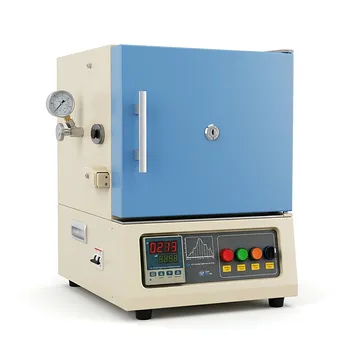
1200C Hybrid Muffle and Tube Furnace for Material Research with Dual Atmosphere Control Quartz Tubes
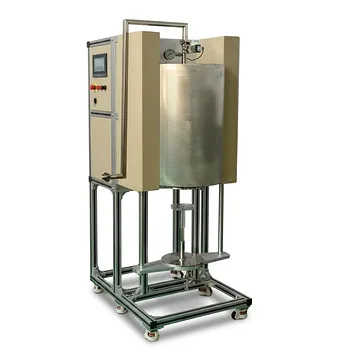
1200°C Atmosphere Controlled Automatic Bottom Loading Furnace with 6 Inch Quartz Tube
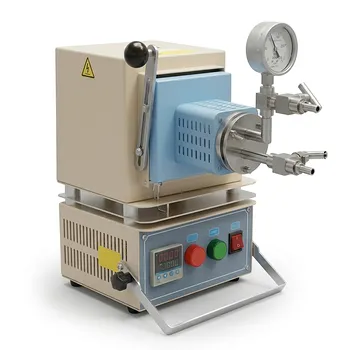
Compact Hybrid Muffle and Tube Furnace for 1000C Controlled Atmosphere Laboratory Material Sintering

Compact Vertical Split Quartz Tube Furnace with Stainless Steel Vacuum Flanges for Rapid Thermal Quenching and Controlled Atmosphere Material Processing

Three Zone Tube Furnace with 11 Inch or 15 Inch Quartz Tube and Hinged Flanges for Vacuum Atmosphere Heat Treatment
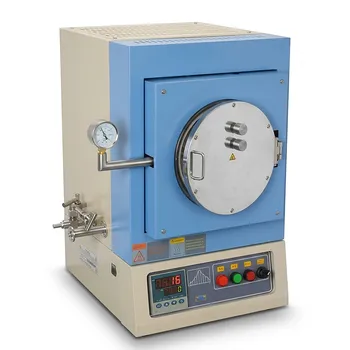
1100°C High Temperature Quartz Chamber Furnace 8 Inch OD with 7.6 Liter Capacity and Vacuum Atmosphere Capability
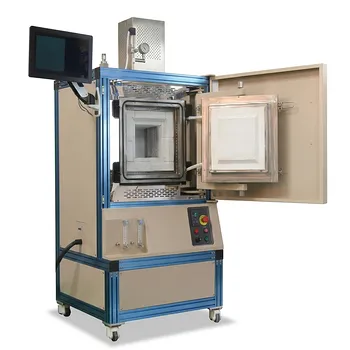
High Temperature Hydrogen Atmosphere Box Furnace 1650C Max Reducing Environment Material Synthesis System 8x8x8 Chamber

High Temperature 1700C Vertical Tube Furnace for Powder Spherification and Material Sintering

Compact High Temperature 1600C Tube Furnace with 50mm Alumina Tube and Vacuum Flanges for Material Sintering

High Temperature 1700C Tube Furnace with High Vacuum Turbomolecular Pump System and Multi Channel Mass Flow Controller Gas Mixer

High Temperature 1700C Six Zone Split Tube Furnace with Alumina Tube and Water Cooled Flanges

1800C High Temperature Compact Vacuum Tube Furnace with 60mm OD Alumina Tube and Kanthal MoSi2 Heating Elements

1100C Tube Furnace with Vacuum Flange and Programmable Temperature Controller for Material Science and Industrial Heat Treatment
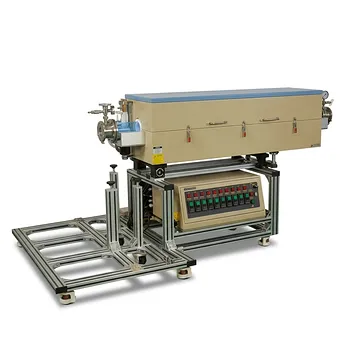
Ten Zone Multi Orientation Laboratory Tube Furnace for 1200C High Temperature Gradient Thermal Processing

High Temperature 1700C Benchtop Tube Furnace with 5 Inch Heating Zone High Purity Alumina Tube and Vacuum Sealing Flanges
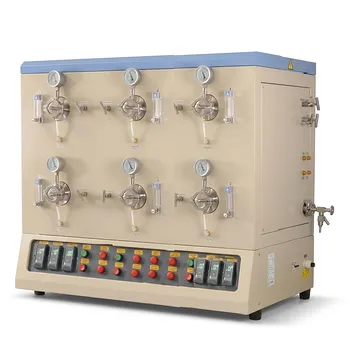
1200C High Throughput Multi Channel Tube Furnace with 50mm Quartz Tubes for Annealing and Material Phase Diagram Research

High Temperature Automated 5 Inch Tube Furnace for Autonomous Material Research and Advanced Laboratory R&D
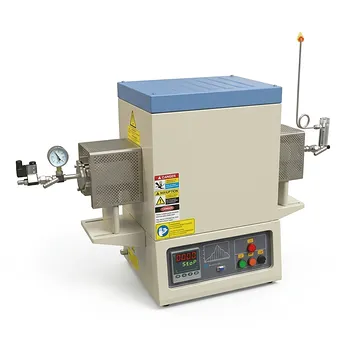
1700C Hydrogen Gas Tube Furnace with 60mm Alumina Process Tube and Integrated Hydrogen Safety Detector