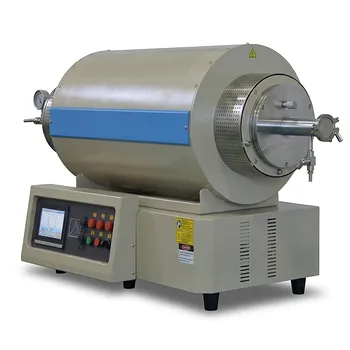
What is the specific role of an atmosphere tube furnace in the construction of TiO2/TiN heterostructures? Synthesis Guide
Updated 3 months ago
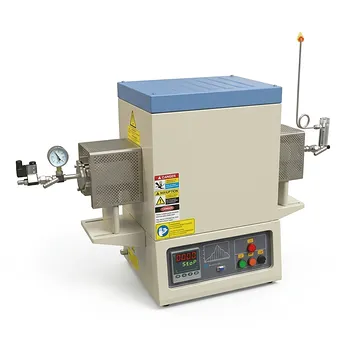
The atmosphere tube furnace serves as the fundamental reactor for the in-situ synthesis of $TiO_2/TiN$ heterostructures. It provides the precise thermal environment (typically 700°C) and controlled gaseous atmosphere (flowing $N_2$) required to simultaneously carbonize organic substrates and partially nitride titanium dioxide. This dual-action process creates the critical heterophase interface that grants the material its high catalytic activity and adsorption capabilities.
Core Takeaway: The atmosphere tube furnace is the "chemical engine" that enables the controlled transformation of simple precursors into complex $TiO_2/TiN$ heterostructures by managing the delicate balance between thermal decomposition, carbonization, and phase-specific nitridation.
Facilitating In-Situ Phase Transformation
The Conversion of $TiO_2$ to $TiN$
The furnace facilitates the low-energy reduction and nitridation of $TiO_2$ nanoparticles. By maintaining a stable temperature of 700°C, it allows the nitrogen sources released from organic substrates to react directly with the titanium dioxide.
Creating the Heterophase Interface
The controlled environment ensures that the nitridation is not total, leaving behind a $TiO_2/TiN$ heterostructure. This interface is vital for catalytic activity, particularly in the management of polysulfides in advanced battery technologies.
Managing Localized Reaction Chemistry
The furnace utilizes the nitrogen source released by the substrate itself during heating. This localized gas release, combined with the external $N_2$ flow, ensures that the nitridation occurs precisely at the site of the nanoparticles.
Controlling the Structural Framework
Carbonization of Organic Substrates
The furnace provides the high-temperature environment necessary to convert organic materials, such as melamine foam, into nitrogen-doped carbon frameworks. These frameworks act as the conductive skeleton for the titanium-based active materials.
Preventing Unwanted Oxidation
By maintaining a continuous flow of inert or protective gas like argon or nitrogen, the furnace prevents the oxidation of sensitive components. This is critical for protecting the titanium nitride and the carbon skeleton from returning to a purely oxide state or burning away.
Maintaining Temperature Field Uniformity
High-quality tube furnaces offer multi-stage programmable control and high uniformity of the thermal field. This consistency is essential for ensuring that the $TiO_2$ transforms evenly across the entire sample, preventing "cold spots" that would lead to incomplete reactions.
Understanding the Trade-offs
Temperature vs. Phase Purity
Higher temperatures (e.g., 900°C) can lead to more complete nitridation using gases like ammonia, but may destroy the organic framework. Conversely, lower temperatures may fail to initiate the phase transformation from amorphous $TiO_2$ to the desired crystalline phases or $TiN$.
Gas Flow Dynamics and Stoichiometry
The rate of gas flow influences the concentration of nitrogen sources around the precursor. If the flow is too high, it may dilute the locally released nitrogen precursors from the substrate; if too low, it may fail to remove byproduct gases, stalling the reaction.
Heating Rate and Structural Integrity
Rapid heating can cause structural collapse of the carbon framework or non-uniform grain growth. Precise multi-stage programming is required to balance the removal of organic impurities with the crystallization of the $TiO_2$ and $TiN$ phases.
How to Optimize Your Synthesis Goal
Making the Right Choice for Your Project
The furnace configuration and settings must be tailored to the specific architecture of the heterostructure you intend to build.
- If your primary focus is maximizing catalytic activity: Use a moderate temperature (700°C) and $N_2$ flow to prioritize the creation of a high-density $TiO_2/TiN$ heterophase interface.
- If your primary focus is electrical conductivity: Consider higher temperatures or ammonia atmospheres to increase the $TiN$ content, as $TiN$ possesses metallic-like conductivity.
- If your primary focus is structural porosity: Utilize a slower ramp rate during the carbonization phase to ensure the nitrogen-doped carbon skeleton remains robust and open.
By masterfully controlling the furnace atmosphere and thermal curve, researchers can precisely tune the electrochemical properties of $TiO_2/TiN$ composites for specific industrial applications.
Summary Table:
| Function | Key Mechanism | Benefit to Material |
|---|---|---|
| Phase Transformation | In-situ low-energy nitridation at 700°C | Creates the critical TiO2/TiN heterophase interface |
| Atmosphere Control | Controlled N2 flow & organic gas release | Prevents oxidation while enabling localized chemistry |
| Carbonization | High-temp organic decomposition | Builds a conductive nitrogen-doped carbon framework |
| Thermal Uniformity | Multi-stage programmable heating | Ensures consistent crystalline phases across the sample |
Elevate Your Material Research with THERMUNITS Precision
As a leading manufacturer of high-temperature laboratory equipment for material science and industrial R&D, THERMUNITS offers the specialized thermal solutions needed to master complex synthesis like TiO2/TiN heterostructures. Our advanced Atmosphere Tube Furnaces and CVD/PECVD systems provide the precise temperature uniformity and atmosphere stability required for superior catalytic and electrochemical results.
From Muffle and Vacuum furnaces to Rotary kilns and Hot Press systems, we empower researchers with cutting-edge heat treatment technology.
Ready to optimize your thermal processing? Contact our experts today to find the perfect equipment for your laboratory.
References
- Shixun Yang, Shulei Chou. In Situ Constructing a TiO<sub>2</sub>/TiN Heterostructure Modified Carbon Interlayer for Balancing the Surface Adsorption and Conversion of Polysulfides in Li–S Batteries. DOI: 10.1002/aenm.202400648
Mentioned Products
- Vertical 1700C Vacuum and Atmosphere Tube Furnace with 80mm Alumina Tube
- 1200C Hybrid Muffle and Tube Furnace for Material Research with Dual Atmosphere Control Quartz Tubes
- 1200°C Atmosphere Controlled Automatic Bottom Loading Furnace with 6 Inch Quartz Tube
- Compact Hybrid Muffle and Tube Furnace for 1000C Controlled Atmosphere Laboratory Material Sintering
- Compact Vertical Split Quartz Tube Furnace with Stainless Steel Vacuum Flanges for Rapid Thermal Quenching and Controlled Atmosphere Material Processing
People Also Ask
- How is an industrial-grade vertical tube furnace utilized in smelting leaching residues? Enhance Metal Recovery Efficiency
- What is the function of a laboratory-grade vertical tube furnace in fast pyrolysis? Optimize Composite Research.
- How does a vertical tube furnace facilitate thermoelectric alloy melting? Precision synthesis for material homogeneity.
- Why is a thermocouple sensor indispensable for monitoring the vertical tube furnace during gallium oxide nanowire production? Optimize VLS Growth
- What are the advantages of using a vertical tube furnace for crucible experiments simulating steel-slag interactions?

Tech Team · ThermUnits
Last updated on Jun 03, 2026
Related Products

Vertical 1700C Vacuum and Atmosphere Tube Furnace with 80mm Alumina Tube
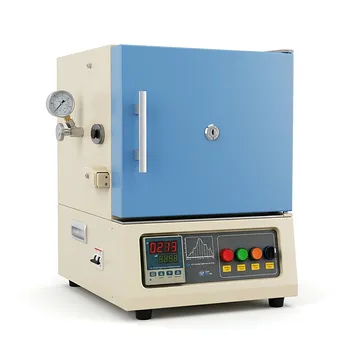
1200C Hybrid Muffle and Tube Furnace for Material Research with Dual Atmosphere Control Quartz Tubes
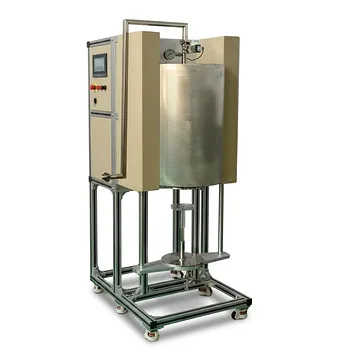
1200°C Atmosphere Controlled Automatic Bottom Loading Furnace with 6 Inch Quartz Tube
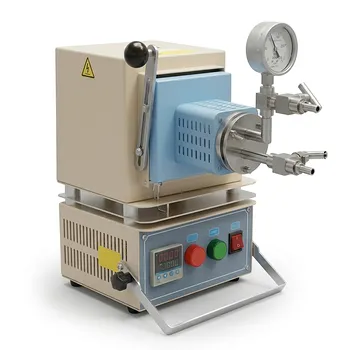
Compact Hybrid Muffle and Tube Furnace for 1000C Controlled Atmosphere Laboratory Material Sintering

Compact Vertical Split Quartz Tube Furnace with Stainless Steel Vacuum Flanges for Rapid Thermal Quenching and Controlled Atmosphere Material Processing
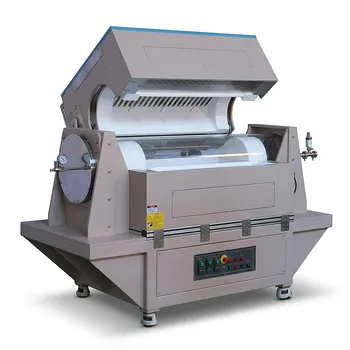
Three Zone Tube Furnace with 11 Inch or 15 Inch Quartz Tube and Hinged Flanges for Vacuum Atmosphere Heat Treatment
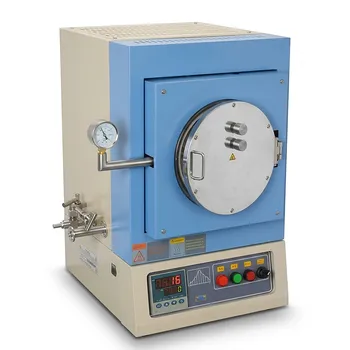
1100°C High Temperature Quartz Chamber Furnace 8 Inch OD with 7.6 Liter Capacity and Vacuum Atmosphere Capability
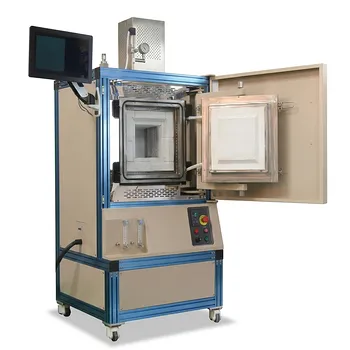
High Temperature Hydrogen Atmosphere Box Furnace 1650C Max Reducing Environment Material Synthesis System 8x8x8 Chamber

High Temperature 1700C Vertical Tube Furnace for Powder Spherification and Material Sintering

Compact High Temperature 1600C Tube Furnace with 50mm Alumina Tube and Vacuum Flanges for Material Sintering

High Temperature 1700C Tube Furnace with High Vacuum Turbomolecular Pump System and Multi Channel Mass Flow Controller Gas Mixer

High Temperature 1700C Six Zone Split Tube Furnace with Alumina Tube and Water Cooled Flanges

1800C High Temperature Compact Vacuum Tube Furnace with 60mm OD Alumina Tube and Kanthal MoSi2 Heating Elements

1100C Tube Furnace with Vacuum Flange and Programmable Temperature Controller for Material Science and Industrial Heat Treatment
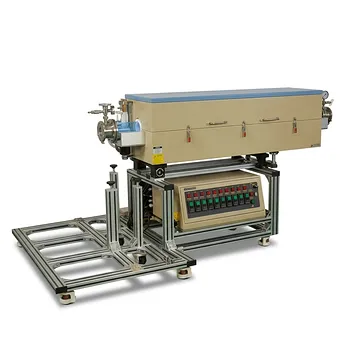
Ten Zone Multi Orientation Laboratory Tube Furnace for 1200C High Temperature Gradient Thermal Processing

High Temperature 1700C Benchtop Tube Furnace with 5 Inch Heating Zone High Purity Alumina Tube and Vacuum Sealing Flanges

1200C High Throughput Multi Channel Tube Furnace with 50mm Quartz Tubes for Annealing and Material Phase Diagram Research

High Temperature Automated 5 Inch Tube Furnace for Autonomous Material Research and Advanced Laboratory R&D
1700C Hydrogen Gas Tube Furnace with 60mm Alumina Process Tube and Integrated Hydrogen Safety Detector