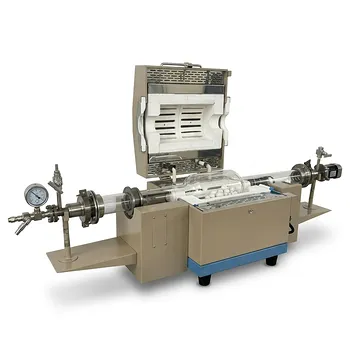
What is the significance of using an industrial-grade tube furnace with an argon atmosphere during the carbothermal reduction of Li3V2(PO4)3? Key to High-Purity Synthesis.
Updated 3 months ago
The use of an industrial-grade tube furnace with an argon atmosphere is essential for maintaining the trivalent state of vanadium and ensuring the formation of a high-purity monoclinic crystal structure. This specific setup prevents the oxidation of $V^{3+}$ ions by ambient oxygen while providing the precise, multi-stage thermal environment required for the carbothermal reduction process and the formation of a conductive carbon coating.
Core Takeaway: The industrial tube furnace acts as a controlled reactor that isolates sensitive vanadium precursors from oxygen, allowing for the precise synthesis of $Li_3V_2(PO_4)_3$ with high phase purity and enhanced electrochemical performance.
Preserving the Oxidation State of Vanadium
Prevention of $V^{3+}$ Oxidation
The primary role of the high-purity argon flow is to create an inert protective environment. During the heating process, vanadium ions are highly susceptible to oxidation if any oxygen is present in the furnace chamber. Maintaining vanadium in its trivalent state ($V^{3+}$) is critical for the material to reach its theoretical specific capacity and maintain its electrochemical activity.
Management of the Pretreatment Phase
The furnace allows for a dedicated 400°C pretreatment phase where the argon atmosphere serves a dual purpose. It prevents oxygen from attacking the vanadium while assisting in the removal of volatile carbon-containing components from the precursor mix. This stage prepares the system for the formal solid-phase reaction without introducing unwanted oxides.
Achieving Structural Precision and Phase Purity
Formation of the Monoclinic Structure
To achieve a high-performance cathode, the material must be converted into a single-phase monoclinic structure. The industrial tube furnace provides the stable thermal energy required to reach and maintain a precise temperature of 750°C. This specific temperature ensures the complete formation of the $Li_3V_2(PO_4)_3$ lattice, which is vital for high lithium-ion diffusion coefficients.
Controlled Thermal Field Distribution
Industrial-grade furnaces offer a stable thermal field distribution that prevents localized hotspots. A uniform temperature throughout the tube ensures that the transition from the precursor to the phosphate structure is smooth and consistent across the entire batch. This uniformity is what allows the final material to achieve high phase purity and avoid the formation of secondary impurity phases.
Optimizing the Carbothermal Reduction Process
Facilitating Carbon Coating
In a carbothermal reduction, a carbon source (such as glucose) is used to reduce the metal precursors and simultaneously form a conductive carbon layer. The inert atmosphere ensures that the carbon source carbonizes into a uniform layer rather than burning away in the presence of oxygen. This layer significantly enhances the electronic conductivity of the resulting $Li_3V_2(PO_4)_3$ particles.
Minimizing Impurity Levels
The sealing performance of a high-quality tube furnace ensures the annealing process occurs entirely within the controlled gas environment. This prevents the formation of oxygen-based impurities and keeps oxygen impurity levels below critical thresholds (often 1 wt. %). Strict atmosphere control also prevents excessive particle sintering, which would otherwise reduce the active surface area of the cathode.
Understanding the Trade-offs and Challenges
Atmosphere Integrity vs. Gas Consumption
Maintaining a high-purity argon environment requires a constant gas flow, which increases operational costs. Any leak in the furnace seals or a drop in gas pressure can lead to immediate oxidation, ruining the entire batch of material. However, the cost of the argon is generally offset by the significantly higher electrochemical performance of the resulting powder.
Heating Rates and Thermal Gradients
While industrial furnaces are precise, programmed heating rates must be carefully calibrated to the specific material volume. Heating too quickly can cause uneven decomposition of organic precursors, leading to non-uniform carbon coatings. Conversely, excessively long sintering times at high temperatures can lead to particle growth, which slows down lithium-ion diffusion.
How to Apply This to Your Project
Recommendations for Material Synthesis
- If your primary focus is Phase Purity: Ensure the furnace has a multi-stage programmable controller to strictly manage the 400°C and 750°C stages.
- If your primary focus is High Conductivity: Use a high-purity argon flow and ensure your carbon source is thoroughly mixed with the precursor to allow the furnace to create a uniform coating.
- If your primary focus is Large-Scale Consistency: Invest in an industrial-grade furnace with a large "constant temperature zone" to ensure all material experiences the same thermal history.
The industrial tube furnace is the definitive tool for bridging the gap between raw chemical precursors and a high-performance, stable $Li_3V_2(PO_4)_3$ cathode.
Summary Table:
| Key Feature | Functional Significance in Li3V2(PO4)3 Synthesis |
|---|---|
| Argon Atmosphere | Prevents $V^{3+}$ oxidation; maintains trivalent state for electrochemical activity. |
| 400°C Pretreatment | Removes volatile organic components without introducing unwanted oxides. |
| 750°C Sintering | Facilitates formation of the high-performance monoclinic crystal structure. |
| Carbothermal Reduction | Enables simultaneous metal reduction and conductive carbon coating formation. |
| Uniform Thermal Field | Ensures phase purity and prevents localized sintering or impurity phases. |
Elevate Your Material Research with THERMUNITS Precision
At THERMUNITS, we understand that the integrity of your material synthesis—like the carbothermal reduction of $Li_3V_2(PO_4)_3$—depends on absolute atmospheric control and thermal uniformity. As a leading manufacturer of high-temperature laboratory equipment, we provide the specialized tools necessary for advanced material science and industrial R&D.
Whether you require Atmosphere Tube Furnaces for inert gas processing, Vacuum/Hydrogen Furnaces, or specialized CVD/PECVD systems, our solutions are designed to prevent oxidation and ensure phase purity. Our product range also includes:
- Muffle, Rotary, and Hot Press Furnaces
- Vacuum Induction Melting Furnaces (VIM)
- Dental and Electric Rotary Kilns
- High-Quality Thermal Elements
Ready to optimize your heat treatment process?
Contact our technical experts today to find the perfect furnace configuration for your specific research or production needs.
References
- Т. П. Гаврилова, S. M. Khantimerov. Li3V2(PO4)3 Cathode Material: Synthesis Method, High Lithium Diffusion Coefficient and Magnetic Inhomogeneity. DOI: 10.3390/ijms25052884
Mentioned Products
- 900°C Max Rotary Tube Furnace with 8 Inch 310S Alloy Tube and Optional Multi Zone Heating for Industrial Material Calcination
- Continuous Feeding Rotary Tube Furnace for Industrial Powder Heat Treatment and Material Research
- 1100C Tube Furnace with Vacuum Flange and Programmable Temperature Controller for Material Science and Industrial Heat Treatment
- Laboratory Tilting Rotary Tubular Furnaces for Material Science and Industrial Heat Treatment
- Compact High Temperature 1600C Tube Furnace with 50mm Alumina Tube and Vacuum Flanges for Material Sintering
People Also Ask
- How does a rotary tube furnace improve the processing of granular materials? Enhance Uniformity and Reaction Kinetics
- Why use a rotary tube furnace for FACS carbonization? Ensure uniform morphology and prevent sphere agglomeration.
- Why is the precise optimization of residence time essential in the catalyst calcination process? Maximize Your Yields.
- In what ways do rotary tube furnaces enhance chemical and specialty mineral processing? Drive Precision and Uniformity.
- What parameters must operators control to maintain product quality in a rotary furnace? Master Your Heat Treatment.

Tech Team · ThermUnits
Last updated on Jun 02, 2026
Related Products
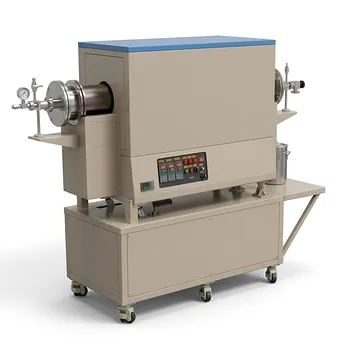
900°C Max Rotary Tube Furnace with 8 Inch 310S Alloy Tube and Optional Multi Zone Heating for Industrial Material Calcination
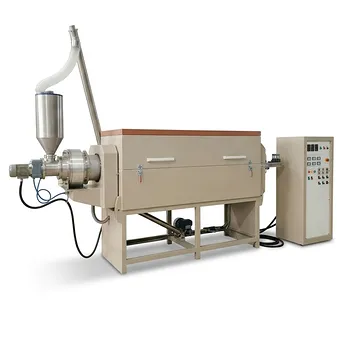
Continuous Feeding Rotary Tube Furnace for Industrial Powder Heat Treatment and Material Research

1100C Tube Furnace with Vacuum Flange and Programmable Temperature Controller for Material Science and Industrial Heat Treatment
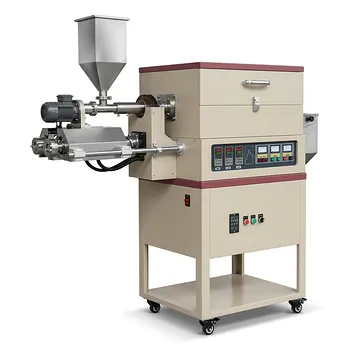
Laboratory Tilting Rotary Tubular Furnaces for Material Science and Industrial Heat Treatment

Compact High Temperature 1600C Tube Furnace with 50mm Alumina Tube and Vacuum Flanges for Material Sintering

High Temperature 1700C Tube Furnace with High Vacuum Turbomolecular Pump System and Multi Channel Mass Flow Controller Gas Mixer

Vertical 1700C Vacuum and Atmosphere Tube Furnace with 80mm Alumina Tube

High Temperature 1700C Vertical Tube Furnace for Powder Spherification and Material Sintering

High Temperature 1700C Six Zone Split Tube Furnace with Alumina Tube and Water Cooled Flanges

Compact Vertical Split Quartz Tube Furnace with Stainless Steel Vacuum Flanges for Rapid Thermal Quenching and Controlled Atmosphere Material Processing

1800C High Temperature Compact Vacuum Tube Furnace with 60mm OD Alumina Tube and Kanthal MoSi2 Heating Elements

1200°C 5 Inch Vertical Quartz Tube Furnace with Stainless Steel Vacuum Flanges

5 Inch Three Zone Rotary Tube Furnace with Integrated Gas Delivery System and 1200C Capability for Advanced Material CVD Processing

High Temperature 1700C Benchtop Tube Furnace with 5 Inch Heating Zone High Purity Alumina Tube and Vacuum Sealing Flanges

High Temperature Automated 5 Inch Tube Furnace for Autonomous Material Research and Advanced Laboratory R&D

1700C Hydrogen Gas Tube Furnace with 60mm Alumina Process Tube and Integrated Hydrogen Safety Detector

1200C High Throughput Multi Channel Tube Furnace with 50mm Quartz Tubes for Annealing and Material Phase Diagram Research
Automated 1200 C Tube Furnace for AI Material Research with 6 Inch OD and Sliding Flange
High Temperature 1700C Tube Furnace with 4 Inch OD Alumina Tube and Vacuum Sealing Flanges