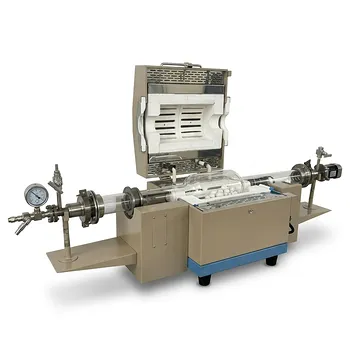
What role does an industrial tube furnace play during the pre-oxidation phase of nickel-PAN nanofibers? Expert Guide
Updated 3 months ago
The industrial tube furnace is the primary tool for thermal stabilization, providing the controlled air atmosphere and precise heating rates—typically around 2 °C per minute—required to transform linear polyacrylonitrile (PAN) into a heat-resistant ladder-like structure. This critical phase ensures that the nickel-PAN nanofibers maintain their shape and do not melt or collapse during subsequent high-temperature carbonization or reduction processes.
Core Takeaway: During pre-oxidation, the tube furnace acts as a chemical reactor that converts unstable organic fibers into a thermally stable precursor. By precisely managing heat and oxygen exposure, it creates the structural foundation necessary for the formation of conductive carbon substrates and metallic nickel nanoparticles.
Facilitating Controlled Thermal Stabilization
Precision Heating Rate Management
The tube furnace allows for an exceptionally slow and consistent heating rate, which is vital for the pre-oxidation of PAN.
If the temperature rises too quickly, the exothermic reactions within the polymer can become uncontrollable, leading to fiber damage.
Precise control (often between 1°C and 2°C per minute) ensures that the chemical transformation occurs uniformly throughout the nanofiber mat.
Maintaining a Constant Air Atmosphere
Unlike later stages that require inert gases, the pre-oxidation phase relies on a stable air atmosphere provided by the furnace.
The presence of oxygen is necessary to facilitate the oxidation and cross-linking of the polymer chains.
The industrial tube furnace ensures a consistent flow of air, which is essential for uniform stabilization across all fibers in the batch.
Engineering the Ladder Structure for Thermal Resistance
The Cyclization Process
The primary chemical role of the furnace is to induce cyclization, where the nitrile groups in the PAN molecular chains react to form closed rings.
This transformation changes the polymer from a linear chain into a ladder-like structure.
This new molecular architecture is significantly more rigid and heat-resistant than the original organic precursor.
Dehydrogenation and Cross-Linking
In addition to cyclization, the furnace environment facilitates dehydrogenation and cross-linking reactions at temperatures typically ranging from 250°C to 280°C.
These reactions remove hydrogen atoms and create bonds between the "ladders," further reinforcing the fiber.
The resulting stabilized fiber serves as a robust "scaffold" that can withstand the extreme temperatures required for final carbonization.
Ensuring Morphological Integrity
Preventing Melting and Collapsing
Without the pre-oxidation step in the tube furnace, PAN nanofibers would melt into a featureless mass when exposed to high-temperature reduction.
The stabilized ladder structure ensures the nanofiber morphology—the long, thin shape of the fibers—is preserved.
This preservation is critical for maintaining the high surface area required for effective nickel nanoparticle distribution.
Establishing the Carbon Substrate Foundation
The pre-oxidation phase is the "setting" stage for the final carbon substrate.
By successfully stabilizing the fibers, the furnace prepares the material for the transition from an organic polymer to a chemically stable, conductive carbon matrix.
This substrate eventually supports the nickel nanoparticles, ensuring they remain active and well-dispersed during the material's end-use.
Understanding the Trade-offs
The Risk of Exothermic Runaway
Because the cyclization of PAN is an exothermic (heat-releasing) process, the furnace must be capable of dissipating excess heat.
If the furnace's thermal management is poor, the internal temperature of the fibers can spike far above the set point, leading to "fusing" where fibers stick together.
This results in a loss of the desired porous nanofiber structure and ruins the material's performance.
Heating Rate vs. Processing Time
There is a direct trade-off between the speed of production and the quality of the fibers.
While faster heating rates increase throughput, they often lead to incomplete stabilization or structural defects.
A slower, more controlled ramp-up in the tube furnace is mandatory for high-quality nickel-PAN nanofibers, even if it extends the total processing time.
How to Apply This to Your Project
Recommendations for Process Optimization
- If your primary focus is structural uniformity: Use a very low heating rate (1°C/min) and ensure high air-flow consistency within the furnace tube to prevent localized overheating.
- If your primary focus is preventing fiber fusing: Incorporate a "dwell time" at the peak pre-oxidation temperature (e.g., 250-280°C) to allow the ladder structure to fully form before proceeding.
- If your primary focus is downstream nickel reduction: Ensure the pre-oxidation is complete by monitoring the fiber color change; under-stabilized fibers will fail when the atmosphere is switched to hydrogen/argon for reduction.
By mastering the pre-oxidation phase within the industrial tube furnace, you secure the structural integrity and performance potential of the final nickel-carbon nanofiber material.
Summary Table:
| Process Phase | Furnace Role | Key Benefit |
|---|---|---|
| Heating Rate Control | Managed ramp-up (1-2°C/min) | Prevents exothermic runaway and fiber damage |
| Atmosphere Management | Continuous air flow supply | Facilitates essential cyclization and cross-linking |
| Structural Formation | Induces ladder-like architecture | Creates heat-resistant fibers that won't melt |
| Morphological Integrity | Thermal dissipation & stability | Preserves thin nanofiber shape and high surface area |
| Pre-Carbonization | Chemical reactor foundation | Prepares stable carbon substrate for nickel particles |
Optimize Your Material Research with THERMUNITS Precision
Achieving the perfect ladder structure in nickel-PAN nanofibers requires the extreme precision of a THERMUNITS industrial tube furnace. As a leading manufacturer of high-temperature laboratory equipment for material science and industrial R&D, we understand the critical nature of thermal stabilization.
Whether your project requires Tube, Vacuum, Atmosphere, or Muffle furnaces, or specialized CVD/PECVD systems and Rotary Kilns, our equipment is designed to deliver the uniform heating and atmosphere control your research demands.
Ready to elevate your lab’s thermal processing capabilities? Contact THERMUNITS Today to discuss your specific furnace requirements and let our experts help you achieve superior heat treatment results.
References
- Chao Hsuan Sung, David Kisailus. Mechanistic Insights into the Synthesis of Nickel‐Graphene Nanostructures for Gas Sensors. DOI: 10.1002/smtd.202400245
Mentioned Products
- 900°C Max Rotary Tube Furnace with 8 Inch 310S Alloy Tube and Optional Multi Zone Heating for Industrial Material Calcination
- Continuous Feeding Rotary Tube Furnace for Industrial Powder Heat Treatment and Material Research
- 1100C Tube Furnace with Vacuum Flange and Programmable Temperature Controller for Material Science and Industrial Heat Treatment
- Laboratory Tilting Rotary Tubular Furnaces for Material Science and Industrial Heat Treatment
- Compact High Temperature 1600C Tube Furnace with 50mm Alumina Tube and Vacuum Flanges for Material Sintering
People Also Ask
- How does a rotary tube furnace improve the processing of granular materials? Enhance Uniformity and Reaction Kinetics
- Why use a rotary tube furnace for FACS carbonization? Ensure uniform morphology and prevent sphere agglomeration.
- Why is the precise optimization of residence time essential in the catalyst calcination process? Maximize Your Yields.
- In what ways do rotary tube furnaces enhance chemical and specialty mineral processing? Drive Precision and Uniformity.
- What parameters must operators control to maintain product quality in a rotary furnace? Master Your Heat Treatment.

Tech Team · ThermUnits
Last updated on Jun 02, 2026
Related Products
900°C Max Rotary Tube Furnace with 8 Inch 310S Alloy Tube and Optional Multi Zone Heating for Industrial Material Calcination
Continuous Feeding Rotary Tube Furnace for Industrial Powder Heat Treatment and Material Research
1100C Tube Furnace with Vacuum Flange and Programmable Temperature Controller for Material Science and Industrial Heat Treatment
Laboratory Tilting Rotary Tubular Furnaces for Material Science and Industrial Heat Treatment

Compact High Temperature 1600C Tube Furnace with 50mm Alumina Tube and Vacuum Flanges for Material Sintering

High Temperature 1700C Tube Furnace with High Vacuum Turbomolecular Pump System and Multi Channel Mass Flow Controller Gas Mixer

Vertical 1700C Vacuum and Atmosphere Tube Furnace with 80mm Alumina Tube

High Temperature 1700C Vertical Tube Furnace for Powder Spherification and Material Sintering

High Temperature 1700C Six Zone Split Tube Furnace with Alumina Tube and Water Cooled Flanges

Compact Vertical Split Quartz Tube Furnace with Stainless Steel Vacuum Flanges for Rapid Thermal Quenching and Controlled Atmosphere Material Processing

1800C High Temperature Compact Vacuum Tube Furnace with 60mm OD Alumina Tube and Kanthal MoSi2 Heating Elements
1200°C 5 Inch Vertical Quartz Tube Furnace with Stainless Steel Vacuum Flanges
5 Inch Three Zone Rotary Tube Furnace with Integrated Gas Delivery System and 1200C Capability for Advanced Material CVD Processing

High Temperature 1700C Benchtop Tube Furnace with 5 Inch Heating Zone High Purity Alumina Tube and Vacuum Sealing Flanges

High Temperature Automated 5 Inch Tube Furnace for Autonomous Material Research and Advanced Laboratory R&D
1700C Hydrogen Gas Tube Furnace with 60mm Alumina Process Tube and Integrated Hydrogen Safety Detector
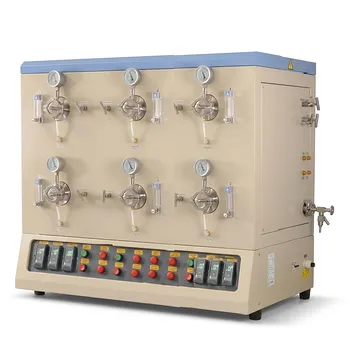
1200C High Throughput Multi Channel Tube Furnace with 50mm Quartz Tubes for Annealing and Material Phase Diagram Research
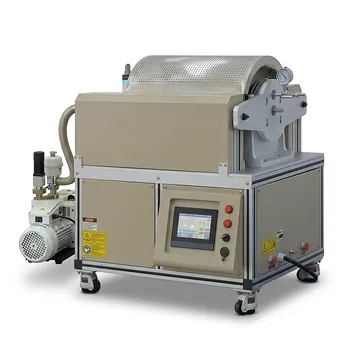
Automated 1200 C Tube Furnace for AI Material Research with 6 Inch OD and Sliding Flange
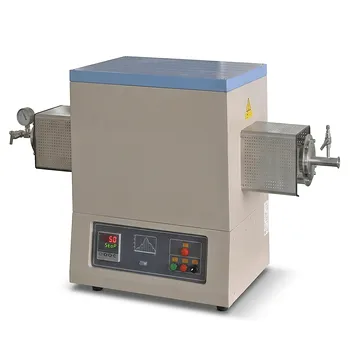
High Temperature 1700C Tube Furnace with 4 Inch OD Alumina Tube and Vacuum Sealing Flanges