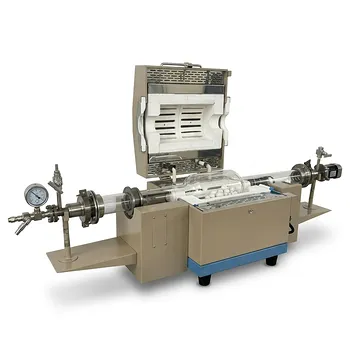
What role does an industrial tube furnace play in the synthesis of calcium ferrites for material research? Precise Control
Updated 3 months ago
The industrial tube furnace is the primary reactor for the high-temperature calcination of nitrate precursors during calcium ferrite synthesis. By providing a stable thermal environment and precise heating rates (typically around 5 °C/min), the furnace facilitates the thermal decomposition of calcium nitrate and ferric nitrate into specific crystalline phases like $CaFe_2O_4$ and $Ca_2Fe_2O_5$. This level of control is essential for achieving the exact phase purity and crystal structure required for advanced material research.
Core Takeaway: An industrial tube furnace acts as a precision thermal reactor that transforms raw chemical precursors into structured calcium ferrites through controlled calcination, ensuring both chemical purity and the specific crystalline orientation needed for research.
Precision Thermal Decomposition of Precursors
Managing the Decomposition Curve
The primary role of the tube furnace is to drive the thermal decomposition of nitrate-based precursors. Specific heating rates, such as 5 °C/min, prevent rapid gas evolution that could disrupt the morphology of the resulting powder. Precise dwell times ensure that the decomposition of calcium nitrate and ferric nitrate is complete before the final phase begins to form.
Uniformity Across the Sample
Tube furnaces provide exceptional temperature uniformity within the heating zone. This ensures that the entire batch of precursor material undergoes the same thermal history, preventing "cold spots" that result in unreacted raw materials. Uniformity is the foundation for producing homogenous powders that behave predictably in subsequent experiments.
Control of Crystalline Phases and Morphology
Orchestrating Solid-State Reactions
The furnace facilitates solid-phase chemical reactions where raw components diffuse at high temperatures to form complex oxides. By adjusting the maximum temperature and holding time, researchers can selectively produce $CaFe_2O_4$, $Ca_2Fe_2O_5$, or other calcium-iron-oxygen stoichiometric ratios. This control is critical for material scientists who need to study the specific properties of one phase without interference from others.
Influencing Particle Size and Active Sites
In the synthesis of high-performance materials, the tube furnace's stable temperature zone controls the rate of crystal growth. Slow, controlled heating helps manage the particle size and the distribution of active sites, which is vital for applications like catalysis. Properly synthesized calcium ferrites require this stability to maintain high surface area and structural integrity.
Atmosphere Management and Redox Control
Regulating Oxygen Partial Pressure
Calcium ferrites are often sensitive to their redox environment; for example, stabilizing phases like SFCA-III requires precise oxygen control. The sealed environment of a tube furnace allows for the introduction of inert or reducing gases to manipulate the oxygen partial pressure. This capability enables researchers to simulate industrial sinter heat exchange zones or create materials that would be impossible to synthesize in open-air muffles.
Protecting Against Contamination
The enclosed nature of the furnace tube protects the high-purity precursors from atmospheric contaminants or cross-contamination from the heating elements. This "clean" environment is necessary for material research where even trace impurities can significantly alter the electrical or catalytic properties of the ferrite. Using specific tube materials, such as alumina or quartz, further ensures that the reaction remains chemically isolated.
Understanding the Trade-offs and Limitations
Throughput vs. Precision
Industrial tube furnaces are designed for precision rather than high-volume batch processing. While they offer superior control over the thermal profile, the limited internal volume of the tube restricts the amount of material that can be synthesized in a single run. Increasing the sample size too much can lead to internal temperature gradients, negating the furnace's primary advantage of uniformity.
Thermal Gradient Challenges
In single-zone furnaces, the temperature may drop near the ends of the tube, creating "dead zones." Researchers must ensure the sample is placed strictly within the "constant temperature zone" to avoid phase impurities. For complex experiments requiring different temperature stages, a standard single-zone furnace may be insufficient, requiring more complex multi-zone configurations.
How to Optimize Your Synthesis Goal
Achieving the best results with a tube furnace depends on aligning the equipment's capabilities with your specific research objectives.
- If your primary focus is phase purity: Prioritize a furnace with a long constant-temperature zone and use slow ramp rates (2–5 °C/min) to ensure complete solid-state diffusion.
- If your primary focus is redox-sensitive ferrites: Select a furnace with high-quality gas-tight seals and integrated mass flow controllers to maintain precise oxygen partial pressure.
- If your primary focus is nanoparticle morphology: Utilize the furnace for precursor pyrolysis under a steady flow of inert gas to prevent over-sintering and maintain high surface area.
By mastering the thermal and atmospheric variables of the tube furnace, researchers can consistently produce calcium ferrites with the precise stoichiometry and crystallinity required for cutting-edge materials science.
Summary Table:
| Key Role | Impact on Synthesis | Critical Control Parameter |
|---|---|---|
| Thermal Decomposition | Prevents gas eruption & maintains morphology | Stable ramp rates (e.g., 5 °C/min) |
| Phase Orchestration | Ensures stoichiometric purity ($CaFe_2O_4$, $Ca_2Fe_2O_5$) | Precise dwell time & temperature |
| Atmosphere Control | Regulates redox states and prevents contamination | Sealed tube with gas flow (O2, Ar, N2) |
| Thermal Uniformity | Eliminates unreacted materials and cold spots | Constant temperature zone alignment |
Maximize Your Research Precision with THERMUNITS
As a leading manufacturer of high-temperature laboratory equipment for material science and industrial R&D, THERMUNITS provides the precision tools necessary for advanced synthesis. Whether you are developing calcium ferrites or exploring new crystalline phases, our thermal solutions ensure repeatable, high-purity results.
Our extensive product range includes:
- Tube & Rotary Furnaces for precise calcination and powder processing.
- Muffle, Vacuum, & Atmosphere Furnaces for controlled environments.
- Hot Press & CVD/PECVD Systems for advanced material fabrication.
- Dental & Vacuum Induction Melting (VIM) Furnaces and high-quality Thermal Elements.
Ready to elevate your heat treatment capabilities? Contact our expert engineering team today to find the perfect furnace for your specific research goals.
References
- Matheus Henrique Pimentel Araújo, Juliana C. Tristão. Calcium ferrites for phosphate adsorption and recovery from wastewater. DOI: 10.1039/d3ra05871a
Mentioned Products
- 900°C Max Rotary Tube Furnace with 8 Inch 310S Alloy Tube and Optional Multi Zone Heating for Industrial Material Calcination
- Continuous Feeding Rotary Tube Furnace for Industrial Powder Heat Treatment and Material Research
- 1100C Tube Furnace with Vacuum Flange and Programmable Temperature Controller for Material Science and Industrial Heat Treatment
- Laboratory Tilting Rotary Tubular Furnaces for Material Science and Industrial Heat Treatment
- Compact High Temperature 1600C Tube Furnace with 50mm Alumina Tube and Vacuum Flanges for Material Sintering
People Also Ask
- How does a rotary tube furnace improve the processing of granular materials? Enhance Uniformity and Reaction Kinetics
- Why use a rotary tube furnace for FACS carbonization? Ensure uniform morphology and prevent sphere agglomeration.
- Why is the precise optimization of residence time essential in the catalyst calcination process? Maximize Your Yields.
- In what ways do rotary tube furnaces enhance chemical and specialty mineral processing? Drive Precision and Uniformity.
- What parameters must operators control to maintain product quality in a rotary furnace? Master Your Heat Treatment.

Tech Team · ThermUnits
Last updated on Jun 02, 2026
Related Products
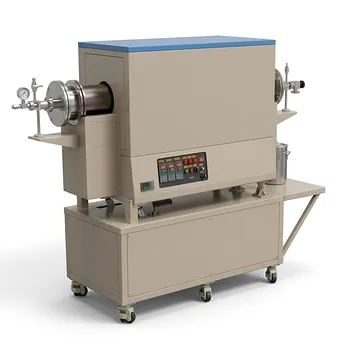
900°C Max Rotary Tube Furnace with 8 Inch 310S Alloy Tube and Optional Multi Zone Heating for Industrial Material Calcination
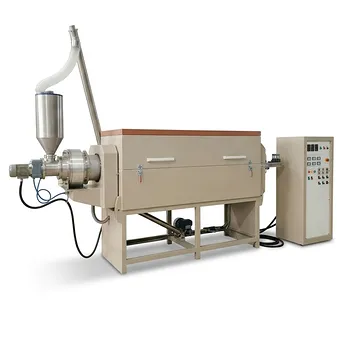
Continuous Feeding Rotary Tube Furnace for Industrial Powder Heat Treatment and Material Research

1100C Tube Furnace with Vacuum Flange and Programmable Temperature Controller for Material Science and Industrial Heat Treatment
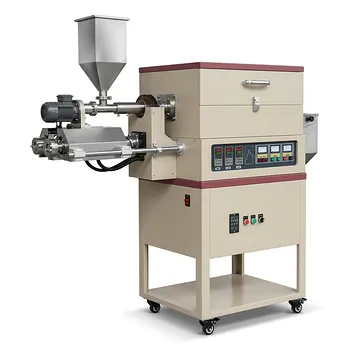
Laboratory Tilting Rotary Tubular Furnaces for Material Science and Industrial Heat Treatment

Compact High Temperature 1600C Tube Furnace with 50mm Alumina Tube and Vacuum Flanges for Material Sintering

High Temperature 1700C Tube Furnace with High Vacuum Turbomolecular Pump System and Multi Channel Mass Flow Controller Gas Mixer

Vertical 1700C Vacuum and Atmosphere Tube Furnace with 80mm Alumina Tube

High Temperature 1700C Vertical Tube Furnace for Powder Spherification and Material Sintering

High Temperature 1700C Six Zone Split Tube Furnace with Alumina Tube and Water Cooled Flanges

Compact Vertical Split Quartz Tube Furnace with Stainless Steel Vacuum Flanges for Rapid Thermal Quenching and Controlled Atmosphere Material Processing

1800C High Temperature Compact Vacuum Tube Furnace with 60mm OD Alumina Tube and Kanthal MoSi2 Heating Elements

1200°C 5 Inch Vertical Quartz Tube Furnace with Stainless Steel Vacuum Flanges
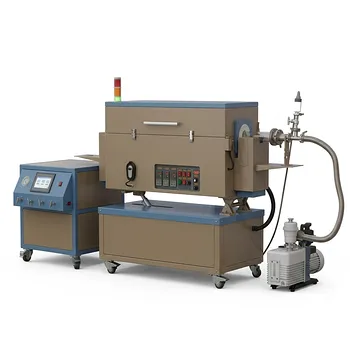
5 Inch Three Zone Rotary Tube Furnace with Integrated Gas Delivery System and 1200C Capability for Advanced Material CVD Processing

High Temperature 1700C Benchtop Tube Furnace with 5 Inch Heating Zone High Purity Alumina Tube and Vacuum Sealing Flanges

1700C Hydrogen Gas Tube Furnace with 60mm Alumina Process Tube and Integrated Hydrogen Safety Detector

High Temperature Automated 5 Inch Tube Furnace for Autonomous Material Research and Advanced Laboratory R&D

1200C High Throughput Multi Channel Tube Furnace with 50mm Quartz Tubes for Annealing and Material Phase Diagram Research
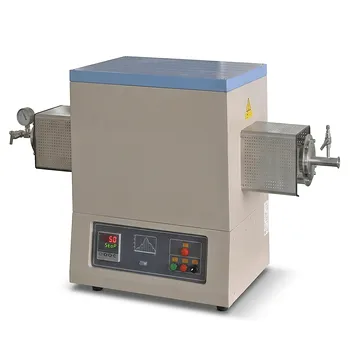
High Temperature 1700C Tube Furnace with 4 Inch OD Alumina Tube and Vacuum Sealing Flanges
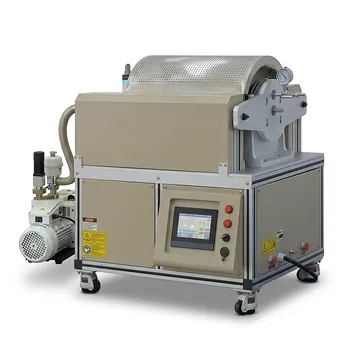
Automated 1200 C Tube Furnace for AI Material Research with 6 Inch OD and Sliding Flange