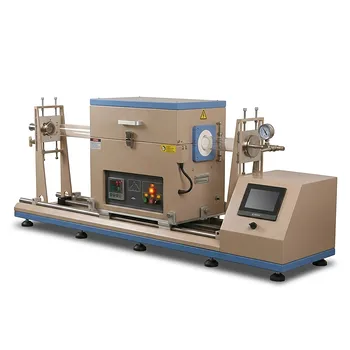
Why is the 360-degree cylindrical geometry of a tube furnace advantageous? Unlock Superior Thermal Uniformity
Updated 5 months ago
The 360-degree cylindrical geometry of a tube furnace is superior because its inherent symmetry maximizes thermal uniformity while minimizing temperature gradients. This design ensures that heat is applied evenly from all directions, preventing the "center heat lag" and inconsistent thermal zones typical of rectangular box or muffle furnaces.
The core advantage of cylindrical geometry lies in its geometric symmetry, which enables precise control over both radial and axial temperature fields. By surrounding the sample entirely, tube furnaces facilitate faster thermal equilibration and more consistent chemical reactions than open-chamber alternatives.
The Physics of Geometric Symmetry
Eliminating Thermal Gradients
The cylindrical design delivers superior thermal uniformity in both radial and axial directions. Because the heating elements surround the process tube, heat radiates inward from a full 360 degrees, ensuring the sample cross-section remains consistent.
Superior Radial Uniformity
In a box furnace, corners and flat walls create uneven heat reflection and "cold spots." The tube furnace’s circular cross-section allows for symmetrical heat distribution, which is critical for processes where even small temperature variances can compromise material integrity.
Consistent Axial Profiles
Beyond the radial cross-section, the tube geometry allows for the creation of distinct, stable thermal zones along the length of the tube. This predictability is essential for applications requiring material movement through a gradient, such as in pusher kilns.
Enhanced Process Control and Kinetics
Avoiding Center Heat Lag
Muffle furnaces often suffer from "center heat lag," where the core of a bulk material remains cooler than the exterior for an extended period. The tube furnace minimizes this effect, ensuring that every particle—especially in large-scale powder production—is heated uniformly and reacts fully with process gases.
Rapid Sample Exchange and Timing
Modified tube furnaces allow for rapid sample exchange, enabling researchers to reach target temperatures within as little as 70 to 103 seconds. This speed is vital for capturing accurate kinetics, such as crack-healing in ceramics, where the initial stages of a reaction occur very quickly.
Dynamic Atmosphere Interaction
In rotary tube furnaces, the cylindrical geometry allows the entire chamber to rotate, creating dynamic atmosphere contact. This constant motion ensures that powder particles are perpetually exposed to the process gas, significantly enhancing production efficiency and batch stability.
Understanding the Trade-offs
Limitations in Sample Geometry
The primary drawback of the tube furnace is its restrictive shape. It is ideal for powders, small parts, or long, thin samples, but it cannot accommodate the large, bulky, or irregularly shaped components that easily fit into a box furnace.
Loading and Accessibility
Tube furnaces are generally more difficult to load than muffle furnaces, which often feature large front-loading doors. The narrow diameter of the tube requires specialized boats or carousels, which can limit the throughput of larger batch sizes that do not require high precision.
Making the Right Choice for Your Goal
How to Apply This to Your Project
To determine if the cylindrical geometry of a tube furnace is the correct choice for your application, consider your primary process requirements:
- If your primary focus is thermal precision and uniformity: The tube furnace is the definitive choice for minimizing gradients and ensuring repeatable results.
- If your primary focus is large-scale powder processing: Use a rotary tube furnace to ensure every particle makes contact with the atmosphere and avoids center heat lag.
- If your primary focus is capturing rapid reaction kinetics: A tube furnace with rapid exchange capabilities is necessary to begin timing your reaction within seconds of reaching the setpoint.
- If your primary focus is processing large, non-uniform parts: A box or muffle furnace is more appropriate due to its flexible internal volume and ease of loading.
By prioritizing geometric symmetry, you ensure that your thermal processing is defined by scientific precision rather than equipment limitations.
Summary Table:
| Feature | Tube Furnace (Cylindrical) | Box/Muffle Furnace (Rectangular) |
|---|---|---|
| Geometry | 360° Symmetrical | Rectangular / Cuboid |
| Thermal Uniformity | Superior Radial & Axial Consistency | Prone to corners and "cold spots" |
| Heating Speed | Faster equilibration & kinetics | Slower due to "center heat lag" |
| Atmosphere Control | High (Ideal for gas/vacuum/rotary) | Moderate (Better for static batches) |
| Ideal Sample | Powders, small parts, long tubes | Bulky or irregularly shaped items |
Elevate Your Research with Precision Thermal Solutions
Maximize your material science breakthroughs with high-performance equipment from THERMUNITS. As a leading manufacturer of high-temperature laboratory solutions for industrial R&D, we specialize in eliminating thermal inconsistencies through advanced geometric design.
Our comprehensive range includes:
- Precision Furnaces: Tube, Muffle, Vacuum, Atmosphere, Rotary, and Hot Press Furnaces.
- Advanced Systems: CVD/PECVD systems, Dental Furnaces, and Electric Rotary Kilns.
- Specialized Equipment: Vacuum Induction Melting (VIM) furnaces and high-quality Thermal Elements.
Whether you are capturing rapid reaction kinetics or scaling powder production, THERMUNITS provides the thermal processing excellence your project demands.
Contact our engineering team today to find your ideal heat treatment solution!
Mentioned Products
- Vertical 1700C Vacuum and Atmosphere Tube Furnace with 80mm Alumina Tube
- Compact High Temperature 1600C Tube Furnace with 50mm Alumina Tube and Vacuum Flanges for Material Sintering
- 900°C Max Rotary Tube Furnace with 8 Inch 310S Alloy Tube and Optional Multi Zone Heating for Industrial Material Calcination
- Split Vertical Tube Furnace with 1200C Quartz Tube and Stainless Steel Vacuum Flanges for Rapid Thermal Processing
- High Temperature 1700C Tube Furnace with High Vacuum Turbomolecular Pump System and Multi Channel Mass Flow Controller Gas Mixer
People Also Ask
- How is an industrial-grade vertical tube furnace utilized in smelting leaching residues? Enhance Metal Recovery Efficiency
- What is the function of a laboratory-grade vertical tube furnace in fast pyrolysis? Optimize Composite Research.
- How does a vertical tube furnace facilitate thermoelectric alloy melting? Precision synthesis for material homogeneity.
- Why is a thermocouple sensor indispensable for monitoring the vertical tube furnace during gallium oxide nanowire production? Optimize VLS Growth
- What are the advantages of using a vertical tube furnace for crucible experiments simulating steel-slag interactions?

Tech Team · ThermUnits
Last updated on Apr 14, 2026
Related Products

Vertical 1700C Vacuum and Atmosphere Tube Furnace with 80mm Alumina Tube

Compact High Temperature 1600C Tube Furnace with 50mm Alumina Tube and Vacuum Flanges for Material Sintering
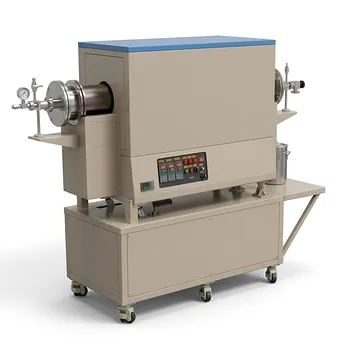
900°C Max Rotary Tube Furnace with 8 Inch 310S Alloy Tube and Optional Multi Zone Heating for Industrial Material Calcination
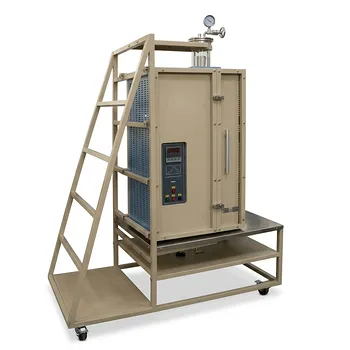
Split Vertical Tube Furnace with 1200C Quartz Tube and Stainless Steel Vacuum Flanges for Rapid Thermal Processing

High Temperature 1700C Tube Furnace with High Vacuum Turbomolecular Pump System and Multi Channel Mass Flow Controller Gas Mixer

1100C Tube Furnace with Vacuum Flange and Programmable Temperature Controller for Material Science and Industrial Heat Treatment
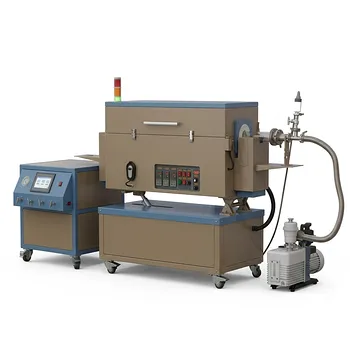
5 Inch Three Zone Rotary Tube Furnace with Integrated Gas Delivery System and 1200C Capability for Advanced Material CVD Processing

1700C Hydrogen Gas Tube Furnace with 60mm Alumina Process Tube and Integrated Hydrogen Safety Detector

1200°C 5 Inch Vertical Quartz Tube Furnace with Stainless Steel Vacuum Flanges

High Temperature 1700C Six Zone Split Tube Furnace with Alumina Tube and Water Cooled Flanges

Compact Vertical Split Quartz Tube Furnace with Stainless Steel Vacuum Flanges for Rapid Thermal Quenching and Controlled Atmosphere Material Processing

High Temperature 1700C Benchtop Tube Furnace with 5 Inch Heating Zone High Purity Alumina Tube and Vacuum Sealing Flanges

1200C High Throughput Multi Channel Tube Furnace with 50mm Quartz Tubes for Annealing and Material Phase Diagram Research
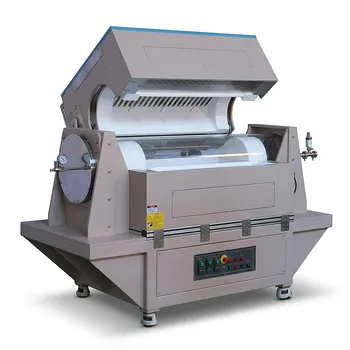
Three Zone Tube Furnace with 11 Inch or 15 Inch Quartz Tube and Hinged Flanges for Vacuum Atmosphere Heat Treatment

1800C High Temperature Compact Vacuum Tube Furnace with 60mm OD Alumina Tube and Kanthal MoSi2 Heating Elements

High Temperature 1700C Vertical Tube Furnace for Powder Spherification and Material Sintering
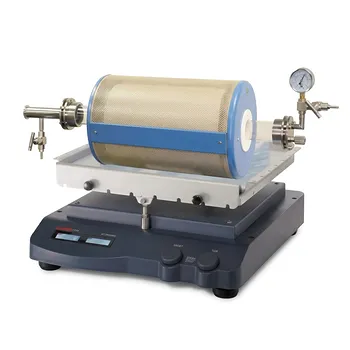
High Temperature Rocking Tube Furnace with Quartz Tube and Vacuum Flange for Materials Synthesis

High Temperature Automated 5 Inch Tube Furnace for Autonomous Material Research and Advanced Laboratory R&D
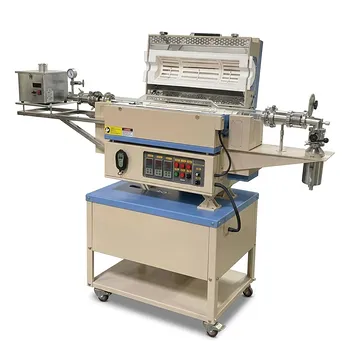
5 Inch Rotary Tube Furnace with Automatic Feeding and Receiving System 1200C Three Zone CVD Powder Processing