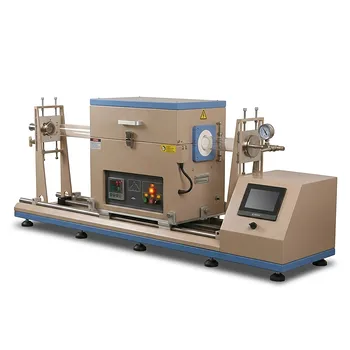
How does a Mass Flow Controller (MFC) regulate argon flow to influence the sulfidation process in a tube furnace?
Updated 3 months ago
A Mass Flow Controller (MFC) serves as the precision engine of the sulfidation process. It regulates high-purity argon to act as a carrier gas that transports sulfur vapor from the evaporation zone to the reaction zone. This constant flow ensures a uniform chemical environment while simultaneously purging the furnace of residual oxygen to prevent unintended sample oxidation.
Core Takeaway: The MFC provides quantitative control over the reaction atmosphere, governing both the transport kinetics of sulfur and the fluid dynamics within the furnace. By maintaining a stable argon flow, it prevents contamination and directly determines the nucleation density, phase, and morphology of the synthesized material.
The Mechanics of Precursor Transport
Consistent Vapor Delivery
The primary role of the MFC is to provide a steady flow rate (typically measured in sccm) that carries evaporated sulfur to the substrate. This ensures a uniform sulfur concentration within the reaction zone, which is essential for achieving a consistent chemical reaction across the entire sample surface.
Oxygen Displacement and Purity
In a tube furnace, the MFC maintains a positive pressure of inert argon to displace residual oxygen. By effectively purging the chamber, the controller prevents the formation of unwanted oxides on the nanorods or substrates, ensuring the purity of the final sulfidated product.
Long-Term Atmospheric Stability
Automated furnaces rely on the MFC to maintain a constant atmospheric composition over cycles that can last for hours or days. This stability is critical for growing high-quality crystals, as even minor fluctuations in gas flow can lead to variations in the chemical environment and result in structural defects.
Kinetic and Morphological Control
Regulation of Supersaturation Levels
The argon flow rate directly impacts the supersaturation level of the precursor vapors in the reaction zone. Precise regulation by the MFC determines the nucleation density and growth rate, which dictates whether the resulting crystals form specific shapes, such as triangular or hexagonal structures.
Influence on Fluid Dynamics
The MFC controls the velocity of the gas, which dictates the fluid dynamics near the substrate. By switching flow rates, researchers can transition the environment between laminar and turbulent flow, a technique used to selectively grow specific structures like microspheres, microplates, or microrods.
Phase Engineering and Cluster Density
In complex synthesis, the MFC is used to manage atomic cluster density. For example, a lower flow rate may favor a specific crystal phase (like alpha-phase nanosheets), while increasing the flow rate drives the transition toward different phases (like beta-phase nanorods) by strengthening the interactions between atoms.
Understanding the Trade-offs
Flow Rate vs. Residence Time
Increasing the argon flow rate improves transport efficiency but reduces the residence time of the sulfur vapor over the substrate. If the flow is too high, the precursors may pass the reaction zone too quickly to react, leading to low yield or incomplete sulfidation.
Turbulence and Uniformity
While higher flow rates can increase precursor delivery, they risk introducing turbulence into the tube. Turbulent flow can cause uneven deposition and non-uniform growth across the sample, negating the benefits of precise mass flow control.
Gas Mixing Complexity
When using an MFC to mix multiple gases (e.g., argon and hydrogen), the molar volume ratios must be strictly controlled. Any calibration error in the MFC system can shift the thermodynamic equilibrium, leading to the formation of secondary phases or incorrect chemical compositions.
Applying MFC Control to Your Project
Recommendations for Process Optimization
The ideal flow rate depends on your specific goals regarding crystal structure, purity, and growth speed.
- If your primary focus is Phase Engineering: Use the MFC to incrementally adjust the argon flow to find the specific cluster density that triggers the desired phase transition.
- If your primary focus is Morphological Uniformity: Prioritize a lower, stable flow rate to maintain laminar flow and ensure even supersaturation across the substrate.
- If your primary focus is Preventing Oxidation: Ensure the MFC is set to a high initial purge rate before lowering it to the reaction setpoint to guarantee all residual oxygen is removed.
By mastering the precise regulation of the carrier gas, you gain direct control over the chemical and structural evolution of your materials during the sulfidation process.
Summary Table:
| MFC Function | Process Impact | Key Benefit |
|---|---|---|
| Vapor Transport | Steady sulfur delivery | Uniform chemical reaction across samples |
| Oxygen Purging | Positive pressure displacement | Prevents unintended sample oxidation |
| Flow Dynamics | Laminar vs. Turbulent flow control | Influences crystal morphology (rods, spheres) |
| Phase Engineering | Adjusts atomic cluster density | Enables precise crystal phase transitions |
| Atmospheric Stability | Constant gas composition | Reduces structural defects in long cycles |
Achieve Precision in Your Sulfidation Research
Precise gas regulation is the key to repeatable material morphology and phase purity. THERMUNITS is a leading manufacturer of high-temperature laboratory equipment for material science and industrial R&D. We provide the robust thermal environments necessary for complex synthesis, offering a comprehensive range of solutions including Tube Furnaces, CVD/PECVD systems, Vacuum and Atmosphere Furnaces, as well as Muffle, Rotary, and Hot Press units.
Whether you are working on phase engineering or large-scale material synthesis, our equipment—including electric rotary kilns, vacuum induction melting (VIM) furnaces, and specialized thermal elements—is engineered for reliability and precision.
Ready to enhance your lab's efficiency? Contact our experts today to find the perfect thermal processing solution for your application.
References
- Long Chen, Hongyan Wang. Improvement of Photocatalytic and Photodegradable ZnSe Nanorods by a Vulcanization Strategy. DOI: 10.1021/acsomega.4c05603
Mentioned Products
- Vertical 1700C Vacuum and Atmosphere Tube Furnace with 80mm Alumina Tube
- Compact High Temperature 1600C Tube Furnace with 50mm Alumina Tube and Vacuum Flanges for Material Sintering
- 900°C Max Rotary Tube Furnace with 8 Inch 310S Alloy Tube and Optional Multi Zone Heating for Industrial Material Calcination
- Split Vertical Tube Furnace with 1200C Quartz Tube and Stainless Steel Vacuum Flanges for Rapid Thermal Processing
- High Temperature 1700C Tube Furnace with High Vacuum Turbomolecular Pump System and Multi Channel Mass Flow Controller Gas Mixer
People Also Ask
- How is an industrial-grade vertical tube furnace utilized in smelting leaching residues? Enhance Metal Recovery Efficiency
- What is the function of a laboratory-grade vertical tube furnace in fast pyrolysis? Optimize Composite Research.
- How does a vertical tube furnace facilitate thermoelectric alloy melting? Precision synthesis for material homogeneity.
- Why is a thermocouple sensor indispensable for monitoring the vertical tube furnace during gallium oxide nanowire production? Optimize VLS Growth
- What are the advantages of using a vertical tube furnace for crucible experiments simulating steel-slag interactions?

Tech Team · ThermUnits
Last updated on Jun 03, 2026
Related Products

Vertical 1700C Vacuum and Atmosphere Tube Furnace with 80mm Alumina Tube

Compact High Temperature 1600C Tube Furnace with 50mm Alumina Tube and Vacuum Flanges for Material Sintering
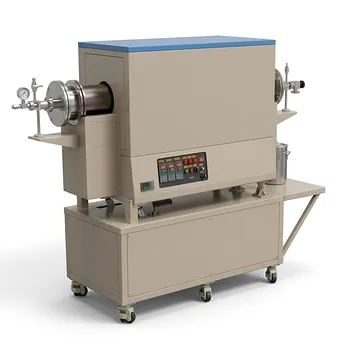
900°C Max Rotary Tube Furnace with 8 Inch 310S Alloy Tube and Optional Multi Zone Heating for Industrial Material Calcination
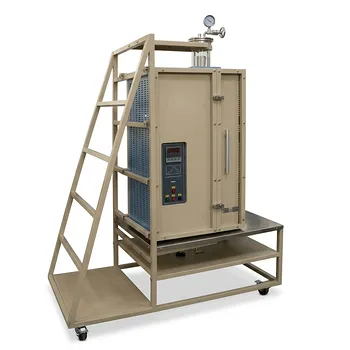
Split Vertical Tube Furnace with 1200C Quartz Tube and Stainless Steel Vacuum Flanges for Rapid Thermal Processing

High Temperature 1700C Tube Furnace with High Vacuum Turbomolecular Pump System and Multi Channel Mass Flow Controller Gas Mixer

1100C Tube Furnace with Vacuum Flange and Programmable Temperature Controller for Material Science and Industrial Heat Treatment

5 Inch Three Zone Rotary Tube Furnace with Integrated Gas Delivery System and 1200C Capability for Advanced Material CVD Processing

1700C Hydrogen Gas Tube Furnace with 60mm Alumina Process Tube and Integrated Hydrogen Safety Detector

1200°C 5 Inch Vertical Quartz Tube Furnace with Stainless Steel Vacuum Flanges

High Temperature 1700C Six Zone Split Tube Furnace with Alumina Tube and Water Cooled Flanges

Compact Vertical Split Quartz Tube Furnace with Stainless Steel Vacuum Flanges for Rapid Thermal Quenching and Controlled Atmosphere Material Processing

High Temperature 1700C Benchtop Tube Furnace with 5 Inch Heating Zone High Purity Alumina Tube and Vacuum Sealing Flanges

1200C High Throughput Multi Channel Tube Furnace with 50mm Quartz Tubes for Annealing and Material Phase Diagram Research

Three Zone Tube Furnace with 11 Inch or 15 Inch Quartz Tube and Hinged Flanges for Vacuum Atmosphere Heat Treatment

1800C High Temperature Compact Vacuum Tube Furnace with 60mm OD Alumina Tube and Kanthal MoSi2 Heating Elements

High Temperature 1700C Vertical Tube Furnace for Powder Spherification and Material Sintering
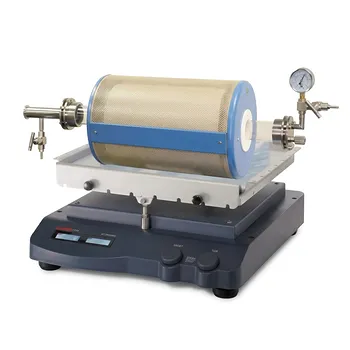
High Temperature Rocking Tube Furnace with Quartz Tube and Vacuum Flange for Materials Synthesis

High Temperature Automated 5 Inch Tube Furnace for Autonomous Material Research and Advanced Laboratory R&D
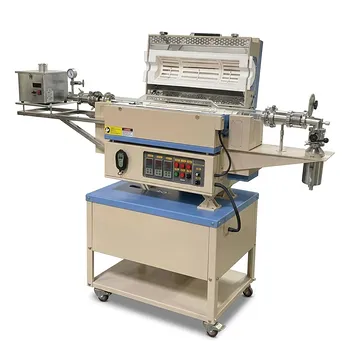
5 Inch Rotary Tube Furnace with Automatic Feeding and Receiving System 1200C Three Zone CVD Powder Processing