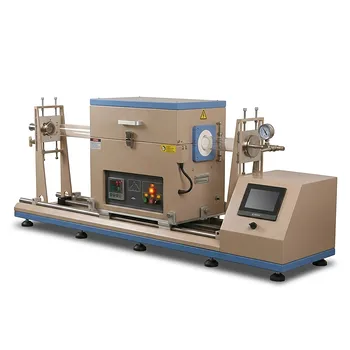
How does a tube furnace influence the surface chemical state of CuFeOx catalysts? Expert Activation & Control Tips
Updated 3 months ago
The tube furnace serves as the definitive environment for the precise chemical modification of CuFeOx surfaces. By providing a sealed chamber for programmed temperature control and a stable flow of reducing gases (such as 10% H₂/He), the furnace facilitates the moderate reduction of the catalyst. This process transforms the surface by converting CuO to Cu₂O, reducing Fe³⁺ to Fe²⁺, and generating high densities of oxygen vacancies essential for CO oxidation.
A tube furnace enables the transition of a CuFeOx catalyst from an inactive oxide state to a highly active surface by strictly regulating the reduction kinetics. Its primary value lies in its ability to generate specific oxidation states ($Cu^+$ and $Fe^{2+}$) and structural defects while preventing the total collapse or sintering of the catalyst framework.
The Mechanism of Surface Chemical Transformation
Generation of Cu+ Active Sites
The tube furnace environment facilitates the partial reduction of copper species within the CuFeOx matrix. By maintaining a steady flow of hydrogen at specific temperatures, the furnace promotes the transition of CuO to Cu₂O. This shift is vital because it creates Cu+ active sites, which are the primary drivers for low-temperature catalytic activity.
Reduction of the Iron Framework
Parallel to the copper transformation, the furnace enables the controlled reduction of the iron components. The thermal energy provided by the furnace allows hydrogen to react with the surface, converting a portion of Fe³⁺ ions into Fe²⁺. This dual-metal reduction creates a synergistic effect that enhances the overall electronic environment of the catalyst.
Induction of Oxygen Vacancies
The removal of oxygen atoms from the CuFeOx lattice during the hydrogen activation process creates oxygen vacancies. The tube furnace's ability to maintain a constant reducing atmosphere ensures that these vacancies are formed uniformly across the surface. These defects are critical for the adsorption and activation of reactant molecules during the CO oxidation process.
Atmospheric and Thermal Control for Structural Integrity
Prevention of Metal Sintering
A key influence of the tube furnace is its ability to prevent the agglomeration of active metal species. By utilizing precise programmed heating profiles, the furnace ensures that the reduction happens slowly enough to maintain high metal dispersion. This prevents the active Cu and Fe sites from sintering into larger, less effective clusters at high temperatures.
Maintaining Atomic-Level Dispersion
The stable environment within the tube furnace promotes the stable atomic-level dispersion of metals within the lattice. This physical confinement, often supported by the catalyst's underlying structure, is maintained by the furnace’s steady gas flow distribution. This ensures that the dual active sites remain exposed and accessible for chemical reactions.
Optimization of Crystal Defects
Beyond simple reduction, the tube furnace allows for the fine-tuning of the catalyst's physical structure, including step sites and crystal defects. By adjusting the heating curve and annealing parameters, researchers can optimize the surface morphology. This level of control is necessary to achieve high selectivity and durability in flexible catalytic applications.
Understanding the Trade-offs
The Risk of Over-Reduction
While reduction is necessary for activation, excessive exposure to hydrogen or high temperatures can lead to over-reduction. If the furnace parameters are not strictly regulated, $Cu^+$ can be further reduced to metallic $Cu^0$, which may diminish the catalyst's specific low-temperature effectiveness.
Sintering vs. Activation Temperature
Higher temperatures in the tube furnace generally increase the rate of oxygen vacancy formation, but they also increase the kinetic energy of surface atoms. There is a constant trade-off between achieving a thorough reduction and risking the loss of surface area due to thermal sintering. Finding the "sweet spot" requires precise control over the furnace’s ramp rates and soak times.
How to Optimize Your Activation Process
Recommendations for Catalyst Treatment
- If your primary focus is maximizing Cu+ active sites: Utilize a lower temperature (e.g., 300°C) with a diluted hydrogen flow to ensure partial, rather than full, reduction of copper oxides.
- If your primary focus is creating oxygen vacancies: Increase the soak time in the tube furnace under a stable reducing atmosphere to allow for deeper lattice oxygen removal.
- If your primary focus is preventing particle growth: Implement a strict programmed temperature ramp and utilize a high flow rate of carrier gas to quickly remove reaction byproducts that could catalyze sintering.
The tube furnace is the essential tool for transforming CuFeOx from a stable oxide into a high-performance catalyst by balancing chemical reduction with structural preservation.
Summary Table:
| Furnace Influence | Chemical/Structural Change | Impact on Catalytic Performance |
|---|---|---|
| Temperature Control | CuO $\rightarrow$ $Cu_2O$ and $Fe^{3+}$ $\rightarrow$ $Fe^{2+}$ | Generates critical $Cu^+$ and $Fe^{2+}$ active sites |
| Reducing Atmosphere | Lattice Oxygen Removal | Induces oxygen vacancies for molecule activation |
| Heating Ramp Rates | Prevention of Metal Agglomeration | Maintains high atomic dispersion and surface area |
| Gas Flow Stability | Uniform Atmosphere Distribution | Ensures consistent activation across the catalyst batch |
Maximize Your Catalytic Performance with THERMUNITS
Precise thermal control is the difference between a failed experiment and a breakthrough. As a leading manufacturer of high-temperature laboratory equipment, THERMUNITS provides the advanced thermal processing solutions required for sensitive material science R&D.
Whether you are activating CuFeOx catalysts or developing new materials, our comprehensive range of Tube, Muffle, Vacuum, and Atmosphere furnaces, as well as CVD/PECVD systems and Vacuum Induction Melting (VIM) furnaces, offers the atmospheric purity and temperature precision you need to prevent sintering and optimize active sites.
Ready to elevate your research? Contact our engineering team today to find the ideal heat treatment solution for your laboratory.
References
- Zhenghua Shen, Shan Ren. Unveiling the Promoting Mechanism of H2 Activation on CuFeOx Catalyst for Low-Temperature CO Oxidation. DOI: 10.3390/molecules29143347
Mentioned Products
- Vertical 1700C Vacuum and Atmosphere Tube Furnace with 80mm Alumina Tube
- Compact High Temperature 1600C Tube Furnace with 50mm Alumina Tube and Vacuum Flanges for Material Sintering
- 900°C Max Rotary Tube Furnace with 8 Inch 310S Alloy Tube and Optional Multi Zone Heating for Industrial Material Calcination
- Split Vertical Tube Furnace with 1200C Quartz Tube and Stainless Steel Vacuum Flanges for Rapid Thermal Processing
- High Temperature 1700C Tube Furnace with High Vacuum Turbomolecular Pump System and Multi Channel Mass Flow Controller Gas Mixer
People Also Ask
- How is an industrial-grade vertical tube furnace utilized in smelting leaching residues? Enhance Metal Recovery Efficiency
- What is the function of a laboratory-grade vertical tube furnace in fast pyrolysis? Optimize Composite Research.
- How does a vertical tube furnace facilitate thermoelectric alloy melting? Precision synthesis for material homogeneity.
- Why is a thermocouple sensor indispensable for monitoring the vertical tube furnace during gallium oxide nanowire production? Optimize VLS Growth
- What are the advantages of using a vertical tube furnace for crucible experiments simulating steel-slag interactions?

Tech Team · ThermUnits
Last updated on Jun 02, 2026
Related Products

Vertical 1700C Vacuum and Atmosphere Tube Furnace with 80mm Alumina Tube

Compact High Temperature 1600C Tube Furnace with 50mm Alumina Tube and Vacuum Flanges for Material Sintering
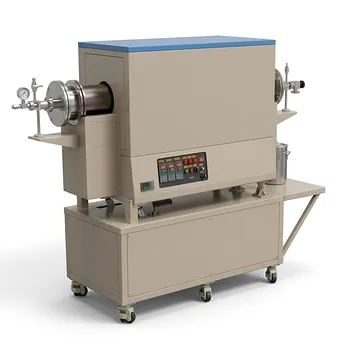
900°C Max Rotary Tube Furnace with 8 Inch 310S Alloy Tube and Optional Multi Zone Heating for Industrial Material Calcination
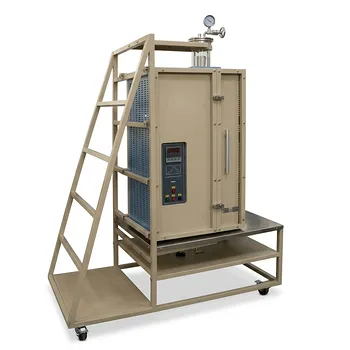
Split Vertical Tube Furnace with 1200C Quartz Tube and Stainless Steel Vacuum Flanges for Rapid Thermal Processing

High Temperature 1700C Tube Furnace with High Vacuum Turbomolecular Pump System and Multi Channel Mass Flow Controller Gas Mixer

1100C Tube Furnace with Vacuum Flange and Programmable Temperature Controller for Material Science and Industrial Heat Treatment

5 Inch Three Zone Rotary Tube Furnace with Integrated Gas Delivery System and 1200C Capability for Advanced Material CVD Processing

1700C Hydrogen Gas Tube Furnace with 60mm Alumina Process Tube and Integrated Hydrogen Safety Detector

1200°C 5 Inch Vertical Quartz Tube Furnace with Stainless Steel Vacuum Flanges

High Temperature 1700C Six Zone Split Tube Furnace with Alumina Tube and Water Cooled Flanges

Compact Vertical Split Quartz Tube Furnace with Stainless Steel Vacuum Flanges for Rapid Thermal Quenching and Controlled Atmosphere Material Processing

High Temperature 1700C Benchtop Tube Furnace with 5 Inch Heating Zone High Purity Alumina Tube and Vacuum Sealing Flanges

1200C High Throughput Multi Channel Tube Furnace with 50mm Quartz Tubes for Annealing and Material Phase Diagram Research

Three Zone Tube Furnace with 11 Inch or 15 Inch Quartz Tube and Hinged Flanges for Vacuum Atmosphere Heat Treatment

1800C High Temperature Compact Vacuum Tube Furnace with 60mm OD Alumina Tube and Kanthal MoSi2 Heating Elements

High Temperature 1700C Vertical Tube Furnace for Powder Spherification and Material Sintering
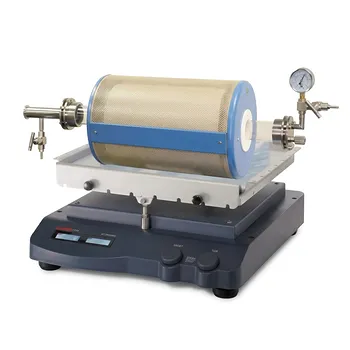
High Temperature Rocking Tube Furnace with Quartz Tube and Vacuum Flange for Materials Synthesis

High Temperature Automated 5 Inch Tube Furnace for Autonomous Material Research and Advanced Laboratory R&D
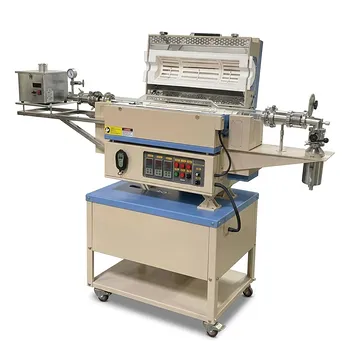
5 Inch Rotary Tube Furnace with Automatic Feeding and Receiving System 1200C Three Zone CVD Powder Processing