How does a tube furnace regulate the oxygen content in Calcium Cobalt Oxide ceramics during post-processing? Expert Guide
Updated 3 months ago
The primary mechanism is controlled re-oxidation. A tube furnace regulates oxygen content in Calcium Cobalt Oxide (CCO) by subjecting the ceramic to prolonged annealing—often up to 100 hours at 1073 K—within a high-purity oxygen or synthetic air atmosphere. This process facilitates the diffusion of oxygen molecules into the lattice to neutralize vacancies created during initial sintering, effectively tuning the oxygen deficiency ($\delta$) to optimize electrical performance.
Core Takeaway: A tube furnace serves as a precision chemical reactor that uses stable thermal fields and controlled gas flow to manage oxygen stoichiometry. By balancing the rate of oxygen diffusion against temperature-dependent reaction kinetics, it allows engineers to fine-tune the material's carrier concentration and thermoelectric efficiency.
The Mechanism of Lattice Re-Oxidation
Mitigating Sintering Vacancies
During high-temperature vacuum sintering, Calcium Cobalt Oxide ceramics naturally lose oxygen atoms, creating oxygen vacancies. These vacancies disrupt the crystal structure and significantly alter the material's electrical properties.
The tube furnace provides a stable environment for post-processing re-oxidation. By maintaining a high-temperature soak, the furnace provides the thermal energy necessary for oxygen molecules to migrate back into these vacant lattice sites.
Atmospheric Control and Flow Dynamics
The furnace regulates the partial pressure of oxygen by utilizing flowing synthetic air or pure oxygen. This constant flow ensures that the concentration of oxygen at the material surface remains high and consistent.
Flowing oxygen also serves a protective role by preventing the reduction of metal ions. In CCO ceramics, maintaining the correct oxidation state of cobalt is critical for preserving the material’s functional phases.
Optimizing Thermoelectric Properties
Tuning Hole Carrier Concentration
The oxygen deficiency, denoted as $\delta$, directly dictates the number of charge carriers in the ceramic. By precisely controlling the annealing duration—ranging from minutes to over 100 hours—the tube furnace allows for the quantitative regulation of these carriers.
As oxygen atoms fill vacancies, they modify the electronic environment of the cobalt-oxide layers. This adjustment is essential for transitioning the material from a highly deficient state to one that is optimized for conductivity.
Enhancing the Seebeck Coefficient
The Seebeck coefficient, a measure of the material's thermoelectric voltage, is highly sensitive to the oxygen stoichiometry. A tube furnace allows for the delicate balancing of this coefficient against electrical resistivity.
By utilizing a stable thermal field, the furnace ensures that oxygen diffusion is uniform throughout the ceramic body. This uniformity prevents localized "hot spots" of high or low oxygen content, which would otherwise degrade the overall device efficiency.
Understanding the Trade-offs
Kinetic Constraints and Energy Costs
Achieving perfect oxygen stoichiometry is a diffusion-limited process. In many cases, this requires extremely long annealing cycles (e.g., 100 hours), leading to high energy consumption and slower production throughput.
Attempting to speed up the process by significantly increasing temperatures can be counterproductive. High temperatures may lead to grain growth or secondary phase formation, which can negatively impact the mechanical and electrical integrity of the CCO ceramic.
Risk of Excessive Oxidation
While filling vacancies is the goal, over-oxidation can occur if the cooling rate or gas flow is not strictly managed. Excessive oxygen can lead to a decrease in the Seebeck coefficient or the formation of insulating layers on the ceramic surface.
Precise thermal control at lower temperatures (e.g., 200°C) is often required during the final stages of cooling. This prevents the thermal decomposition of organic precursors or the loss of lithium in specific cathode-modified CCO variants.
How to Apply This to Your Project
Making the Right Choice for Your Goal
- If your primary focus is maximizing the Seebeck coefficient: Prioritize long-duration annealing at moderate temperatures (1073 K) in pure oxygen to ensure full lattice saturation.
- If your primary focus is high-throughput production: Utilize high-precision flow controllers to increase oxygen partial pressure, potentially reducing the time required for diffusion.
- If your primary focus is surface modification or core-shell growth: Employ low-temperature calcination (approx. 200°C) with short durations (5 to 120 minutes) to control the growth of the oxide shell without altering the core.
By mastering the relationship between time, temperature, and atmospheric flow, you can transform a simple tube furnace into a powerful tool for stoichiometric engineering.
Summary Table:
| Key Parameter | Mechanism | Resulting Material Property |
|---|---|---|
| Atmosphere Control | Controlled Re-oxidation | Neutralizes oxygen vacancies (δ) |
| Thermal Soak (1073 K) | Diffusion Kinetics | Ensures uniform lattice saturation |
| Flow Dynamics | Partial Pressure Management | Prevents reduction of metal ions |
| Annealing Duration | Carrier Tuning | Optimized Seebeck Coefficient |
Elevate Your Material Research with THERMUNITS
As a leading manufacturer of high-temperature laboratory equipment for material science and industrial R&D, THERMUNITS provides the precision tools you need for advanced stoichiometric engineering. Our comprehensive range includes high-performance Tube, Vacuum, and Atmosphere furnaces, as well as CVD/PECVD systems and Hot Press furnaces specifically designed for the delicate processing of ceramics like Calcium Cobalt Oxide.
Don't let imprecise thermal control limit your material's potential. From Muffle furnaces and electric rotary kilns to vacuum induction melting furnaces (VIM) and Thermal Elements, our equipment offers the stability and atmospheric control required for superior heat treatment and R&D efficiency. Contact us today to discuss your specific research goals and find the ideal furnace solution for your laboratory!
References
- Katharina Kruppa, Armin Feldhoff. Advances in Texturing and Thermoelectric Properties of a Calcium Cobaltite Ceramic via Combined Spark Plasma Sintering and Spark Plasma Texturing. DOI: 10.1002/adfm.202409259
Mentioned Products
- Vertical 1700C Vacuum and Atmosphere Tube Furnace with 80mm Alumina Tube
- Compact High Temperature 1600C Tube Furnace with 50mm Alumina Tube and Vacuum Flanges for Material Sintering
- 900°C Max Rotary Tube Furnace with 8 Inch 310S Alloy Tube and Optional Multi Zone Heating for Industrial Material Calcination
- Split Vertical Tube Furnace with 1200C Quartz Tube and Stainless Steel Vacuum Flanges for Rapid Thermal Processing
- High Temperature 1700C Tube Furnace with High Vacuum Turbomolecular Pump System and Multi Channel Mass Flow Controller Gas Mixer
People Also Ask
- How is an industrial-grade vertical tube furnace utilized in smelting leaching residues? Enhance Metal Recovery Efficiency
- What is the function of a laboratory-grade vertical tube furnace in fast pyrolysis? Optimize Composite Research.
- How does a vertical tube furnace facilitate thermoelectric alloy melting? Precision synthesis for material homogeneity.
- Why is a thermocouple sensor indispensable for monitoring the vertical tube furnace during gallium oxide nanowire production? Optimize VLS Growth
- What are the advantages of using a vertical tube furnace for crucible experiments simulating steel-slag interactions?

Tech Team · ThermUnits
Last updated on Jun 02, 2026
Related Products

Vertical 1700C Vacuum and Atmosphere Tube Furnace with 80mm Alumina Tube

Compact High Temperature 1600C Tube Furnace with 50mm Alumina Tube and Vacuum Flanges for Material Sintering
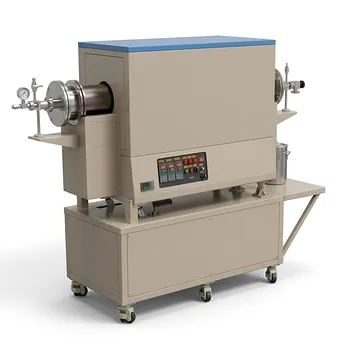
900°C Max Rotary Tube Furnace with 8 Inch 310S Alloy Tube and Optional Multi Zone Heating for Industrial Material Calcination
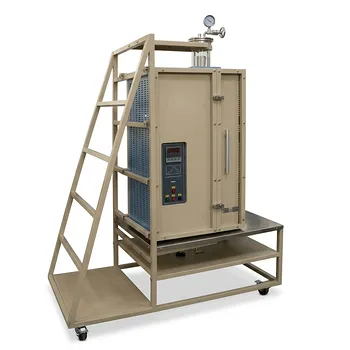
Split Vertical Tube Furnace with 1200C Quartz Tube and Stainless Steel Vacuum Flanges for Rapid Thermal Processing

High Temperature 1700C Tube Furnace with High Vacuum Turbomolecular Pump System and Multi Channel Mass Flow Controller Gas Mixer

1100C Tube Furnace with Vacuum Flange and Programmable Temperature Controller for Material Science and Industrial Heat Treatment

5 Inch Three Zone Rotary Tube Furnace with Integrated Gas Delivery System and 1200C Capability for Advanced Material CVD Processing

1200°C 5 Inch Vertical Quartz Tube Furnace with Stainless Steel Vacuum Flanges

1700C Hydrogen Gas Tube Furnace with 60mm Alumina Process Tube and Integrated Hydrogen Safety Detector

High Temperature 1700C Six Zone Split Tube Furnace with Alumina Tube and Water Cooled Flanges

Compact Vertical Split Quartz Tube Furnace with Stainless Steel Vacuum Flanges for Rapid Thermal Quenching and Controlled Atmosphere Material Processing

High Temperature 1700C Benchtop Tube Furnace with 5 Inch Heating Zone High Purity Alumina Tube and Vacuum Sealing Flanges

1200C High Throughput Multi Channel Tube Furnace with 50mm Quartz Tubes for Annealing and Material Phase Diagram Research

Three Zone Tube Furnace with 11 Inch or 15 Inch Quartz Tube and Hinged Flanges for Vacuum Atmosphere Heat Treatment

1800C High Temperature Compact Vacuum Tube Furnace with 60mm OD Alumina Tube and Kanthal MoSi2 Heating Elements

High Temperature 1700C Vertical Tube Furnace for Powder Spherification and Material Sintering
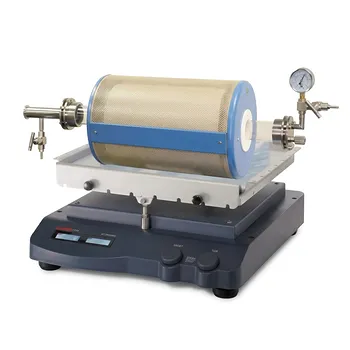
High Temperature Rocking Tube Furnace with Quartz Tube and Vacuum Flange for Materials Synthesis

High Temperature Automated 5 Inch Tube Furnace for Autonomous Material Research and Advanced Laboratory R&D
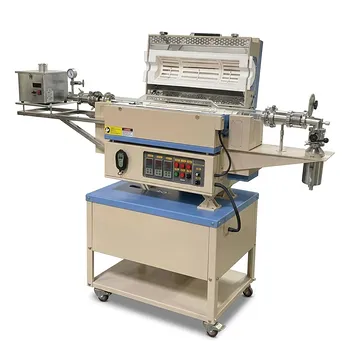
5 Inch Rotary Tube Furnace with Automatic Feeding and Receiving System 1200C Three Zone CVD Powder Processing