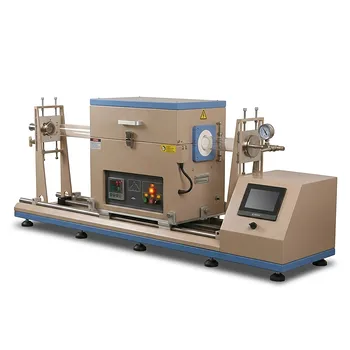
How does a tube furnace with programmable temperature control influence porous carbon? Optimize Microstructure Now.
Updated 3 months ago
A programmable tube furnace optimizes hierarchical porous carbon by providing precise control over heating kinetics and atmospheric composition, which prevents the structural collapse common in standard heating equipment. By strictly managing heating rates—typically between 3°C and 5°C per minute—these furnaces ensure a steady release of volatiles and the uniform alignment of carbon microcrystals. This precision facilitates the development of a balanced distribution of micropores and mesopores, resulting in a significantly higher specific surface area and improved ion transport efficiency.
Core Takeaway: The primary advantage of a programmable tube furnace lies in its ability to synchronize thermal energy with chemical reaction windows. This prevents the "flash" release of gases that destroys pore architecture, allowing for the engineering of specific carbon microstructures, such as hard carbon with large interlayer spacing.
Precise Control of Carbonization Kinetics
Regulating the Release of Volatiles
Standard furnaces often suffer from thermal overshoot or inconsistent ramping, which causes rapid gas evolution within the carbon precursor. A programmable tube furnace manages the kinetics of the carbonization reaction, ensuring that volatiles are released smoothly. This steady process prevents the internal pressure from rupturing the developing pore walls, maintaining the structural integrity of the carbon skeleton.
Optimizing Chemical Etching and Activation
During activation processes involving agents like potassium hydroxide (KOH), maintaining a uniform thermal field at specific temperatures (e.g., 700°C) is critical. The programmable furnace allows for specific residence times that ensure the chemical activator reacts thoroughly with the carbon atoms. This controlled etching is what transforms raw biomass into a complex, hierarchical network of pores.
Defining Pore Size Distribution
By utilizing multi-stage programming, researchers can execute complex sintering profiles that distinguish between low-temperature burnout and high-temperature carbonization. This control determines the growth of necks between particles and the final size of micropores within the material walls. Precise temperature management prevents the "closure" of pores that typically occurs during uncontrolled, rapid heating.
Structural Engineering at the Microscopic Level
Guiding Micro-architecture Formation
Programmable control allows for the coordination of heating curves with the decomposition windows of surface functional groups. This enables the suppression of soft carbon structures and guides the formation of hard carbon architectures. Such materials often feature large interlayer spacings (approximately 0.37 to 0.40 nm), which are essential for high-capacity energy storage, particularly in sodium-ion batteries.
Achieving High Specific Surface Area
The stability of the temperature gradient in a tube furnace ensures that the resulting material achieves an ultra-high specific surface area. By preventing the collapse of pore walls, the furnace enables the coexistence of micropores and mesopores. This hierarchical structure is the "gold standard" for supercapacitors, as it maximizes active sites while providing channels for rapid ion transport.
Atmospheric Isolation and Pyrolysis
Unlike standard muffle furnaces, tube furnaces provide a sealed environment for continuous injection of inert gases like argon or nitrogen. This oxygen-free environment is mandatory for true pyrolysis and aromatization. It prevents the direct combustion of the biomass, ensuring that the raw material is converted into functional carbon rather than ash.
Understanding the Trade-offs
Equipment Complexity and Cost
While programmable tube furnaces offer superior control, they require significant initial investment and specialized training compared to standard ovens. The complexity of programming multi-stage curves and managing gas flow rates adds layers of operational difficulty. Incorrectly calibrated sensors can lead to a false sense of security, resulting in batches that fail to meet structural specifications.
Throughput and Scalability Constraints
Tube furnaces generally have smaller chamber volumes than industrial batch furnaces, limiting the amount of material produced per cycle. The reliance on precise, slow heating rates (e.g., 3°C/min) also means that production cycles are significantly longer. While this is ideal for research and high-performance materials, it can become a bottleneck for high-volume manufacturing needs.
How to Apply This to Your Project
Recommendations Based on Material Goals
- If your primary focus is supercapacitor performance: Use a programmable rate of 5°C/min and a KOH activation stage at 700°C to maximize specific surface area and hierarchical porosity.
- If your primary focus is sodium-ion battery anodes: Prioritize multi-stage programming to control the solidification phase, aiming for a hard carbon structure with an interlayer spacing of at least 0.37 nm.
- If your primary focus is biomass-to-carbon conversion: Ensure a stable nitrogen protective atmosphere to facilitate aromatization reactions while preventing any oxygen-induced combustion.
By leveraging the precise thermal and atmospheric control of a programmable tube furnace, you can move beyond simple carbonization to true microscopic structural engineering.
Summary Table:
| Feature | Programmable Tube Furnace | Standard Heating Equipment |
|---|---|---|
| Heating Kinetics | Precise Ramping (3-5°C/min) | Inconsistent/High Overshoot |
| Atmosphere | Sealed Inert (Argon/Nitrogen) | Ambient/Poor Isolation |
| Pore Structure | Balanced Micro/Mesopores | Risk of Structural Collapse |
| Surface Area | Ultra-high Specific Area | Lower and Non-uniform |
| Application | Advanced Material Engineering | Basic Heat Treatment |
Precision Thermal Solutions for Your Research
Elevate your material science research with THERMUNITS, a leading manufacturer of high-temperature laboratory equipment. We provide the precise thermal control necessary for engineering hierarchical porous carbon and other advanced materials. Our comprehensive range of solutions includes:
- Advanced Furnaces: Muffle, Vacuum, Atmosphere, Tube, Rotary, and Hot Press models.
- Specialized Systems: CVD/PECVD systems, Dental Furnaces, and Vacuum Induction Melting (VIM) furnaces.
- Industrial R&D: Electric rotary kilns and high-performance Thermal Elements.
Don't let inconsistent heating compromise your results. Whether you are focusing on sodium-ion battery anodes or high-performance supercapacitors, our technical experts are ready to help you find the perfect thermal processing equipment.
Contact THERMUNITS today to request a quote or technical consultation
References
- Wen Kong, Wanju Zhang. Biological pretreatment with white rot fungi for preparing hierarchical porous carbon from Banlangen residues with high performance for supercapacitors and dye adsorption. DOI: 10.3389/fmicb.2024.1374974
Mentioned Products
- Vertical 1700C Vacuum and Atmosphere Tube Furnace with 80mm Alumina Tube
- Compact High Temperature 1600C Tube Furnace with 50mm Alumina Tube and Vacuum Flanges for Material Sintering
- 900°C Max Rotary Tube Furnace with 8 Inch 310S Alloy Tube and Optional Multi Zone Heating for Industrial Material Calcination
- Split Vertical Tube Furnace with 1200C Quartz Tube and Stainless Steel Vacuum Flanges for Rapid Thermal Processing
- High Temperature 1700C Tube Furnace with High Vacuum Turbomolecular Pump System and Multi Channel Mass Flow Controller Gas Mixer
People Also Ask
- How is an industrial-grade vertical tube furnace utilized in smelting leaching residues? Enhance Metal Recovery Efficiency
- What is the function of a laboratory-grade vertical tube furnace in fast pyrolysis? Optimize Composite Research.
- How does a vertical tube furnace facilitate thermoelectric alloy melting? Precision synthesis for material homogeneity.
- Why is a thermocouple sensor indispensable for monitoring the vertical tube furnace during gallium oxide nanowire production? Optimize VLS Growth
- What are the advantages of using a vertical tube furnace for crucible experiments simulating steel-slag interactions?

Tech Team · ThermUnits
Last updated on Jun 02, 2026
Related Products

Vertical 1700C Vacuum and Atmosphere Tube Furnace with 80mm Alumina Tube

Compact High Temperature 1600C Tube Furnace with 50mm Alumina Tube and Vacuum Flanges for Material Sintering
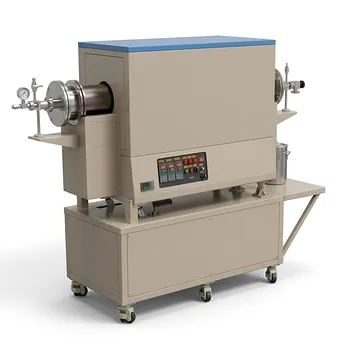
900°C Max Rotary Tube Furnace with 8 Inch 310S Alloy Tube and Optional Multi Zone Heating for Industrial Material Calcination
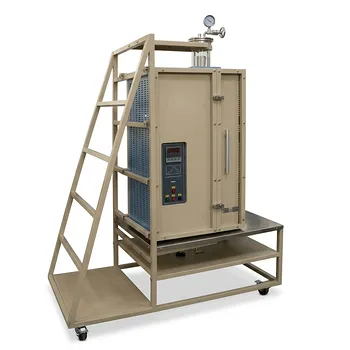
Split Vertical Tube Furnace with 1200C Quartz Tube and Stainless Steel Vacuum Flanges for Rapid Thermal Processing

High Temperature 1700C Tube Furnace with High Vacuum Turbomolecular Pump System and Multi Channel Mass Flow Controller Gas Mixer

1100C Tube Furnace with Vacuum Flange and Programmable Temperature Controller for Material Science and Industrial Heat Treatment

5 Inch Three Zone Rotary Tube Furnace with Integrated Gas Delivery System and 1200C Capability for Advanced Material CVD Processing

1700C Hydrogen Gas Tube Furnace with 60mm Alumina Process Tube and Integrated Hydrogen Safety Detector

1200°C 5 Inch Vertical Quartz Tube Furnace with Stainless Steel Vacuum Flanges

High Temperature 1700C Six Zone Split Tube Furnace with Alumina Tube and Water Cooled Flanges

Compact Vertical Split Quartz Tube Furnace with Stainless Steel Vacuum Flanges for Rapid Thermal Quenching and Controlled Atmosphere Material Processing

High Temperature 1700C Benchtop Tube Furnace with 5 Inch Heating Zone High Purity Alumina Tube and Vacuum Sealing Flanges

1200C High Throughput Multi Channel Tube Furnace with 50mm Quartz Tubes for Annealing and Material Phase Diagram Research

Three Zone Tube Furnace with 11 Inch or 15 Inch Quartz Tube and Hinged Flanges for Vacuum Atmosphere Heat Treatment

1800C High Temperature Compact Vacuum Tube Furnace with 60mm OD Alumina Tube and Kanthal MoSi2 Heating Elements

High Temperature 1700C Vertical Tube Furnace for Powder Spherification and Material Sintering
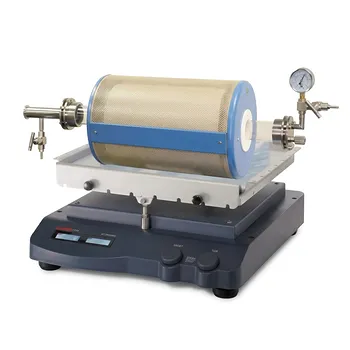
High Temperature Rocking Tube Furnace with Quartz Tube and Vacuum Flange for Materials Synthesis

High Temperature Automated 5 Inch Tube Furnace for Autonomous Material Research and Advanced Laboratory R&D
5 Inch Rotary Tube Furnace with Automatic Feeding and Receiving System 1200C Three Zone CVD Powder Processing