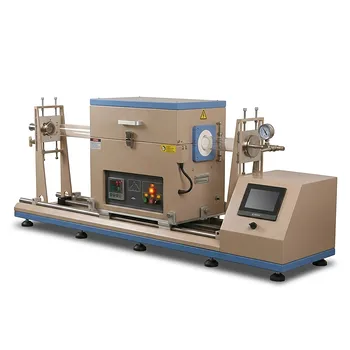
How does heat treatment in a tube furnace contribute to the formation of CoMoO4@rGO composite materials? Expert Synthesis
Updated 3 months ago
Heat treatment in a tube furnace is the essential transition phase that converts solvothermal precursors into a high-performance $CoMoO_4@rGO$ composite. By providing a precisely controlled high-temperature environment under a nitrogen-protected atmosphere, the furnace facilitates tight chemical bonding between the $CoMoO_4$ nanoparticles and the reduced graphene oxide (rGO) matrix, while simultaneously removing residual organic matter to maximize electrochemical activity.
The tube furnace acts as a controlled reactor that transforms loose material components into a stable, conductive 3D network. Its primary role is to manage the delicate balance between thermal reduction, organic purification, and interfacial bonding.
The Role of Controlled Atmosphere and Thermal Processing
Maintaining an Inert Environment
A tube furnace allows for the introduction of high-purity nitrogen or argon, creating an oxygen-free environment. This protection is critical because it prevents the oxidative loss of the graphene components and ensures the metal oxides do not undergo unintended deep oxidation.
Effective Removal of Organic Residues
The high-temperature calcination process, typically performed at 500 °C, effectively decomposes and removes residual organic matter left over from previous solvothermal reactions. This purification step is vital for uncovering the active sites of the $CoMoO_4$, which significantly enhances the electrochemical activity of the final material.
Precise Temperature Regulation
Consistency in material properties relies on the furnace’s ability to maintain a stable heating rate and holding duration. This precision ensures that the thermal energy is applied uniformly, preventing localized overheating that could lead to the aggregation of the $CoMoO_4$ nanostructures.
Engineering the Composite Structure
Facilitating Interfacial Bonding
The thermal energy provided by the furnace facilitates tight chemical bonding between the nanoscale $CoMoO_4$ and the rGO matrix. This strong interface is necessary for efficient charge transfer and ensures that the particles remain attached to the conductive support during repeated use.
Developing the 3D Conductive Network
By integrating the metal oxide with the carbon framework, the heat treatment establishes a stable three-dimensional conductive network. This architecture provides a continuous path for electron transport, which is essential for high-rate performance in energy storage applications.
Thermal Reduction of Graphene Oxide
The heat treatment serves as a secondary reduction step, removing oxygen-containing functional groups from the graphene oxide (GO) precursor. This repairs the $sp^2$ hybrid structure of the carbon framework, transforming it into highly conductive reduced graphene oxide (rGO) with improved mechanical toughness.
Understanding the Trade-offs
Temperature Sensitivity
If the calcination temperature is too low, organic residues may remain, and the chemical bonding between $CoMoO_4$ and rGO will be weak, leading to poor stability. Conversely, if the temperature is too high, the $CoMoO_4$ nanoparticles may undergo grain growth or sintering, reducing the surface area available for electrochemical reactions.
Atmospheric Purity Requirements
Even trace amounts of oxygen in the furnace tube can lead to the partial combustion of the rGO matrix. This degrades the conductive network and alters the stoichiometric balance of the $CoMoO_4$, highlighting the need for high-quality seals and high-purity gas supplies.
How to Apply This to Your Synthesis Goal
The success of your $CoMoO_4@rGO$ composite depends on aligning your furnace parameters with your specific performance requirements.
- If your primary focus is Maximum Conductivity: Prioritize a slightly higher reduction temperature and longer holding time to ensure the complete restoration of the graphene $sp^2$ network.
- If your primary focus is High Surface Area: Use a lower, strictly controlled calcination temperature (near 500 °C) to prevent the $CoMoO_4$ nanoparticles from coarsening.
- If your primary focus is Structural Longevity: Ensure a very slow cooling rate within the tube furnace to minimize internal stresses and promote stronger interfacial bonding between the components.
The tube furnace is the definitive tool for bridging the gap between raw chemical precursors and a sophisticated, electronically optimized composite material.
Summary Table:
| Feature | Function during Synthesis | Resulting Material Property |
|---|---|---|
| Inert Atmosphere | Prevents oxidative loss of graphene | High structural integrity & carbon purity |
| 500°C Calcination | Decomposes residual organic matter | Increased active sites & electrochemical activity |
| Thermal Reduction | Removes oxygen groups from GO | Restored $sp^2$ network & high electrical conductivity |
| Precise Temp Control | Prevents nanoparticle grain growth | Maintained high surface area & uniform structure |
Elevate Your Material Research with THERMUNITS
THERMUNITS is a leading manufacturer of high-performance laboratory equipment for material science and industrial R&D. Our precision tube furnaces offer the exact thermal stability and atmospheric control required to bridge the gap between raw precursors and sophisticated, electronically optimized composites like $CoMoO_4@rGO$.
From academic research to industrial production, we provide a comprehensive range of high-temperature solutions tailored to your needs:
- Advanced Furnaces: Muffle, Vacuum, Atmosphere, Tube, Rotary, and Hot Press furnaces.
- Specialized Systems: CVD/PECVD systems, Dental Furnaces, Electric Rotary Kilns, and Vacuum Induction Melting (VIM) furnaces.
- Quality Components: High-grade Thermal Elements and various laboratory heat treatment accessories.
Ready to optimize your thermal processing? Contact our experts today to discover how THERMUNITS can empower your next breakthrough!
References
- Ronggang Zhang, Qi‐Hui Wu. In Situ Synthesis of CoMoO4 Microsphere@rGO as a Matrix for High-Performance Li-S Batteries at Room and Low Temperatures. DOI: 10.3390/molecules29215146
Mentioned Products
- Vertical 1700C Vacuum and Atmosphere Tube Furnace with 80mm Alumina Tube
- Compact High Temperature 1600C Tube Furnace with 50mm Alumina Tube and Vacuum Flanges for Material Sintering
- 900°C Max Rotary Tube Furnace with 8 Inch 310S Alloy Tube and Optional Multi Zone Heating for Industrial Material Calcination
- Split Vertical Tube Furnace with 1200C Quartz Tube and Stainless Steel Vacuum Flanges for Rapid Thermal Processing
- High Temperature 1700C Tube Furnace with High Vacuum Turbomolecular Pump System and Multi Channel Mass Flow Controller Gas Mixer
People Also Ask
- How is an industrial-grade vertical tube furnace utilized in smelting leaching residues? Enhance Metal Recovery Efficiency
- What is the function of a laboratory-grade vertical tube furnace in fast pyrolysis? Optimize Composite Research.
- How does a vertical tube furnace facilitate thermoelectric alloy melting? Precision synthesis for material homogeneity.
- Why is a thermocouple sensor indispensable for monitoring the vertical tube furnace during gallium oxide nanowire production? Optimize VLS Growth
- What are the advantages of using a vertical tube furnace for crucible experiments simulating steel-slag interactions?

Tech Team · ThermUnits
Last updated on Jun 02, 2026
Related Products

Vertical 1700C Vacuum and Atmosphere Tube Furnace with 80mm Alumina Tube

Compact High Temperature 1600C Tube Furnace with 50mm Alumina Tube and Vacuum Flanges for Material Sintering
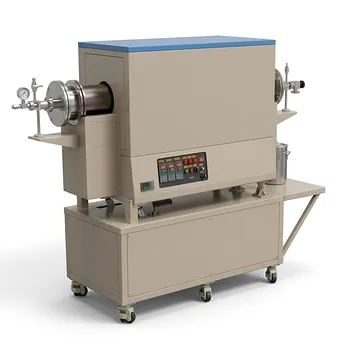
900°C Max Rotary Tube Furnace with 8 Inch 310S Alloy Tube and Optional Multi Zone Heating for Industrial Material Calcination
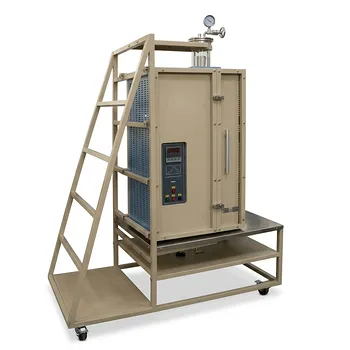
Split Vertical Tube Furnace with 1200C Quartz Tube and Stainless Steel Vacuum Flanges for Rapid Thermal Processing

High Temperature 1700C Tube Furnace with High Vacuum Turbomolecular Pump System and Multi Channel Mass Flow Controller Gas Mixer

1100C Tube Furnace with Vacuum Flange and Programmable Temperature Controller for Material Science and Industrial Heat Treatment
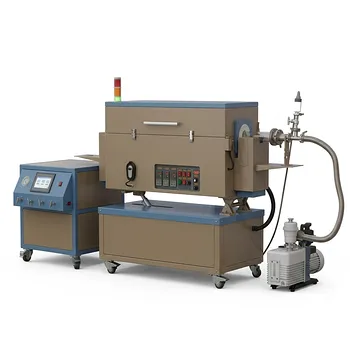
5 Inch Three Zone Rotary Tube Furnace with Integrated Gas Delivery System and 1200C Capability for Advanced Material CVD Processing

1200°C 5 Inch Vertical Quartz Tube Furnace with Stainless Steel Vacuum Flanges

High Temperature 1700C Six Zone Split Tube Furnace with Alumina Tube and Water Cooled Flanges
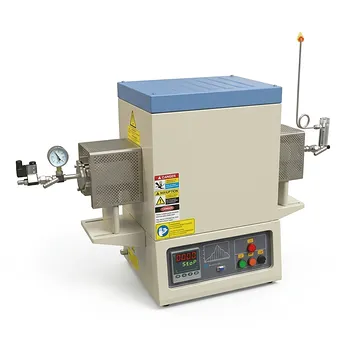
1700C Hydrogen Gas Tube Furnace with 60mm Alumina Process Tube and Integrated Hydrogen Safety Detector

Compact Vertical Split Quartz Tube Furnace with Stainless Steel Vacuum Flanges for Rapid Thermal Quenching and Controlled Atmosphere Material Processing

High Temperature 1700C Benchtop Tube Furnace with 5 Inch Heating Zone High Purity Alumina Tube and Vacuum Sealing Flanges
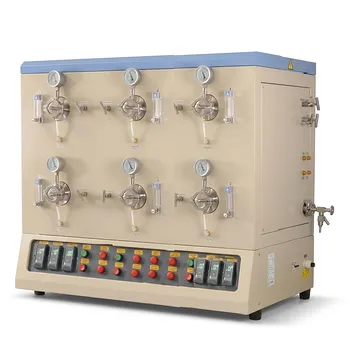
1200C High Throughput Multi Channel Tube Furnace with 50mm Quartz Tubes for Annealing and Material Phase Diagram Research
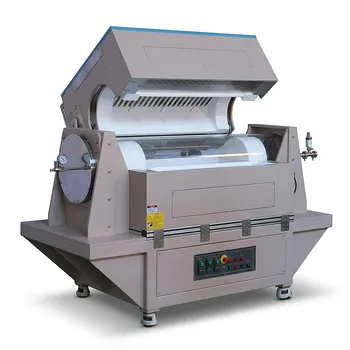
Three Zone Tube Furnace with 11 Inch or 15 Inch Quartz Tube and Hinged Flanges for Vacuum Atmosphere Heat Treatment

1800C High Temperature Compact Vacuum Tube Furnace with 60mm OD Alumina Tube and Kanthal MoSi2 Heating Elements

High Temperature 1700C Vertical Tube Furnace for Powder Spherification and Material Sintering
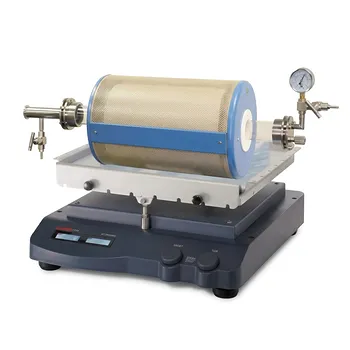
High Temperature Rocking Tube Furnace with Quartz Tube and Vacuum Flange for Materials Synthesis

High Temperature Automated 5 Inch Tube Furnace for Autonomous Material Research and Advanced Laboratory R&D
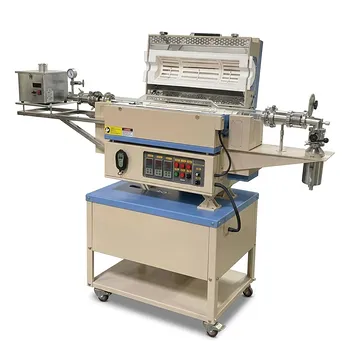
5 Inch Rotary Tube Furnace with Automatic Feeding and Receiving System 1200C Three Zone CVD Powder Processing