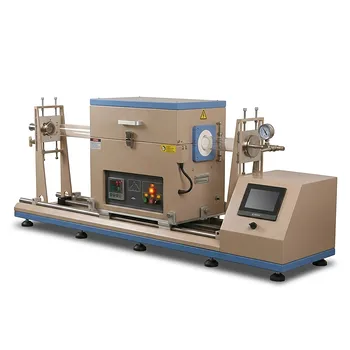
How is an industrial-grade tube furnace used to introduce oxygen vacancies into BiVO4 photoanodes? Thermal Reduction Guide
Updated 3 months ago
The introduction of oxygen vacancies into BiVO4 photoanodes using an industrial-grade tube furnace is achieved through a controlled thermal reduction process. By subjecting the material to a precise 450 °C isothermal environment under a continuous flow of pure nitrogen, the furnace facilitates the removal of lattice oxygen. This specific configuration allows for the formation of ordered vacancies across both the surface and bulk of the crystal while maintaining the structural integrity of the BiVO4 lattice.
The core mechanism of this process is the use of a stable, oxygen-free thermal environment to induce controlled defects. These oxygen vacancies serve as essential defect dipoles that enable subsequent polarization and improved photoelectrochemical performance.
The Mechanics of Thermal Reduction in Tube Furnaces
Precision Temperature Control at 450 °C
The tube furnace provides a stable isothermal environment that is critical for consistent vacancy formation. Maintaining a steady temperature of exactly 450 °C ensures there is sufficient thermal energy to liberate oxygen atoms without triggering unwanted phase changes.
The Role of the Pure Nitrogen Atmosphere
Operating under a pure nitrogen gas flow is the fundamental driver of the reduction process. By eliminating oxygen from the reaction chamber, the furnace creates a chemical potential gradient that forces oxygen out of the BiVO4 structure.
Precise Control of the Reaction Atmosphere
Industrial-grade furnaces allow for meticulous regulation of gas flow rates and pressure. This high level of control ensures that the reduction is uniform across the entire surface of the photoanode, preventing localized over-processing.
Structural Evolution of the BiVO4 Photoanode
Creating Ordered Surface and Bulk Vacancies
Unlike superficial treatments, the furnace process introduces ordered oxygen vacancies that penetrate into both the surface and the bulk of the material. This dual-layer defect distribution is vital for optimizing charge carrier transport throughout the photoanode.
Formation of Defect Dipoles
The vacancies created during the thermal soak act as defect dipoles. These dipoles are necessary for subsequent polarization steps, which help in the separation of electron-hole pairs during water splitting.
Preserving the Primary Crystal Lattice
A key technical advantage of this method is the ability to introduce defects without compromising the primary BiVO4 crystal lattice. The structural framework remains intact, ensuring the material retains its mechanical durability and semi-conductive properties.
Understanding the Trade-offs
The Risk of Lattice Degradation
If the temperature exceeds the specific 450 °C threshold or if the dwell time is too long, the material may suffer from lattice collapse. This destroys the catalyst's effectiveness and can lead to a complete loss of photoelectrochemical activity.
Dependency on Gas Purity
The process is highly sensitive to the purity of the nitrogen flow. Any trace oxygen contamination within the furnace will stall the reduction process, resulting in an insufficient density of oxygen vacancies.
Surface vs. Bulk Balance
While the furnace is excellent for depth, achieving the perfect ratio of surface-to-bulk vacancies requires precise timing. An imbalance can lead to recombination centers that actually decrease the efficiency of the photoanode.
How to Apply This to Your Project
When utilizing a tube furnace for BiVO4 modification, your approach should be dictated by your specific performance requirements.
- If your primary focus is maximizing charge separation: Ensure the furnace is calibrated for a perfect 450 °C soak to create the deep bulk vacancies required for defect dipoles.
- If your primary focus is maintaining material longevity: Prioritize the use of high-purity (99.999%) nitrogen to ensure the lattice is not prematurely degraded by uncontrolled oxidation/reduction cycles.
- If your primary focus is surface reactivity: Focus on the ramp-up and cool-down rates of the furnace to fine-tune the density of vacancies specifically at the photoanode-electrolyte interface.
By mastering the thermal environment of the tube furnace, you can precisely engineer the defect chemistry of BiVO4 to unlock its full potential in photoelectrochemical applications.
Summary Table:
| Parameter | Setting/Requirement | Key Benefit |
|---|---|---|
| Temperature | Stable 450 °C | Provides energy for vacancy formation without lattice collapse. |
| Atmosphere | Pure Nitrogen (N2) | Creates a chemical potential gradient to facilitate oxygen removal. |
| Gas Control | Precise Flow Regulation | Ensures uniform vacancy distribution across surface and bulk layers. |
| Primary Effect | Ordered Vacancies | Forms defect dipoles essential for electron-hole pair separation. |
| Structural Integrity | Lattice Preservation | Maintains the material's durability and semi-conductive properties. |
Optimize Your Material Research with THERMUNITS
Achieving precise defect engineering in advanced materials like BiVO4 requires world-class thermal stability and atmosphere control. THERMUNITS is a leading manufacturer of high-temperature laboratory equipment specifically designed for material science and industrial R&D.
We offer a comprehensive range of thermal processing solutions to meet your exact specifications, including:
- Tube & Atmosphere Furnaces for precise gas-controlled reduction.
- Vacuum, Muffle, and Rotary Furnaces for diverse heat treatment needs.
- CVD/PECVD Systems for advanced thin-film deposition.
- Hot Press & Vacuum Induction Melting (VIM) Furnaces for specialized metallurgy.
Ready to enhance your lab's efficiency and research accuracy? Contact our experts today to discuss how our high-performance furnace systems can unlock the full potential of your photoelectrochemical applications.
References
- Xianlong Li, Lianzhou Wang. Oxygen vacancy induced defect dipoles in BiVO4 for photoelectrocatalytic partial oxidation of methane. DOI: 10.1038/s41467-024-53426-8
Mentioned Products
- Vertical 1700C Vacuum and Atmosphere Tube Furnace with 80mm Alumina Tube
- Compact High Temperature 1600C Tube Furnace with 50mm Alumina Tube and Vacuum Flanges for Material Sintering
- 900°C Max Rotary Tube Furnace with 8 Inch 310S Alloy Tube and Optional Multi Zone Heating for Industrial Material Calcination
- Split Vertical Tube Furnace with 1200C Quartz Tube and Stainless Steel Vacuum Flanges for Rapid Thermal Processing
- High Temperature 1700C Tube Furnace with High Vacuum Turbomolecular Pump System and Multi Channel Mass Flow Controller Gas Mixer
People Also Ask
- How is an industrial-grade vertical tube furnace utilized in smelting leaching residues? Enhance Metal Recovery Efficiency
- What is the function of a laboratory-grade vertical tube furnace in fast pyrolysis? Optimize Composite Research.
- How does a vertical tube furnace facilitate thermoelectric alloy melting? Precision synthesis for material homogeneity.
- Why is a thermocouple sensor indispensable for monitoring the vertical tube furnace during gallium oxide nanowire production? Optimize VLS Growth
- What are the advantages of using a vertical tube furnace for crucible experiments simulating steel-slag interactions?

Tech Team · ThermUnits
Last updated on Jun 03, 2026
Related Products

Vertical 1700C Vacuum and Atmosphere Tube Furnace with 80mm Alumina Tube

Compact High Temperature 1600C Tube Furnace with 50mm Alumina Tube and Vacuum Flanges for Material Sintering
900°C Max Rotary Tube Furnace with 8 Inch 310S Alloy Tube and Optional Multi Zone Heating for Industrial Material Calcination
Split Vertical Tube Furnace with 1200C Quartz Tube and Stainless Steel Vacuum Flanges for Rapid Thermal Processing

High Temperature 1700C Tube Furnace with High Vacuum Turbomolecular Pump System and Multi Channel Mass Flow Controller Gas Mixer
1100C Tube Furnace with Vacuum Flange and Programmable Temperature Controller for Material Science and Industrial Heat Treatment
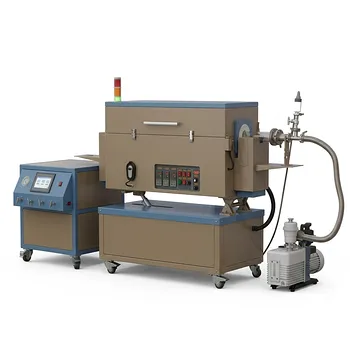
5 Inch Three Zone Rotary Tube Furnace with Integrated Gas Delivery System and 1200C Capability for Advanced Material CVD Processing
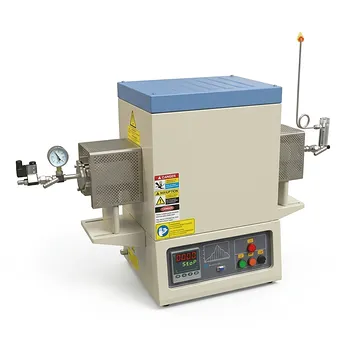
1700C Hydrogen Gas Tube Furnace with 60mm Alumina Process Tube and Integrated Hydrogen Safety Detector

1200°C 5 Inch Vertical Quartz Tube Furnace with Stainless Steel Vacuum Flanges

High Temperature 1700C Six Zone Split Tube Furnace with Alumina Tube and Water Cooled Flanges

Compact Vertical Split Quartz Tube Furnace with Stainless Steel Vacuum Flanges for Rapid Thermal Quenching and Controlled Atmosphere Material Processing

High Temperature 1700C Benchtop Tube Furnace with 5 Inch Heating Zone High Purity Alumina Tube and Vacuum Sealing Flanges

1800C High Temperature Compact Vacuum Tube Furnace with 60mm OD Alumina Tube and Kanthal MoSi2 Heating Elements
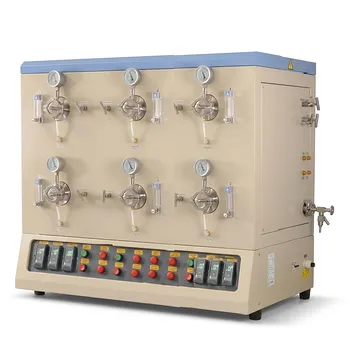
1200C High Throughput Multi Channel Tube Furnace with 50mm Quartz Tubes for Annealing and Material Phase Diagram Research
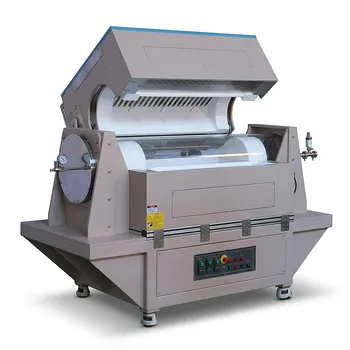
Three Zone Tube Furnace with 11 Inch or 15 Inch Quartz Tube and Hinged Flanges for Vacuum Atmosphere Heat Treatment

High Temperature 1700C Vertical Tube Furnace for Powder Spherification and Material Sintering
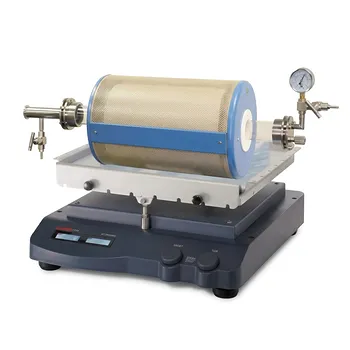
High Temperature Rocking Tube Furnace with Quartz Tube and Vacuum Flange for Materials Synthesis

High Temperature Automated 5 Inch Tube Furnace for Autonomous Material Research and Advanced Laboratory R&D
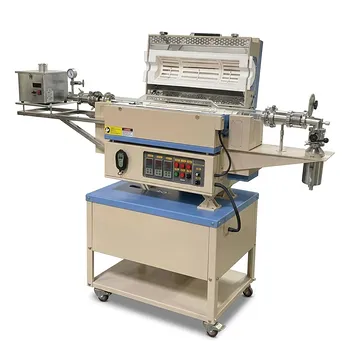
5 Inch Rotary Tube Furnace with Automatic Feeding and Receiving System 1200C Three Zone CVD Powder Processing