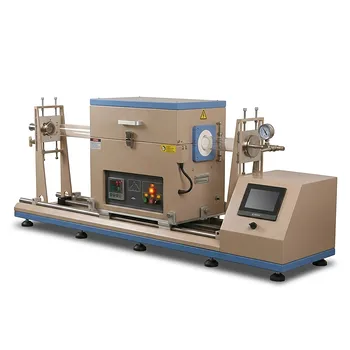
How is the in-situ growth of MoS2 achieved within a tube furnace for Co,N-C@MoS2? Expert Synthesis Guide
Updated 3 months ago
In-situ growth of molybdenum disulfide ($MoS_2$) within $Co,N-C$ composites is primarily achieved through the thermal decomposition of a single-source precursor. This process utilizes a laboratory tube furnace to maintain a precise temperature of $500^\circ C$ under a controlled hydrogen/argon ($H_2/Ar$) mixed atmosphere. The furnace facilitates a vapor deposition process that allows $MoS_2$ to nucleate and anchor directly onto the surface of the $Co,N-C$ carrier.
The core takeaway is that the tube furnace acts as a controlled reactor to decompose ammonium tetrathiomolybdate ($(NH_4)_2MoS_4$) directly onto a carbon-based substrate. This in-situ method ensures a uniform distribution of $MoS_2$ nanoparticles and maximizes the exposure of active edge sites, which are essential for high-performance electrocatalysis.
The Mechanism of In-Situ Growth
Thermal Decomposition of the Precursor
The process begins with ammonium tetrathiomolybdate ($(NH_4)_2MoS_4$), which serves as the source for both molybdenum and sulfur. When the tube furnace reaches $500^\circ C$, this compound undergoes thermal decomposition, breaking down into its constituent elements in a gaseous or semi-gaseous state.
Vapor Deposition and Nucleation
As the precursor decomposes, it undergoes a vapor deposition process within the furnace's quartz tube. The $MoS_2$ molecules nucleate directly on the $Co,N-C$ carrier, ensuring that the nanoparticles are intimately and uniformly "anchored" to the substrate rather than just physically mixed.
Formation of Active Edge Sites
This specific growth method results in a layered structure of $MoS_2$. Because the growth is restricted by the presence of the carbon carrier, it encourages the formation of abundant edge active sites, which are significantly more catalytically active than the basal planes of the material.
The Role of the Laboratory Tube Furnace
Precise Temperature Regulation
The tube furnace is critical because it provides a stable thermal zone necessary for consistent decomposition. Maintaining the temperature strictly at $500^\circ C$ prevents the over-aggregation of $MoS_2$ particles while ensuring complete conversion from the precursor.
Controlled Atmospheric Environment
The use of a hydrogen/argon ($H_2/Ar$) mix is vital for the chemical environment. The argon acts as an inert carrier gas to prevent oxidation, while the hydrogen can assist in the reduction process and influence the final crystalline quality of the $MoS_2$ layers.
Axial Gradient and Uniformity
The horizontal design of the furnace allows for the establishment of a controlled thermal gradient. This ensures that the gas-phase reactions occur uniformly across the entire batch of $Co,N-C$ substrate, leading to a homogenous composite material.
Understanding the Trade-offs
Temperature Sensitivity
While $500^\circ C$ is ideal for this specific composite, higher temperatures (often $600^\circ C$ to $800^\circ C$) are sometimes used in other $MoS_2$ syntheses to improve crystallinity. However, excessive heat can lead to the "sintering" or clumping of nanoparticles, which reduces the surface area and hides the active edge sites.
Precursor Selection
Using a single-source precursor like $(NH_4)_2MoS_4$ simplifies the process but offers less control over the sulfur-to-molybdenum ratio compared to dual-source CVD (using $MoO_3$ and Sulfur powder). The dual-source method, however, is significantly more complex to calibrate within a standard tube furnace.
Interfacial Resistance
In-situ growth generally reduces interfacial resistance between the $MoS_2$ and the carbon substrate compared to post-synthesis mixing. However, if the carbon carrier is not properly prepared, the $MoS_2$ may not anchor effectively, leading to poor durability during electrocatalytic cycles.
Applying This to Your Project
Recommendations for Synthesis
- If your primary focus is maximizing catalytic activity: Stick to the $500^\circ C$ in-situ decomposition method to ensure the highest density of active edge sites.
- If your primary focus is long-term structural stability: Ensure the $Co,N-C$ substrate is thoroughly cleaned and activated before deposition to promote stronger interfacial bonding.
- If your primary focus is high crystalline purity: You may need to experiment with a secondary post-treatment "annealing" step in the furnace at slightly higher temperatures ($600^\circ C+$) under a pure nitrogen atmosphere.
The precise control of the tube furnace's thermal and atmospheric environment is the definitive factor in transforming raw precursors into high-performance $Co,N-C@MoS_2$ electrocatalysts.
Summary Table:
| Parameter | Specification | Role in Synthesis |
|---|---|---|
| Precursor | $(NH_4)_2MoS_4$ | Single-source for Mo and S decomposition |
| Temperature | $500^\circ C$ | Ensures decomposition without nanoparticle sintering |
| Atmosphere | $H_2/Ar$ Mix | Prevents oxidation and controls crystalline quality |
| Substrate | $Co,N-C$ | Provides anchoring sites for uniform deposition |
| Key Outcome | Layered $MoS_2$ | Maximizes active edge sites for catalysis |
Elevate Your Material Research with THERMUNITS
Achieving the precise thermal and atmospheric conditions required for advanced in-situ growth like $Co,N-C@MoS_2$ composites demands high-performance equipment. THERMUNITS is a leading manufacturer specializing in high-temperature laboratory solutions for material science and industrial R&D.
We provide the precision tools necessary for consistent, reproducible results, including:
- Tube & Rotary Furnaces: Ideal for vapor deposition and controlled in-situ synthesis.
- Vacuum, Atmosphere, & Muffle Furnaces: For versatile heat treatment requirements.
- CVD/PECVD Systems: Advanced setups for thin-film and 2D material growth.
- Specialized Equipment: Including Hot Press furnaces, Dental Furnaces, Vacuum Induction Melting (VIM), and high-quality Thermal Elements.
Ready to optimize your laboratory's efficiency and research outcomes? Contact us today to find your ideal thermal solution and leverage our expertise in high-temperature engineering.
References
- Tianming Wang, Shenghuang Lin. In Situ Growth of MoS<sub>2</sub> Onto Co‐Based MOF Derivatives Toward High‐Efficiency Quantum Dot‐Sensitized Solar Cells. DOI: 10.1002/advs.202406476
Mentioned Products
- Vertical 1700C Vacuum and Atmosphere Tube Furnace with 80mm Alumina Tube
- Compact High Temperature 1600C Tube Furnace with 50mm Alumina Tube and Vacuum Flanges for Material Sintering
- 900°C Max Rotary Tube Furnace with 8 Inch 310S Alloy Tube and Optional Multi Zone Heating for Industrial Material Calcination
- Split Vertical Tube Furnace with 1200C Quartz Tube and Stainless Steel Vacuum Flanges for Rapid Thermal Processing
- High Temperature 1700C Tube Furnace with High Vacuum Turbomolecular Pump System and Multi Channel Mass Flow Controller Gas Mixer
People Also Ask
- How is an industrial-grade vertical tube furnace utilized in smelting leaching residues? Enhance Metal Recovery Efficiency
- What is the function of a laboratory-grade vertical tube furnace in fast pyrolysis? Optimize Composite Research.
- How does a vertical tube furnace facilitate thermoelectric alloy melting? Precision synthesis for material homogeneity.
- Why is a thermocouple sensor indispensable for monitoring the vertical tube furnace during gallium oxide nanowire production? Optimize VLS Growth
- What are the advantages of using a vertical tube furnace for crucible experiments simulating steel-slag interactions?

Tech Team · ThermUnits
Last updated on Jun 02, 2026
Related Products

Vertical 1700C Vacuum and Atmosphere Tube Furnace with 80mm Alumina Tube

Compact High Temperature 1600C Tube Furnace with 50mm Alumina Tube and Vacuum Flanges for Material Sintering
900°C Max Rotary Tube Furnace with 8 Inch 310S Alloy Tube and Optional Multi Zone Heating for Industrial Material Calcination
Split Vertical Tube Furnace with 1200C Quartz Tube and Stainless Steel Vacuum Flanges for Rapid Thermal Processing

High Temperature 1700C Tube Furnace with High Vacuum Turbomolecular Pump System and Multi Channel Mass Flow Controller Gas Mixer

1100C Tube Furnace with Vacuum Flange and Programmable Temperature Controller for Material Science and Industrial Heat Treatment

5 Inch Three Zone Rotary Tube Furnace with Integrated Gas Delivery System and 1200C Capability for Advanced Material CVD Processing

1700C Hydrogen Gas Tube Furnace with 60mm Alumina Process Tube and Integrated Hydrogen Safety Detector

1200°C 5 Inch Vertical Quartz Tube Furnace with Stainless Steel Vacuum Flanges

High Temperature 1700C Six Zone Split Tube Furnace with Alumina Tube and Water Cooled Flanges

Compact Vertical Split Quartz Tube Furnace with Stainless Steel Vacuum Flanges for Rapid Thermal Quenching and Controlled Atmosphere Material Processing

High Temperature 1700C Benchtop Tube Furnace with 5 Inch Heating Zone High Purity Alumina Tube and Vacuum Sealing Flanges

1200C High Throughput Multi Channel Tube Furnace with 50mm Quartz Tubes for Annealing and Material Phase Diagram Research

Three Zone Tube Furnace with 11 Inch or 15 Inch Quartz Tube and Hinged Flanges for Vacuum Atmosphere Heat Treatment

1800C High Temperature Compact Vacuum Tube Furnace with 60mm OD Alumina Tube and Kanthal MoSi2 Heating Elements

High Temperature 1700C Vertical Tube Furnace for Powder Spherification and Material Sintering
High Temperature Rocking Tube Furnace with Quartz Tube and Vacuum Flange for Materials Synthesis

High Temperature Automated 5 Inch Tube Furnace for Autonomous Material Research and Advanced Laboratory R&D
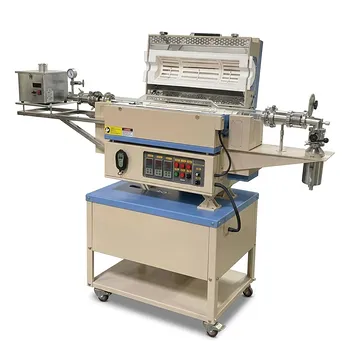
5 Inch Rotary Tube Furnace with Automatic Feeding and Receiving System 1200C Three Zone CVD Powder Processing