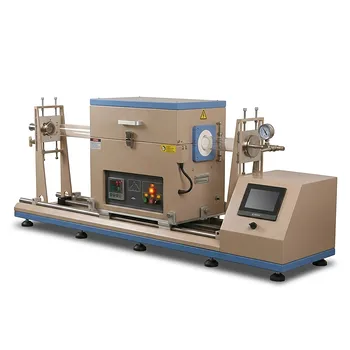
What advantages does a tube furnace provide for biogas DRM and CDM? Precision Control for Superior Lab Results
Updated 3 months ago
A tube furnace is the preferred instrument for biogas dry reforming (DRM) and methane decomposition (CDM) due to its ability to maintain a highly stable thermal field and a strictly controlled atmosphere. In the 700–1100 °C range required for these reactions, it ensures uniform heating of the catalyst bed, which is essential for studying endothermic kinetics and the synthesis of carbon nanotubes.
Core Takeaway: Tube furnaces provide the thermal stability and atmospheric isolation necessary to prevent catalyst oxidation and sintering while ensuring precise kinetic control. This makes them superior to open-air or less uniform heating methods for high-temperature biogas processing.
Precision Thermal Management for Endothermic Reactions
Ensuring Uniformity Across the Catalyst Bed
Biogas dry reforming and methane decomposition are highly endothermic, meaning they require consistent energy input to maintain reaction rates. A tube furnace provides a stable high-temperature thermal field that ensures the entire catalyst bed remains at the target temperature. This uniformity prevents cold spots that could lead to incomplete conversion or localized carbon deposition.
Programmable Kinetic Control
The use of precision programmable control systems allows researchers to execute specific heating rates, such as 5°C/min. This level of control is critical for regulating reaction kinetics and ensuring the steady development of pore structures in catalyst supports. Stable heating curves prevent the premature closure of pores, which is a common failure point in less sophisticated heating methods.
High-Temperature Stability
DRM and CDM typically operate in the 700–1100 °C range, where many heating elements struggle with longevity or stability. Tube furnaces are engineered to maintain structural integrity and temperature accuracy at these extremes. This allows for long-duration experiments necessary to test catalyst deactivation and lifetime.
Advanced Atmospheric Control and Catalyst Protection
Facilitating Catalyst Activation
Before DRM or CDM can begin, catalysts often require hydrogen (H2) reduction activation. The sealed environment of a tube furnace allows for the safe and continuous introduction of reducing gases. This ensures the metal active sites are fully prepared and optimized before the biogas feed is introduced.
Prevention of Oxidation and Contamination
The superior sealing capabilities of a tube furnace allow it to operate under high vacuum or specific protective gases like Argon and Nitrogen. This isolation ensures that catalysts and carbon products are not contaminated by oxygen or moisture. By maintaining an oxygen-free environment, the furnace prevents the biomass or catalyst from oxidizing prematurely at high temperatures.
Managing Dynamic Gas Flow
The elongated reaction space of the tube is ideal for controlling the residence time and flow direction of reaction gases. This design allows for a steady state to be reached more quickly and accurately than in batch-style reactors. It also supports the efficient removal of byproducts, which is essential for accurate kinetic modeling.
Enhancing Material Synthesis and Carbon Quality
Narrowing Particle Size Distribution
In methane decomposition, the quality of the resulting carbon (such as carbon nanotubes or nanoparticles) is highly dependent on temperature stability. The tube furnace’s ability to inhibit the coarsening of nanoparticles results in a much narrower particle size distribution. This prevents excessive sintering and agglomeration, ensuring a high specific surface area for the produced materials.
Split-Open Design for Rapid Inspection
Many modern tube furnaces feature a split-open design, which significantly eases the installation and debugging of reactor piping. This feature also allows for rapid cooling after an experiment is concluded. Rapid cooling is vital for "freezing" the state of the catalyst and carbon products for post-reaction analysis.
Understanding the Trade-offs
While tube furnaces offer unmatched precision, they do have limitations compared to industrial-scale reactors. They are primarily bench-top instruments designed for research, meaning they have a limited throughput for large-scale fuel production.
Furthermore, the quartz or alumina tubes used in these furnaces are susceptible to thermal shock if cooled too rapidly without using a split-furnace design. Users must also be diligent about seal maintenance at the tube ends, as high-temperature runs can degrade gaskets, potentially compromising the inert atmosphere.
How to Apply This to Your Project
Choosing the Right Setup
- If your primary focus is kinetic modeling: Utilize a programmable tube furnace to strictly control heating rates and ensure a uniform thermal field across the catalyst bed.
- If your primary focus is carbon nanotube (CNT) growth: Prioritize a system with precise gas flow control to manage the residence time of methane within the hot zone.
- If your primary focus is catalyst durability testing: Opt for a furnace with high-grade alumina tubing and robust seals to handle long-duration, high-temperature runs without atmospheric leakage.
By leveraging the precise thermal and atmospheric control of a tube furnace, researchers can transform biogas processing from a variable process into a highly repeatable scientific standard.
Summary Table:
| Key Feature | Benefit for DRM/CDM Research | Impact on Experimental Outcomes |
|---|---|---|
| Thermal Uniformity | Stable 700–1100 °C thermal field | Prevents cold spots and ensures complete conversion. |
| Atmospheric Isolation | Sealed environment for H2, Ar, or N2 | Protects catalysts from oxidation and contamination. |
| Programmable Kinetics | Precise control of heating rates | Regulates catalyst pore structures and reaction rates. |
| Split-Open Design | Rapid cooling and easy maintenance | "Freezes" catalyst states for accurate post-analysis. |
| Flow Management | Controlled residence time of gases | Enhances kinetic modeling and byproduct removal. |
Accelerate Your Material Science Research with THERMUNITS
Achieving repeatable success in biogas dry reforming (DRM) and methane decomposition (CDM) requires specialized thermal equipment that offers absolute precision. THERMUNITS is a leading manufacturer of high-temperature laboratory equipment, providing the advanced solutions necessary for material science and industrial R&D.
Our comprehensive range of thermal processing equipment includes:
- Tube and Rotary Furnaces for precise gas-solid reactions.
- CVD/PECVD Systems for advanced carbon nanotube synthesis.
- Muffle, Vacuum, Atmosphere, and Hot Press Furnaces for diverse heat treatments.
- Dental Furnaces, Electric Rotary Kilns, and Vacuum Induction Melting (VIM) systems.
Don't let thermal instability compromise your research results. Partner with THERMUNITS to access durable, high-performance equipment designed for the most demanding laboratory environments.
Ready to upgrade your laboratory setup? Contact our technical experts today to find the perfect furnace solution for your specific application.
References
- Nonthicha Sae-tang, Sakhon Ratchahat. Simultaneous production of syngas and carbon nanotubes from CO2/CH4 mixture over high-performance NiMo/MgO catalyst. DOI: 10.1038/s41598-024-66938-6
Mentioned Products
- Vertical 1700C Vacuum and Atmosphere Tube Furnace with 80mm Alumina Tube
- Compact High Temperature 1600C Tube Furnace with 50mm Alumina Tube and Vacuum Flanges for Material Sintering
- 900°C Max Rotary Tube Furnace with 8 Inch 310S Alloy Tube and Optional Multi Zone Heating for Industrial Material Calcination
- Split Vertical Tube Furnace with 1200C Quartz Tube and Stainless Steel Vacuum Flanges for Rapid Thermal Processing
- High Temperature 1700C Tube Furnace with High Vacuum Turbomolecular Pump System and Multi Channel Mass Flow Controller Gas Mixer
People Also Ask
- How is an industrial-grade vertical tube furnace utilized in smelting leaching residues? Enhance Metal Recovery Efficiency
- What is the function of a laboratory-grade vertical tube furnace in fast pyrolysis? Optimize Composite Research.
- How does a vertical tube furnace facilitate thermoelectric alloy melting? Precision synthesis for material homogeneity.
- Why is a thermocouple sensor indispensable for monitoring the vertical tube furnace during gallium oxide nanowire production? Optimize VLS Growth
- What are the advantages of using a vertical tube furnace for crucible experiments simulating steel-slag interactions?

Tech Team · ThermUnits
Last updated on Jun 03, 2026
Related Products

Vertical 1700C Vacuum and Atmosphere Tube Furnace with 80mm Alumina Tube

Compact High Temperature 1600C Tube Furnace with 50mm Alumina Tube and Vacuum Flanges for Material Sintering
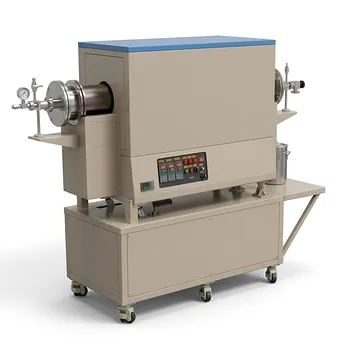
900°C Max Rotary Tube Furnace with 8 Inch 310S Alloy Tube and Optional Multi Zone Heating for Industrial Material Calcination
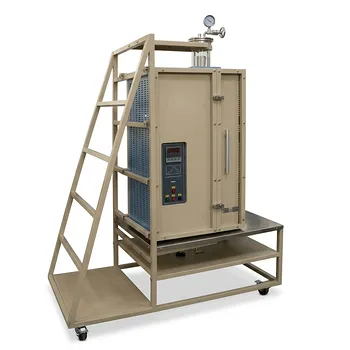
Split Vertical Tube Furnace with 1200C Quartz Tube and Stainless Steel Vacuum Flanges for Rapid Thermal Processing

High Temperature 1700C Tube Furnace with High Vacuum Turbomolecular Pump System and Multi Channel Mass Flow Controller Gas Mixer

1100C Tube Furnace with Vacuum Flange and Programmable Temperature Controller for Material Science and Industrial Heat Treatment

5 Inch Three Zone Rotary Tube Furnace with Integrated Gas Delivery System and 1200C Capability for Advanced Material CVD Processing

1200°C 5 Inch Vertical Quartz Tube Furnace with Stainless Steel Vacuum Flanges

1700C Hydrogen Gas Tube Furnace with 60mm Alumina Process Tube and Integrated Hydrogen Safety Detector

High Temperature 1700C Six Zone Split Tube Furnace with Alumina Tube and Water Cooled Flanges

Compact Vertical Split Quartz Tube Furnace with Stainless Steel Vacuum Flanges for Rapid Thermal Quenching and Controlled Atmosphere Material Processing

High Temperature 1700C Benchtop Tube Furnace with 5 Inch Heating Zone High Purity Alumina Tube and Vacuum Sealing Flanges

1200C High Throughput Multi Channel Tube Furnace with 50mm Quartz Tubes for Annealing and Material Phase Diagram Research

Three Zone Tube Furnace with 11 Inch or 15 Inch Quartz Tube and Hinged Flanges for Vacuum Atmosphere Heat Treatment

1800C High Temperature Compact Vacuum Tube Furnace with 60mm OD Alumina Tube and Kanthal MoSi2 Heating Elements

High Temperature 1700C Vertical Tube Furnace for Powder Spherification and Material Sintering
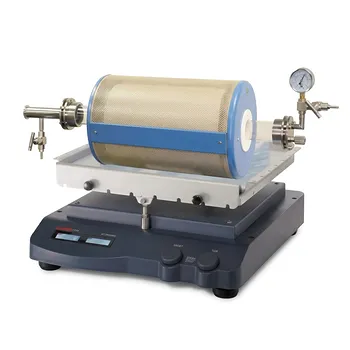
High Temperature Rocking Tube Furnace with Quartz Tube and Vacuum Flange for Materials Synthesis

High Temperature Automated 5 Inch Tube Furnace for Autonomous Material Research and Advanced Laboratory R&D
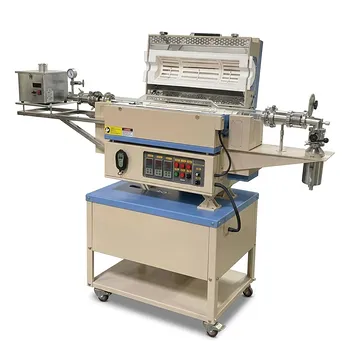
5 Inch Rotary Tube Furnace with Automatic Feeding and Receiving System 1200C Three Zone CVD Powder Processing