What atmosphere control capabilities do tube furnaces provide? Master Precision Gas & Vacuum Environments for R&D.
Updated 5 months ago
Tube furnaces provide a sealed, highly controllable thermal environment that allows for material processing under conditions ranging from high vacuum to precise gas mixtures. By utilizing gas-tight end seals and mass-flow controllers (MFCs), these systems isolate samples from ambient air, enabling specialized reactions such as chemical vapor deposition (CVD), anaerobic pyrolysis, and high-purity annealing.
Tube furnaces function as closed-system reactors that decouple thermal energy from the ambient atmosphere. This capability allows researchers to precisely manipulate chemical potentials—preventing material degradation or facilitating specific phase changes—by regulating gas composition, purity, and pressure.
Essential Atmosphere Types for Material Processing
Inert and Protective Environments
The most common use of atmosphere control is the displacement of oxygen and moisture using inert gases like high-purity argon or nitrogen. This prevents oxidation and nitridation of sensitive materials, such as silicon or carbon precursors, during high-temperature cycles.
Reactive and Reducing Atmospheres
Tube furnaces can introduce reducing gases, such as hydrogen mixtures, to remove oxygen from metal oxides or to facilitate carbonization. Conversely, oxidizing environments using air or pure oxygen are employed for specialized chemical synthesis and the purification of inorganic compounds.
Vacuum and Low-Pressure Capabilities
Integrated vacuum pumping systems allow the furnace to operate under high vacuum or controlled low-pressure conditions. This is critical for degassing materials, preventing contamination at a sub-ppm level, and supporting specialized processes like Chemical Vapor Transport.
Engineering the Controlled Environment
Sealing and Isolation Mechanisms
The integrity of the atmosphere depends on gas-tight end seals that cap the process tube. These seals ensure that the internal environment remains isolated from the external atmosphere, which is vital for maintaining the stability of the gas chemistry at temperatures exceeding 1500°C.
Precision Gas Delivery and Monitoring
Mass-flow controllers (MFCs) provide exact regulation of gas input, allowing for stable flow rates or the creation of specific gas blends. For high-stakes R&D, these systems are often compatible with oxygen sensors and gas analyzers to verify that impurity levels remain within acceptable thresholds.
Uniform Radial Heating Dynamics
The cylindrical geometry of the tube furnace provides highly uniform radial heating. This uniformity is essential for gas-solid heterogeneous reactions, ensuring that the gas interacts consistently with the sample surface across the entire heated zone.
Understanding Technical Trade-offs and Limitations
Sealing Integrity vs. Pressure Extremes
While tube furnaces excel at maintaining specific gas flows, they are generally not designed for high-pressure operation. Attempting to over-pressurize a quartz or ceramic tube can lead to catastrophic failure; conversely, achieving ultra-high vacuum requires specialized seals and high-performance pumping stations.
Gas Purity vs. Tube Material Interactions
The material of the furnace tube (e.g., alumina, quartz) can sometimes react with the atmosphere at extreme temperatures. For example, certain reducing atmospheres may strip oxygen from ceramic tubes, potentially contaminating the sample or degrading the tube's structural integrity over time.
Selecting the Optimal Control Strategy
To achieve the best results in your thermal processing, you must align your atmosphere control strategy with your specific material requirements and reaction goals.
- If your primary focus is preventing oxidation: Use a high-purity argon purge combined with gas-tight seals to maintain an inert environment throughout the heating and cooling cycles.
- If your primary focus is chemical synthesis or CVD: Implement a multi-channel mass-flow controller system to precisely blend reactive gases and maintain stable flow dynamics.
- If your primary focus is anaerobic pyrolysis: Utilize a continuous nitrogen flow to displace oxygen, ensuring organic materials convert to carbon structures without undergoing oxidative burnout.
- If your primary focus is phase equilibrium studies: Combine high-vacuum evacuation with backfilling of specific inert gases to achieve sub-ppm impurity levels and stable chemical potentials.
By mastering these atmosphere control capabilities, you ensure that the chemical environment of your furnace is as precise and reproducible as the temperature itself.
Summary Table:
| Atmosphere Capability | Primary Gases Used | Key Industrial & Lab Applications |
|---|---|---|
| Inert / Protective | Argon (Ar), Nitrogen (N2) | Preventing oxidation; high-purity annealing. |
| Reactive / Reducing | Hydrogen (H2), Oxygen (O2) | Metal oxide reduction; chemical synthesis. |
| Vacuum / Low-Pressure | High vacuum pumping | Degassing materials; Chemical Vapor Transport (CVT). |
| Controlled Flow | MFC Blended Mixtures | CVD/PECVD; precise gas-solid heterogeneous reactions. |
Elevate Your Research with THERMUNITS Precision
As a leading manufacturer of high-temperature laboratory equipment, THERMUNITS empowers material science and industrial R&D with advanced thermal processing solutions. Whether you require Tube, Vacuum, Atmosphere, or CVD/PECVD systems, our equipment ensures unparalleled atmosphere integrity and temperature uniformity for your most sensitive processes.
Why partner with THERMUNITS?
- Comprehensive Range: We offer everything from Muffle and Rotary furnaces to Hot Press, Vacuum Induction Melting (VIM), and Dental furnaces.
- Expert Engineering: Our systems facilitate complex chemical synthesis, anaerobic pyrolysis, and high-purity heat treatment.
- Precision Control: Integrated mass-flow controllers (MFCs) and gas-tight sealing for stable, reproducible environments.
Ready to optimize your thermal processing? Contact THERMUNITS Today to discuss your specific atmosphere control requirements with our technical experts.
Mentioned Products
- Vertical 1700C Vacuum and Atmosphere Tube Furnace with 80mm Alumina Tube
- Compact High Temperature 1600C Tube Furnace with 50mm Alumina Tube and Vacuum Flanges for Material Sintering
- 900°C Max Rotary Tube Furnace with 8 Inch 310S Alloy Tube and Optional Multi Zone Heating for Industrial Material Calcination
- Split Vertical Tube Furnace with 1200C Quartz Tube and Stainless Steel Vacuum Flanges for Rapid Thermal Processing
- High Temperature 1700C Tube Furnace with High Vacuum Turbomolecular Pump System and Multi Channel Mass Flow Controller Gas Mixer
People Also Ask
- How is an industrial-grade vertical tube furnace utilized in smelting leaching residues? Enhance Metal Recovery Efficiency
- What is the function of a laboratory-grade vertical tube furnace in fast pyrolysis? Optimize Composite Research.
- How does a vertical tube furnace facilitate thermoelectric alloy melting? Precision synthesis for material homogeneity.
- Why is a thermocouple sensor indispensable for monitoring the vertical tube furnace during gallium oxide nanowire production? Optimize VLS Growth
- What are the advantages of using a vertical tube furnace for crucible experiments simulating steel-slag interactions?

Tech Team · ThermUnits
Last updated on Apr 14, 2026
Related Products

Vertical 1700C Vacuum and Atmosphere Tube Furnace with 80mm Alumina Tube

Compact High Temperature 1600C Tube Furnace with 50mm Alumina Tube and Vacuum Flanges for Material Sintering
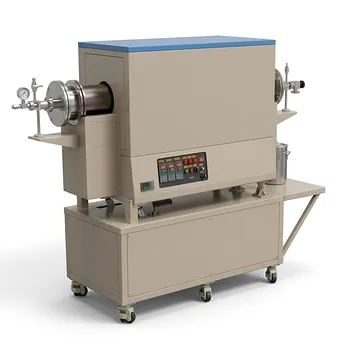
900°C Max Rotary Tube Furnace with 8 Inch 310S Alloy Tube and Optional Multi Zone Heating for Industrial Material Calcination
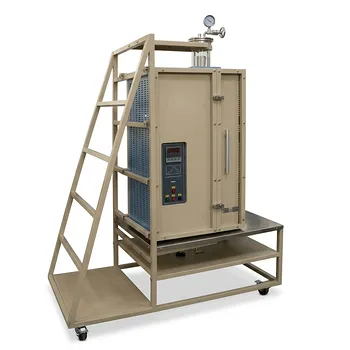
Split Vertical Tube Furnace with 1200C Quartz Tube and Stainless Steel Vacuum Flanges for Rapid Thermal Processing

High Temperature 1700C Tube Furnace with High Vacuum Turbomolecular Pump System and Multi Channel Mass Flow Controller Gas Mixer

1100C Tube Furnace with Vacuum Flange and Programmable Temperature Controller for Material Science and Industrial Heat Treatment
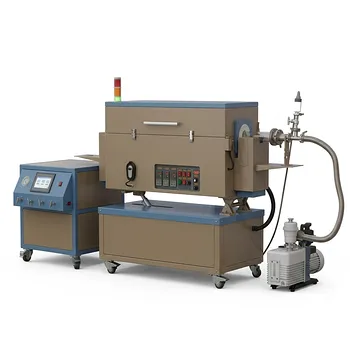
5 Inch Three Zone Rotary Tube Furnace with Integrated Gas Delivery System and 1200C Capability for Advanced Material CVD Processing

1700C Hydrogen Gas Tube Furnace with 60mm Alumina Process Tube and Integrated Hydrogen Safety Detector

1200°C 5 Inch Vertical Quartz Tube Furnace with Stainless Steel Vacuum Flanges

High Temperature 1700C Six Zone Split Tube Furnace with Alumina Tube and Water Cooled Flanges

Compact Vertical Split Quartz Tube Furnace with Stainless Steel Vacuum Flanges for Rapid Thermal Quenching and Controlled Atmosphere Material Processing

High Temperature 1700C Benchtop Tube Furnace with 5 Inch Heating Zone High Purity Alumina Tube and Vacuum Sealing Flanges

1200C High Throughput Multi Channel Tube Furnace with 50mm Quartz Tubes for Annealing and Material Phase Diagram Research

Three Zone Tube Furnace with 11 Inch or 15 Inch Quartz Tube and Hinged Flanges for Vacuum Atmosphere Heat Treatment

1800C High Temperature Compact Vacuum Tube Furnace with 60mm OD Alumina Tube and Kanthal MoSi2 Heating Elements

High Temperature 1700C Vertical Tube Furnace for Powder Spherification and Material Sintering
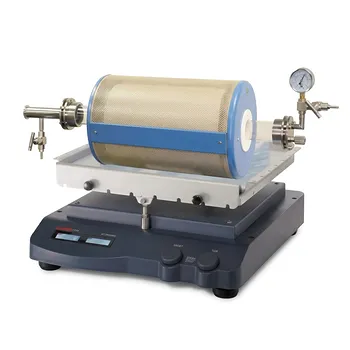
High Temperature Rocking Tube Furnace with Quartz Tube and Vacuum Flange for Materials Synthesis

High Temperature Automated 5 Inch Tube Furnace for Autonomous Material Research and Advanced Laboratory R&D
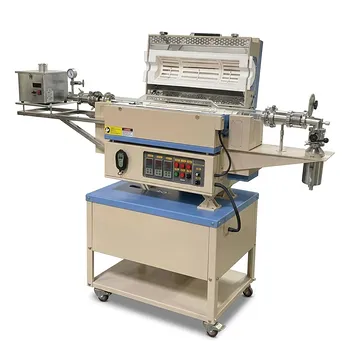
5 Inch Rotary Tube Furnace with Automatic Feeding and Receiving System 1200C Three Zone CVD Powder Processing