What is the purpose of introducing a controlled air flow into a tube furnace? Optimize Co3O4-gC3N4 Material Synthesis
Updated 3 months ago
The introduction of a controlled air flow transforms the tube furnace from a simple heating chamber into an active chemical reactor. In the synthesis of $\text{Co}_3\text{O}_4\text{-gC}_3\text{N}_4$ composites, the oxygen in the air acts as a critical reactant that drives the oxidative decomposition of cobalt acetate precursors into $\text{Co}_3\text{O}_4$ nanoparticles.
Core Takeaway: Controlled air flow provides the necessary oxygen to chemically convert metal precursors into oxides while simultaneously facilitating their in-situ anchoring onto the carbon nitride framework to create high-performance heterojunctions.
The Role of Oxygen as a Chemical Reactant
Converting Precursors to Functional Oxides
The primary purpose of the air flow is to supply oxygen for the thermal decomposition of cobalt acetate. Without this reactive atmosphere, the precursor would not transform into the required $\text{Co}_3\text{O}_4$ nanoparticles.
Facilitating In-Situ Nanoscale Loading
As the cobalt precursors decompose, the nanoparticles are fixed directly onto the forming $\text{g-C}_3\text{N}_4$ thin-layer framework. This in-situ growth is essential for achieving a uniform distribution of particles and preventing the agglomeration that often occurs in traditional mixing methods.
Creation of Heterojunction Structures
The interaction between the oxidizing metal species and the carbon nitride framework during heating creates unique heterojunction structures. These interfaces are vital for electronic applications, as they improve charge separation and catalytic activity in the final composite.
Balancing Stability and Reactivity
Precise Flow Rate Control
The use of a specific flow rate (such as 50 mL/min) ensures a constant supply of oxygen while preventing turbulence. This stability allows the tellurization or oxidation reactions to proceed uniformly across the entire sample within the furnace's constant temperature zone.
Managing Phase Purity
By controlling the atmosphere, researchers can ensure the phase purity of the cobalt oxide. In inert environments, metal-organic frameworks might instead reduce to metallic cobalt or different oxide phases, which would lack the specific properties needed for the composite.
Comparison with Inert Environments
While many carbon-based materials require argon or nitrogen to prevent degradation, this specific composite synthesis uses air to intentionally trigger oxidation. The tube furnace provides the stable thermal environment necessary to balance this oxidation without completely destroying the carbon nitride template.
Understanding the Trade-offs
Risk of Oxidative Degradation
The most significant risk of using air flow is the unintended oxidation of the carbon nitride framework itself. At temperatures near 550°C, oxygen can begin to decompose the $\text{g-C}_3\text{N}_4$ precursor, potentially reducing the yield or thinning the layers excessively.
Sensitivity to Temperature Fluctuations
Because oxidative decomposition is exothermic, precise temperature control is mandatory. If the furnace temperature is not strictly managed, the local heat generated by the reaction can lead to uncontrolled nanoparticle growth, resulting in larger particles and lower surface area.
How to Apply This to Your Synthesis
When designing your synthesis protocol in a tube furnace, the choice of atmosphere must align with your specific material goals.
- If your primary focus is forming metal oxide heterojunctions: Use a controlled air flow to ensure the metal precursor fully oxidizes and bonds to the substrate in-situ.
- If your primary focus is preserving a delicate carbon framework: Consider a two-step process or a highly restricted oxygen flow to prevent the oxidative gasification of the carbon structure.
- If your primary focus is creating oxygen vacancies for catalysis: You may need to transition from an air flow to an inert gas (like Argon) during the cooling phase to "lock in" specific oxidation states and surface defects.
Mastering the balance between reactive air flow and thermal stability is the key to engineering high-performance $\text{Co}_3\text{O}_4\text{-gC}_3\text{N}_4$ composites.
Summary Table:
| Function | Mechanism | Synthesis Impact |
|---|---|---|
| Oxygen Supply | Oxidative Decomposition | Converts metal precursors into active Co3O4 nanoparticles |
| Flow Control | Stable Reactant Delivery | Prevents turbulence and ensures phase purity of the oxide |
| Atmosphere Management | In-Situ Anchoring | Facilitates uniform nanoparticle loading on the g-C3N4 framework |
| Thermal Precision | Exothermic Management | Prevents uncontrolled particle growth and carbon degradation |
Elevate Your Material Synthesis with THERMUNITS
Precise atmospheric control is the difference between a failed experiment and a breakthrough in material science. As a leading manufacturer of high-temperature laboratory equipment, THERMUNITS provides the advanced thermal processing solutions required for complex syntheses like $\text{Co}_3\text{O}_4\text{-gC}_3\text{N}_4$ composites.
Whether your research requires Tube Furnaces with precision gas mixing, Vacuum Atmosphere Furnaces, or specialized CVD/PECVD systems, our equipment is engineered to deliver the stability and accuracy your R&D demands. We also offer Muffle, Rotary, and Hot Press furnaces, alongside high-quality Thermal Elements for industrial-grade reliability.
Ready to optimize your heat treatment process?
Contact our technical experts today to find the perfect furnace solution for your laboratory or industrial application!
References
- Abniel Machín, Francisco Márquez. Synergistic Effects of Co3O4-gC3N4-Coated ZnO Nanoparticles: A Novel Approach for Enhanced Photocatalytic Degradation of Ciprofloxacin and Hydrogen Evolution via Water Splitting. DOI: 10.3390/ma17051059
Mentioned Products
- Vertical 1700C Vacuum and Atmosphere Tube Furnace with 80mm Alumina Tube
- Compact High Temperature 1600C Tube Furnace with 50mm Alumina Tube and Vacuum Flanges for Material Sintering
- 900°C Max Rotary Tube Furnace with 8 Inch 310S Alloy Tube and Optional Multi Zone Heating for Industrial Material Calcination
- Split Vertical Tube Furnace with 1200C Quartz Tube and Stainless Steel Vacuum Flanges for Rapid Thermal Processing
- High Temperature 1700C Tube Furnace with High Vacuum Turbomolecular Pump System and Multi Channel Mass Flow Controller Gas Mixer
People Also Ask
- How is an industrial-grade vertical tube furnace utilized in smelting leaching residues? Enhance Metal Recovery Efficiency
- What is the function of a laboratory-grade vertical tube furnace in fast pyrolysis? Optimize Composite Research.
- How does a vertical tube furnace facilitate thermoelectric alloy melting? Precision synthesis for material homogeneity.
- Why is a thermocouple sensor indispensable for monitoring the vertical tube furnace during gallium oxide nanowire production? Optimize VLS Growth
- What are the advantages of using a vertical tube furnace for crucible experiments simulating steel-slag interactions?

Tech Team · ThermUnits
Last updated on Jun 02, 2026
Related Products

Vertical 1700C Vacuum and Atmosphere Tube Furnace with 80mm Alumina Tube

Compact High Temperature 1600C Tube Furnace with 50mm Alumina Tube and Vacuum Flanges for Material Sintering
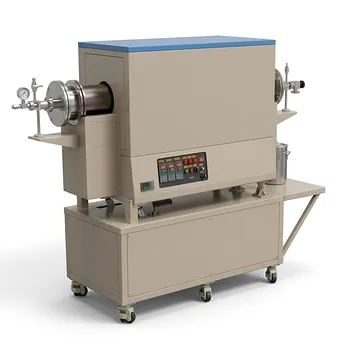
900°C Max Rotary Tube Furnace with 8 Inch 310S Alloy Tube and Optional Multi Zone Heating for Industrial Material Calcination
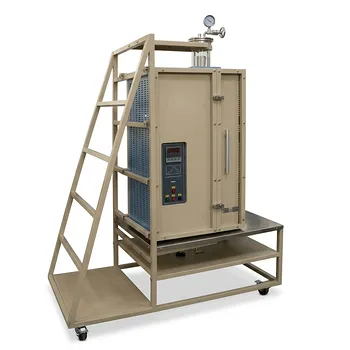
Split Vertical Tube Furnace with 1200C Quartz Tube and Stainless Steel Vacuum Flanges for Rapid Thermal Processing

High Temperature 1700C Tube Furnace with High Vacuum Turbomolecular Pump System and Multi Channel Mass Flow Controller Gas Mixer

1100C Tube Furnace with Vacuum Flange and Programmable Temperature Controller for Material Science and Industrial Heat Treatment
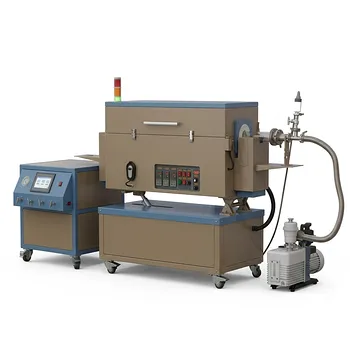
5 Inch Three Zone Rotary Tube Furnace with Integrated Gas Delivery System and 1200C Capability for Advanced Material CVD Processing
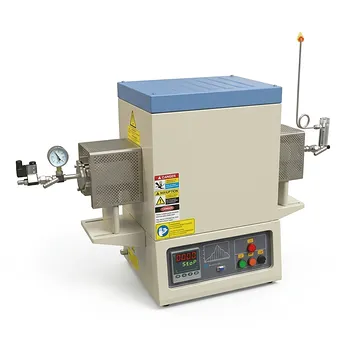
1700C Hydrogen Gas Tube Furnace with 60mm Alumina Process Tube and Integrated Hydrogen Safety Detector

1200°C 5 Inch Vertical Quartz Tube Furnace with Stainless Steel Vacuum Flanges

High Temperature 1700C Six Zone Split Tube Furnace with Alumina Tube and Water Cooled Flanges

Compact Vertical Split Quartz Tube Furnace with Stainless Steel Vacuum Flanges for Rapid Thermal Quenching and Controlled Atmosphere Material Processing

High Temperature 1700C Benchtop Tube Furnace with 5 Inch Heating Zone High Purity Alumina Tube and Vacuum Sealing Flanges
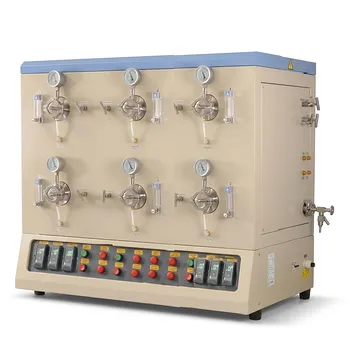
1200C High Throughput Multi Channel Tube Furnace with 50mm Quartz Tubes for Annealing and Material Phase Diagram Research
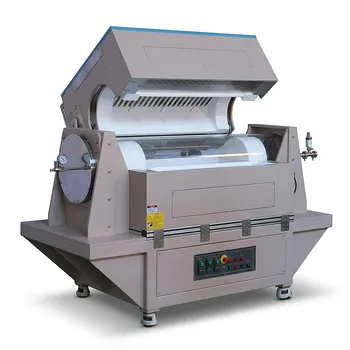
Three Zone Tube Furnace with 11 Inch or 15 Inch Quartz Tube and Hinged Flanges for Vacuum Atmosphere Heat Treatment

1800C High Temperature Compact Vacuum Tube Furnace with 60mm OD Alumina Tube and Kanthal MoSi2 Heating Elements

High Temperature 1700C Vertical Tube Furnace for Powder Spherification and Material Sintering
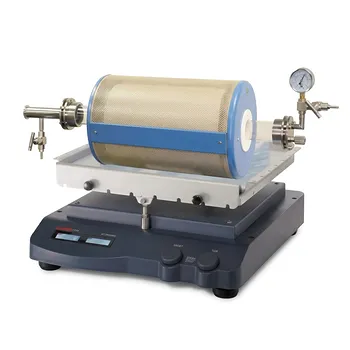
High Temperature Rocking Tube Furnace with Quartz Tube and Vacuum Flange for Materials Synthesis

High Temperature Automated 5 Inch Tube Furnace for Autonomous Material Research and Advanced Laboratory R&D
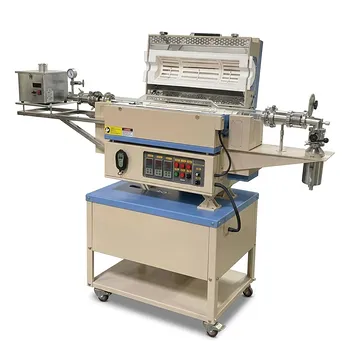
5 Inch Rotary Tube Furnace with Automatic Feeding and Receiving System 1200C Three Zone CVD Powder Processing