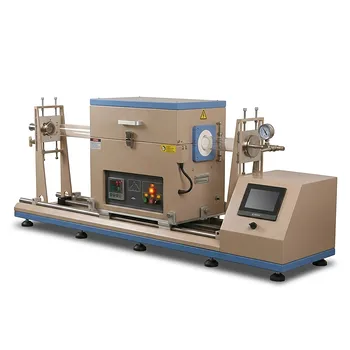
What role do high-vacuum or atmospheric tube furnaces play in the post-treatment of LaMnO3 thin films? Optimizing Results
Updated 3 months ago
High-vacuum and atmospheric tube furnaces serve as the primary environment for thermal annealing, a critical post-treatment phase that optimizes the chemical stoichiometry and magnetic properties of $LaMnO_3$ thin films. By providing a controlled thermal field, these furnaces drive oxygen diffusion and structural relaxation to transform the film from its "as-grown" state into a high-performance functional material.
Core Takeaway: Post-treatment in a tube furnace is essential for $LaMnO_3$ to eliminate oxygen vacancies and shift Manganese valence states, directly translating to enhanced magnetic performance and phase stability.
Optimizing Chemical Stoichiometry through Atmosphere Control
Driving Oxygen Diffusion
During the growth of $LaMnO_3$ thin films, oxygen vacancies—gaps in the crystal lattice where oxygen atoms should be—often form. Atmospheric tube furnaces allow oxygen to diffuse into the film at elevated temperatures, typically around 600°C, ensuring the material is fully oxidized.
Manganese Valence State Manipulation
The magnetic performance of $LaMnO_3$ is highly dependent on the valence state of its Manganese ions. The thermal energy provided by the furnace facilitates the transition of $Mn^{2+}$ ions to $Mn^{3+}/Mn^{4+}$ states, a shift that is fundamental to the material's double-exchange interaction and magnetic properties.
Eliminating Growth Defects
By maintaining a consistent temperature for extended periods (such as six hours), tube furnaces allow the lattice to reach chemical equilibrium. This process repairs defects generated during high-energy deposition phases, resulting in a more uniform and stable thin film structure.
Structural Refinement and Phase Transition
Facilitating Perovskite Crystallization
$LaMnO_3$ must achieve a specific perovskite crystal structure to exhibit its desired catalytic and magnetic behaviors. High-temperature furnaces provide the necessary energy to drive the transition from a disordered or amorphous state into a highly crystalline phase.
Stress Relief and Lattice Integrity
The deposition process often introduces internal mechanical stresses due to lattice mismatch with the substrate. Thermal treatment in a controlled furnace environment promotes atomic structural relaxation, reducing internal strain and improving the overall integrity of the crystal lattice.
Grain Growth and Surface Morphology
Precise temperature profiles allow for controlled grain growth within the thin film. This refinement of the microstructure is critical for applications where surface area and grain boundary characteristics dictate the material's conductivity or catalytic activity.
Understanding the Trade-offs: Atmosphere vs. Vacuum
The Risk of Over-Oxidation or Reduction
Choosing between an atmospheric or high-vacuum environment is a delicate balance. While atmospheric annealing corrects oxygen deficiencies in $LaMnO_3$, an overly oxidizing environment can sometimes lead to secondary phases; conversely, a high-vacuum environment—while excellent for stress relief—may inadvertently strip oxygen from the lattice.
Balancing Temperature and Time
Higher temperatures (e.g., above 800°C) can accelerate crystallization but may also trigger unwanted interdiffusion between the thin film and the substrate. Engineers must carefully calibrate the duration of the heat treatment to ensure full oxidation without compromising the film-substrate interface.
Vacuum Environment Limitations
While high-vacuum furnaces are essential for materials like $SrMoO_3$ to prevent oxidation, they are generally used more sparingly for $LaMnO_3$ unless the specific goal is to study oxygen-deficient states or to perform initial stress relief before a secondary oxidation step.
How to Apply Furnace Post-Treatment to Your Project
When determining the specific furnace parameters for $LaMnO_3$ or similar perovskite thin films, your choice should be dictated by the final application of the material.
- If your primary focus is Maximum Magnetic Performance: Utilize an atmospheric tube furnace at approximately 600°C for an extended duration (6+ hours) to ensure the conversion of Manganese ions to $Mn^{3+}/Mn^{4+}$.
- If your primary focus is Structural Perfection and Grain Size: Opt for higher temperature profiles (up to 800°C-950°C) in a controlled inert or nitrogen atmosphere to drive recrystallization and eliminate internal sputtering stresses.
- If your primary focus is Phase Purity in Nanosheets: Use an atmospheric furnace with precise ramp rates to ensure a complete transition to the perovskite phase while maintaining the high surface area required for catalytic activity.
A precisely calibrated thermal post-treatment is the bridge between a raw deposited layer and a high-performance functional thin film.
Summary Table:
| Treatment Phase | Primary Goal | Recommended Conditions |
|---|---|---|
| Oxidation | Eliminate oxygen vacancies | 600°C in Atmospheric Tube Furnace |
| Valence Tuning | $Mn^{2+} \to Mn^{3+}/Mn^{4+}$ shift | Extended annealing (6+ hours) |
| Crystallization | Perovskite phase transition | 800°C - 950°C |
| Stress Relief | Lattice structural relaxation | Controlled inert or vacuum environment |
Elevate Your Material Research with THERMUNITS
As a leading manufacturer of high-temperature laboratory equipment, THERMUNITS provides the precision heating solutions necessary for advanced material science and industrial R&D. Whether you require Tube, Vacuum, or Atmosphere furnaces for $LaMnO_3$ annealing, or specialized CVD/PECVD systems, Muffle, and Hot Press furnaces, our equipment ensures uniform thermal fields and exact atmosphere control.
Achieve superior stoichiometry and structural integrity in your thin films. Contact our expert team today to find the perfect thermal processing solution for your laboratory.
References
- F. Stramaglia, C. A. F. Vaz. Role of interdiffusion on the magnetism of ultrathin LaMnO3 films. DOI: 10.1063/9.0000803
Mentioned Products
- Vertical 1700C Vacuum and Atmosphere Tube Furnace with 80mm Alumina Tube
- Compact High Temperature 1600C Tube Furnace with 50mm Alumina Tube and Vacuum Flanges for Material Sintering
- 900°C Max Rotary Tube Furnace with 8 Inch 310S Alloy Tube and Optional Multi Zone Heating for Industrial Material Calcination
- Split Vertical Tube Furnace with 1200C Quartz Tube and Stainless Steel Vacuum Flanges for Rapid Thermal Processing
- High Temperature 1700C Tube Furnace with High Vacuum Turbomolecular Pump System and Multi Channel Mass Flow Controller Gas Mixer
People Also Ask
- How is an industrial-grade vertical tube furnace utilized in smelting leaching residues? Enhance Metal Recovery Efficiency
- What is the function of a laboratory-grade vertical tube furnace in fast pyrolysis? Optimize Composite Research.
- How does a vertical tube furnace facilitate thermoelectric alloy melting? Precision synthesis for material homogeneity.
- Why is a thermocouple sensor indispensable for monitoring the vertical tube furnace during gallium oxide nanowire production? Optimize VLS Growth
- What are the advantages of using a vertical tube furnace for crucible experiments simulating steel-slag interactions?

Tech Team · ThermUnits
Last updated on Jun 02, 2026
Related Products

Vertical 1700C Vacuum and Atmosphere Tube Furnace with 80mm Alumina Tube

Compact High Temperature 1600C Tube Furnace with 50mm Alumina Tube and Vacuum Flanges for Material Sintering
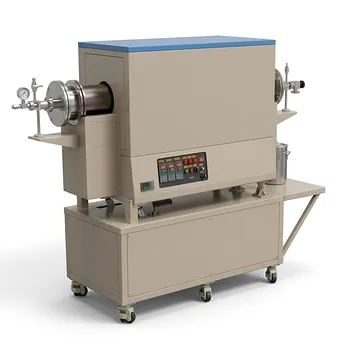
900°C Max Rotary Tube Furnace with 8 Inch 310S Alloy Tube and Optional Multi Zone Heating for Industrial Material Calcination
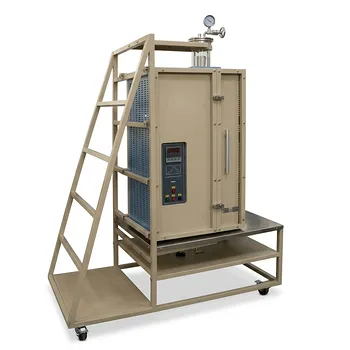
Split Vertical Tube Furnace with 1200C Quartz Tube and Stainless Steel Vacuum Flanges for Rapid Thermal Processing

High Temperature 1700C Tube Furnace with High Vacuum Turbomolecular Pump System and Multi Channel Mass Flow Controller Gas Mixer

1100C Tube Furnace with Vacuum Flange and Programmable Temperature Controller for Material Science and Industrial Heat Treatment

5 Inch Three Zone Rotary Tube Furnace with Integrated Gas Delivery System and 1200C Capability for Advanced Material CVD Processing

1700C Hydrogen Gas Tube Furnace with 60mm Alumina Process Tube and Integrated Hydrogen Safety Detector
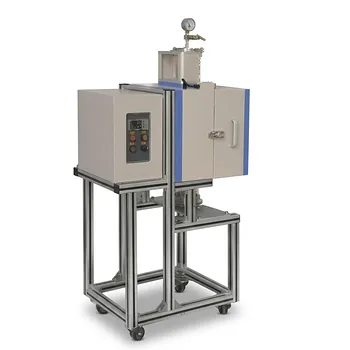
1200°C 5 Inch Vertical Quartz Tube Furnace with Stainless Steel Vacuum Flanges

High Temperature 1700C Six Zone Split Tube Furnace with Alumina Tube and Water Cooled Flanges

Compact Vertical Split Quartz Tube Furnace with Stainless Steel Vacuum Flanges for Rapid Thermal Quenching and Controlled Atmosphere Material Processing

High Temperature 1700C Benchtop Tube Furnace with 5 Inch Heating Zone High Purity Alumina Tube and Vacuum Sealing Flanges

1200C High Throughput Multi Channel Tube Furnace with 50mm Quartz Tubes for Annealing and Material Phase Diagram Research

Three Zone Tube Furnace with 11 Inch or 15 Inch Quartz Tube and Hinged Flanges for Vacuum Atmosphere Heat Treatment

1800C High Temperature Compact Vacuum Tube Furnace with 60mm OD Alumina Tube and Kanthal MoSi2 Heating Elements

High Temperature 1700C Vertical Tube Furnace for Powder Spherification and Material Sintering
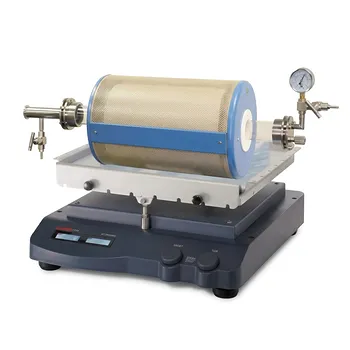
High Temperature Rocking Tube Furnace with Quartz Tube and Vacuum Flange for Materials Synthesis

High Temperature Automated 5 Inch Tube Furnace for Autonomous Material Research and Advanced Laboratory R&D
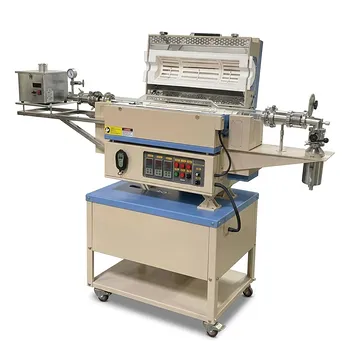
5 Inch Rotary Tube Furnace with Automatic Feeding and Receiving System 1200C Three Zone CVD Powder Processing