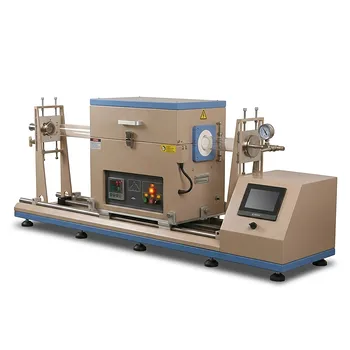
What role does a high-yield heat treatment tube furnace play in CNT powder? Enhance Defect Engineering and EMI Shielding
Updated 3 months ago
In the synthesis of defect-structured carbon nanotube (CNT) powder, a high-yield heat treatment tube furnace acts as the primary reactor for controlled chemical activation. By subjecting KOH-impregnated nanotubes to precise temperature gradients—typically ranging from 500°C to 900°C—the furnace facilitates the etching of the carbon lattice. This process induces specific densities of vacancy defects, which are essential for tuning the material's electromagnetic shielding and infrared camouflage capabilities.
The tube furnace is the critical hardware required to transform standard CNTs into defect-engineered functional powders. It achieves this by providing a highly stable thermal and atmospheric environment that dictates the rate and depth of chemical activation at the molecular level.
Precise Control of the Activation Environment
Orchestrating Temperature Gradients
The furnace allows researchers to apply specific thermal profiles, such as 500°C, 700°C, and 900°C, to the CNT precursor. These gradients are vital because the degree of chemical activation and the resulting defect density are directly proportional to the heat intensity. A high-yield furnace ensures that these temperatures are maintained uniformly across the entire powder batch, preventing localized over-processing.
Managing Atmospheric Integrity
To prevent the total oxidation of the carbon framework, the tube furnace provides a sealed environment for inert gases like argon or nitrogen. This controlled atmosphere ensures that the heat energy is used exclusively for the KOH-CNT reaction rather than unintended combustion. This stability is what allows for the precise removal of non-carbon elements while preserving the overall tubular structure.
Facilitating Phase Transition and Kinetic Control
The furnace provides the linear heating space necessary for researching the phase transition kinetics of the powder. By managing slow heating rates and prolonged soaking times, the equipment allows for the controlled rearrangement of carbon atoms. This level of control is necessary to transition from a pristine lattice to one characterized by engineered "impurities" or vacancies.
Engineering the CNT Lattice for Functional Performance
Inducing Specific Vacancy Defects
The core role of the furnace is to catalyze the reaction between the KOH impregnate and the CNT walls. This reaction etches the lattice, creating vacancy defects that serve as active sites for electromagnetic absorption. Without the precise thermal energy provided by the furnace, these defects would be inconsistent, leading to poor material performance.
Refining Surface Chemistry
Beyond inducing defects, the furnace is used to remove residual impurities and unstable functional groups from the CNT surface. By heating the nanotubes to approximately 500°C under argon, the furnace creates a uniform surface state. This clean, defect-structured foundation is essential for any subsequent chemical modifications, such as the introduction of hydroxyl or carboxyl groups.
Scaling Through Batch Uniformity
High-yield furnaces are designed to transition microscopic results into macro-scale production. They provide a large heating volume that ensures every gram of CNT powder experiences the same thermal history. This uniformity is the only way to ensure that the electrical conductivity and shielding properties remain consistent across an entire production lot.
Understanding the Trade-offs
While the tube furnace is essential for inducing defects, there is a delicate balance between activation and structural integrity. If the temperature is too high or the soaking time too long, the chemical activation can become too aggressive, leading to the total collapse of the nanotube walls and a loss of mechanical strength.
Furthermore, while inducing defects enhances electromagnetic shielding, it simultaneously reduces the intrinsic electrical conductivity of the nanotubes. High-temperature treatments are also energy-intensive, and the use of corrosive activators like KOH at 900°C can significantly shorten the lifespan of the quartz or ceramic tubes used within the furnace.
How to Apply This to Your Project
Making the Right Choice for Your Goal
- If your primary focus is maximizing electromagnetic interference (EMI) shielding: Utilize the furnace at the higher end of the temperature spectrum (700°C–900°C) to maximize vacancy defect density.
- If your primary focus is maintaining high mechanical strength: Stick to lower temperature gradients (approx. 500°C) and shorter soaking times to limit the depth of lattice etching.
- If your primary focus is infrared camouflage: Precisely calibrate the temperature to achieve a specific balance of defects that optimizes the material's thermal emissivity.
- If your primary focus is material purity: Use a high-vacuum configuration (10⁻³ mbar) during the heat treatment to facilitate the complete removal of amorphous carbon and volatile impurities.
The tube furnace is not merely a heater but a precision instrument for molecular engineering, turning inert carbon structures into highly active, defect-rich materials.
Summary Table:
| Key Feature | Functional Role | Material Outcome |
|---|---|---|
| Precise Temperature Control | Manages KOH-CNT etching gradients (500°C-900°C) | Tunable vacancy defect density |
| Atmospheric Integrity | Provides sealed inert environment (Argon/Nitrogen) | Prevents oxidation; preserves tubular structure |
| Kinetic Management | Controls linear heating rates and soaking times | Precise molecular rearrangement and phase transition |
| Batch Uniformity | Ensures consistent thermal history across large volumes | Scalable production with uniform conductivity |
Optimize Your CNT Synthesis with THERMUNITS
As a leading manufacturer of high-temperature laboratory equipment for material science, THERMUNITS provides the precision hardware required for advanced defect engineering. Our high-yield furnaces empower researchers and industrial R&D teams to achieve the exact thermal profiles necessary for high-performance CNT powders and other advanced materials.
Why choose THERMUNITS for your lab?
- Comprehensive Solutions: We offer a full range of thermal equipment including Tube, Vacuum, Atmosphere, Muffle, and Rotary furnaces, as well as CVD/PECVD systems.
- Precision Engineering: Ideal for applications requiring strict atmospheric control and stable temperature gradients like KOH activation.
- Versatile R&D Support: From Vacuum Induction Melting (VIM) to Hot Press furnaces, we support the most demanding heat treatment protocols.
Ready to enhance your material properties? Contact our expert team today to find the perfect high-temperature solution for your project!
References
- Yue Wu, Guangbin Ji. Manipulating CNT Films with Atomic Precision for Absorption Effectiveness–Enhanced Electromagnetic Interference Shielding and Adaptive Infrared Camouflage. DOI: 10.1002/adfm.202402193
Mentioned Products
- Vertical 1700C Vacuum and Atmosphere Tube Furnace with 80mm Alumina Tube
- Compact High Temperature 1600C Tube Furnace with 50mm Alumina Tube and Vacuum Flanges for Material Sintering
- 900°C Max Rotary Tube Furnace with 8 Inch 310S Alloy Tube and Optional Multi Zone Heating for Industrial Material Calcination
- Split Vertical Tube Furnace with 1200C Quartz Tube and Stainless Steel Vacuum Flanges for Rapid Thermal Processing
- High Temperature 1700C Tube Furnace with High Vacuum Turbomolecular Pump System and Multi Channel Mass Flow Controller Gas Mixer
People Also Ask
- How is an industrial-grade vertical tube furnace utilized in smelting leaching residues? Enhance Metal Recovery Efficiency
- What is the function of a laboratory-grade vertical tube furnace in fast pyrolysis? Optimize Composite Research.
- How does a vertical tube furnace facilitate thermoelectric alloy melting? Precision synthesis for material homogeneity.
- Why is a thermocouple sensor indispensable for monitoring the vertical tube furnace during gallium oxide nanowire production? Optimize VLS Growth
- What are the advantages of using a vertical tube furnace for crucible experiments simulating steel-slag interactions?

Tech Team · ThermUnits
Last updated on Jun 03, 2026
Related Products

Vertical 1700C Vacuum and Atmosphere Tube Furnace with 80mm Alumina Tube

Compact High Temperature 1600C Tube Furnace with 50mm Alumina Tube and Vacuum Flanges for Material Sintering
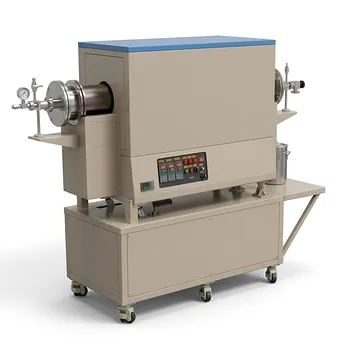
900°C Max Rotary Tube Furnace with 8 Inch 310S Alloy Tube and Optional Multi Zone Heating for Industrial Material Calcination
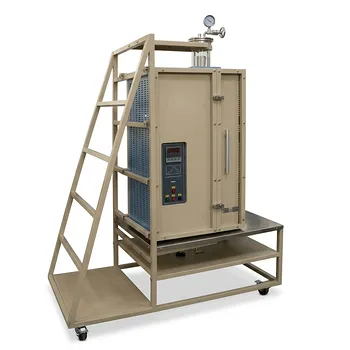
Split Vertical Tube Furnace with 1200C Quartz Tube and Stainless Steel Vacuum Flanges for Rapid Thermal Processing

High Temperature 1700C Tube Furnace with High Vacuum Turbomolecular Pump System and Multi Channel Mass Flow Controller Gas Mixer

1100C Tube Furnace with Vacuum Flange and Programmable Temperature Controller for Material Science and Industrial Heat Treatment
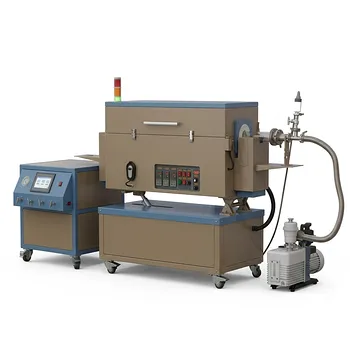
5 Inch Three Zone Rotary Tube Furnace with Integrated Gas Delivery System and 1200C Capability for Advanced Material CVD Processing

1200°C 5 Inch Vertical Quartz Tube Furnace with Stainless Steel Vacuum Flanges

1700C Hydrogen Gas Tube Furnace with 60mm Alumina Process Tube and Integrated Hydrogen Safety Detector

High Temperature 1700C Six Zone Split Tube Furnace with Alumina Tube and Water Cooled Flanges

Compact Vertical Split Quartz Tube Furnace with Stainless Steel Vacuum Flanges for Rapid Thermal Quenching and Controlled Atmosphere Material Processing

High Temperature 1700C Benchtop Tube Furnace with 5 Inch Heating Zone High Purity Alumina Tube and Vacuum Sealing Flanges

1800C High Temperature Compact Vacuum Tube Furnace with 60mm OD Alumina Tube and Kanthal MoSi2 Heating Elements
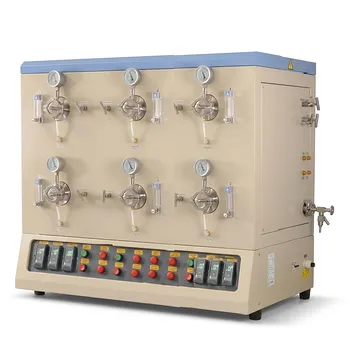
1200C High Throughput Multi Channel Tube Furnace with 50mm Quartz Tubes for Annealing and Material Phase Diagram Research
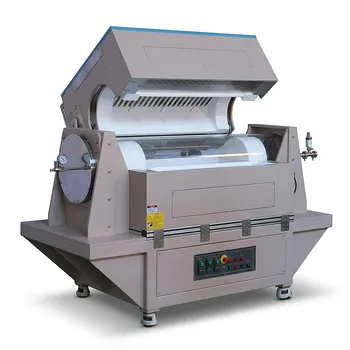
Three Zone Tube Furnace with 11 Inch or 15 Inch Quartz Tube and Hinged Flanges for Vacuum Atmosphere Heat Treatment

High Temperature 1700C Vertical Tube Furnace for Powder Spherification and Material Sintering
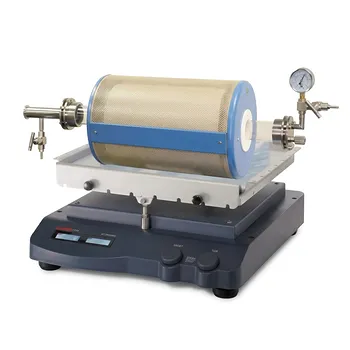
High Temperature Rocking Tube Furnace with Quartz Tube and Vacuum Flange for Materials Synthesis

High Temperature Automated 5 Inch Tube Furnace for Autonomous Material Research and Advanced Laboratory R&D
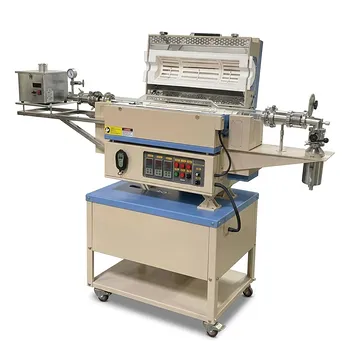
5 Inch Rotary Tube Furnace with Automatic Feeding and Receiving System 1200C Three Zone CVD Powder Processing