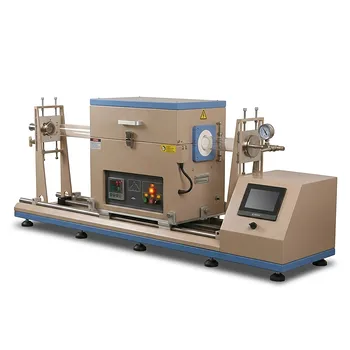
What role does a tube furnace play in the 250 °C pre-carbonization of lignin? Mastering Thermal Stabilization
Updated 3 months ago
The 250 °C pre-carbonization stage is a critical structural safeguard. In this phase, a tube furnace provides a strictly controlled thermal environment that facilitates the preliminary cross-linking and oxidative stabilization of lignin. By maintaining this specific temperature, the furnace prevents the material from melting or losing its shape, ensuring the final carbon product retains its intended morphology during subsequent high-temperature treatments.
Core Takeaway: The tube furnace acts as a precision stabilizer at 250 °C, bridging the gap between raw lignin’s low melting point and the high temperatures required for carbonization. It effectively "locks" the material's structure through cross-linking before the final pyrolysis begins.
Preventing Structural Melting and Collapse
Managing the Glass Transition Temperature
Lignin possesses a relatively low glass transition temperature ($T_g$), typically ranging between 110 °C and 235 °C. If lignin is subjected to high-temperature carbonization (e.g., 500 °C or 1000 °C) immediately, it will pass through this $T_g$ and soften, causing particles to melt or fuse together.
Preserving Spherical Morphology
The 250 °C isothermal treatment in a tube furnace ensures that lignin particles retain their specific shapes, such as spherical morphology. This "thermal setting" is vital for applications where the surface area and particle geometry determine the performance of the final carbon material.
Facilitating Chemical Stabilization
Preliminary Cross-linking
At 250 °C, the tube furnace environment promotes preliminary cross-linking between lignin molecules. This chemical bonding creates a more robust molecular network that can withstand the aggressive deoxygenation and dehydrogenation reactions that occur at higher temperatures.
Oxidative Stabilization
The furnace allows for oxidative stabilization, which increases the overall thermal stability of the precursor. By carefully controlling the heating rate and environment, the furnace ensures the material transitions from a thermoplastic state to a thermoset state, making it infusible.
The Importance of Precise Environment Control
Temperature Uniformity and Isothermal Zones
A tube furnace is uniquely suited for this stage because it offers stable isothermal zones. This means every lignin particle is exposed to the exact same 250 °C temperature, preventing localized melting or under-stabilized "soft spots" in the batch.
Atmosphere Management
While the 250 °C stage is focused on stabilization, the tube furnace’s ability to control the atmosphere (often using nitrogen or air depending on the specific stabilization protocol) is essential. This prevents uncontrolled combustion while allowing the necessary chemical modifications to proceed steadily.
Understanding the Trade-offs and Pitfalls
The Risk of Insufficient Stabilization
If the 250 °C stage is skipped or rushed, the lignin will likely collapse into a non-porous mass during the 800 °C–1200 °C carbonization phase. This results in a significant loss of specific surface area and destroys any engineered pore structures or templates.
Over-stabilization and Processing Time
While stabilization is necessary, excessively long soak times at 250 °C can lead to brittle precursors or unnecessary energy consumption. Finding the precise "dwell time" in the tube furnace is a balancing act between structural integrity and processing efficiency.
Heating Rate Sensitivity
Applying heat too quickly to reach 250 °C can cause internal pressure build-up from volatile release, leading to cracked particles. A controlled heating rate (often as low as 2–10 °C/min) is required to allow gases to escape without damaging the microscopic skeleton.
How to Apply This to Your Production Process
Implementation Based on Material Goals
- If your primary focus is preserving particle shape: Ensure the 250 °C dwell time is sufficient to fully cross-link the outer shell of the lignin particles before increasing heat.
- If your primary focus is high porosity: Use the tube furnace to meticulously control the heating rate up to 250 °C to prevent the "sealing" of pores that occurs during rapid melting.
- If your primary focus is maximizing throughput: Experiment with the minimum stabilization time required for your specific lignin source, as $T_g$ varies based on the extraction method (e.g., Kraft vs. Organosolv lignin).
By treating the 250 °C stage as a foundational structural phase rather than just a heating step, you ensure the success of all subsequent high-temperature carbonization and activation processes.
Summary Table:
| Process Feature | Function at 250 °C | Core Benefit for Lignin |
|---|---|---|
| Thermal Precision | Manages Glass Transition ($T_g$) | Prevents particle melting and fusion |
| Chemical Activation | Facilitates preliminary cross-linking | Creates a robust molecular network |
| Atmosphere Control | Enables oxidative stabilization | Converts material to an infusible thermoset |
| Isothermal Zones | Uniform heat distribution | Preserves specific morphology and porosity |
| Heating Rate Control | Controlled degasification | Prevents internal pressure and cracking |
Elevate Your Material Research with THERMUNITS
At THERMUNITS, we understand that the success of high-temperature carbonization begins with precision at the stabilization stage. As a leading manufacturer of high-temperature laboratory equipment for material science and industrial R&D, we provide the thermal accuracy required to "lock" your material's morphology and ensure superior performance.
Our comprehensive range of thermal processing solutions includes:
- Furnaces: Muffle, Vacuum, Atmosphere, Tube, Rotary, and Hot Press furnaces.
- Advanced Systems: CVD/PECVD systems, Dental Furnaces, and Electric Rotary Kilns.
- Specialized Equipment: Vacuum Induction Melting (VIM) furnaces and high-quality Thermal Elements.
Ready to optimize your heat treatment process? Our experts are here to help you select the ideal equipment for your lignin-based research or industrial production.
References
- Piotr Łątka, Piotr Kuśtrowski. Spherical Lignin-Derived Activated Carbons for the Adsorption of Phenol from Aqueous Media. DOI: 10.3390/molecules29050960
Mentioned Products
- Vertical 1700C Vacuum and Atmosphere Tube Furnace with 80mm Alumina Tube
- Compact High Temperature 1600C Tube Furnace with 50mm Alumina Tube and Vacuum Flanges for Material Sintering
- 900°C Max Rotary Tube Furnace with 8 Inch 310S Alloy Tube and Optional Multi Zone Heating for Industrial Material Calcination
- Split Vertical Tube Furnace with 1200C Quartz Tube and Stainless Steel Vacuum Flanges for Rapid Thermal Processing
- High Temperature 1700C Tube Furnace with High Vacuum Turbomolecular Pump System and Multi Channel Mass Flow Controller Gas Mixer
People Also Ask
- How is an industrial-grade vertical tube furnace utilized in smelting leaching residues? Enhance Metal Recovery Efficiency
- What is the function of a laboratory-grade vertical tube furnace in fast pyrolysis? Optimize Composite Research.
- How does a vertical tube furnace facilitate thermoelectric alloy melting? Precision synthesis for material homogeneity.
- Why is a thermocouple sensor indispensable for monitoring the vertical tube furnace during gallium oxide nanowire production? Optimize VLS Growth
- What are the advantages of using a vertical tube furnace for crucible experiments simulating steel-slag interactions?

Tech Team · ThermUnits
Last updated on Jun 02, 2026
Related Products

Vertical 1700C Vacuum and Atmosphere Tube Furnace with 80mm Alumina Tube

Compact High Temperature 1600C Tube Furnace with 50mm Alumina Tube and Vacuum Flanges for Material Sintering
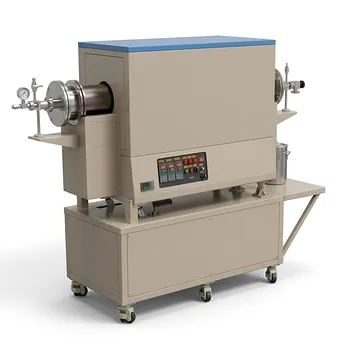
900°C Max Rotary Tube Furnace with 8 Inch 310S Alloy Tube and Optional Multi Zone Heating for Industrial Material Calcination
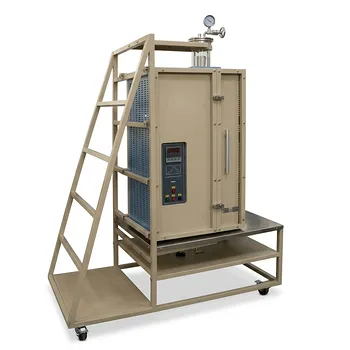
Split Vertical Tube Furnace with 1200C Quartz Tube and Stainless Steel Vacuum Flanges for Rapid Thermal Processing

High Temperature 1700C Tube Furnace with High Vacuum Turbomolecular Pump System and Multi Channel Mass Flow Controller Gas Mixer

1100C Tube Furnace with Vacuum Flange and Programmable Temperature Controller for Material Science and Industrial Heat Treatment
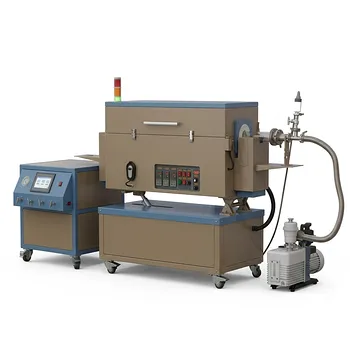
5 Inch Three Zone Rotary Tube Furnace with Integrated Gas Delivery System and 1200C Capability for Advanced Material CVD Processing
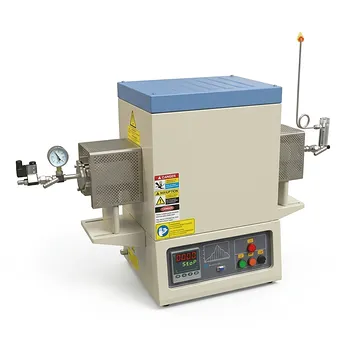
1700C Hydrogen Gas Tube Furnace with 60mm Alumina Process Tube and Integrated Hydrogen Safety Detector

1200°C 5 Inch Vertical Quartz Tube Furnace with Stainless Steel Vacuum Flanges

High Temperature 1700C Six Zone Split Tube Furnace with Alumina Tube and Water Cooled Flanges

Compact Vertical Split Quartz Tube Furnace with Stainless Steel Vacuum Flanges for Rapid Thermal Quenching and Controlled Atmosphere Material Processing

High Temperature 1700C Benchtop Tube Furnace with 5 Inch Heating Zone High Purity Alumina Tube and Vacuum Sealing Flanges
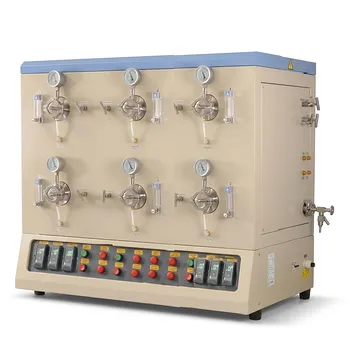
1200C High Throughput Multi Channel Tube Furnace with 50mm Quartz Tubes for Annealing and Material Phase Diagram Research

Three Zone Tube Furnace with 11 Inch or 15 Inch Quartz Tube and Hinged Flanges for Vacuum Atmosphere Heat Treatment

1800C High Temperature Compact Vacuum Tube Furnace with 60mm OD Alumina Tube and Kanthal MoSi2 Heating Elements

High Temperature 1700C Vertical Tube Furnace for Powder Spherification and Material Sintering
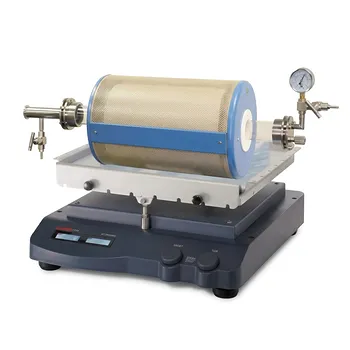
High Temperature Rocking Tube Furnace with Quartz Tube and Vacuum Flange for Materials Synthesis

High Temperature Automated 5 Inch Tube Furnace for Autonomous Material Research and Advanced Laboratory R&D
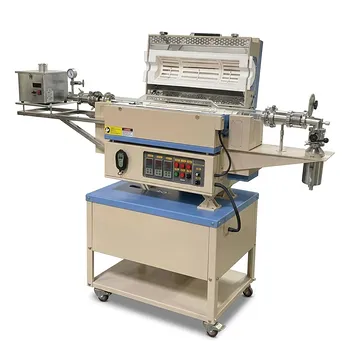
5 Inch Rotary Tube Furnace with Automatic Feeding and Receiving System 1200C Three Zone CVD Powder Processing