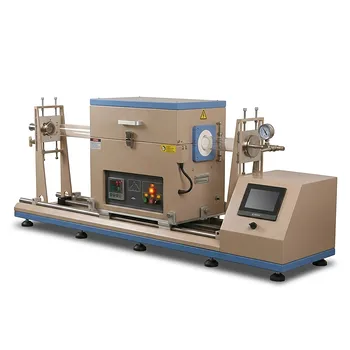
What role does a Tube Furnace play in metal-loaded TiO2 catalysts? Optimize High-Performance Catalyst Preparation
Updated 3 months ago
The preparation of metal-loaded titanium dioxide catalysts depends on the Tube Furnace to transform liquid-soaked precursors into active, solid-state materials. After the incipient wetness impregnation (IWI) step, the furnace provides the controlled thermal environment needed to decompose precursor salts and reduce metal ions into active metallic nanoparticles precisely distributed across the titanium dioxide support.
A Tube Furnace serves as the essential reactor for both calcination and thermal reduction, allowing researchers to control the catalyst’s final oxidation state, crystal structure, and particle distribution through precise temperature and atmosphere management.
Driving the Thermal Reduction of Metal Ions
Precision Atmosphere Control
The most critical role of the Tube Furnace is providing a specialized gas environment, such as a mixture of hydrogen (H2) and argon (Ar). This atmosphere is required to facilitate the thermal reduction of metal precursor ions once they have been impregnated into the TiO2.
Conversion to Active Co-catalysts
By maintaining specific temperatures—commonly around 200 °C for reduction—the furnace triggers the chemical transformation of precursor ions into metallic co-catalysts. This ensures the active metals are uniformly distributed on the surface of the titanium dioxide support rather than forming large, inactive clusters.
Maintaining Temperature Stability
Consistency is vital for achieving a high-performance catalyst. The Tube Furnace provides a stable, long temperature zone that prevents thermal fluctuations, ensuring that every part of the catalyst batch undergoes the same chemical transformation.
Decomposing Precursors and Anchoring Metals
The Calcination Process
Before reduction, the furnace is often used for calcination, typically in an inert atmosphere like nitrogen or a reactive one like air. This step reaches higher temperatures (often between 500 °C and 800 °C) to decompose metal salts and remove volatile organic compounds.
Strengthening Metal-Support Interaction
High-temperature treatment in the furnace ensures that the active metal components are firmly anchored to the titanium dioxide or nitride support. This interaction is critical because it dictates the catalyst's durability and long-term stability during chemical reactions.
Removal of Trace Impurities
The furnace can be used at lower temperatures, such as 110 °C, to provide pre-drying. This removes residual moisture and stabilizes the metal precursors on the support surface, creating a solid foundation for subsequent high-temperature processing.
Managing Crystalline Phase and Purity
Directing the Anatase Phase
In TiO2 synthesis and modification, the Tube Furnace is used to ensure the precursor converts into the anatase crystalline phase. This specific phase is often preferred for its high specific surface area and superior catalytic activity.
Prevention of Contamination
By operating as a closed system with a flowing gas stream, the Tube Furnace prevents contamination from atmospheric oxygen or impurities. This isolation is essential for maintaining the high purity required for sensitive photocatalytic or single-atom catalyst applications.
Controlling Particle Size
The programmable heating curves of the furnace allow for "slow-cook" or "flash" heating. This control directly influences the grain size of the active components, ensuring the metal particles remain at the nanoscale for maximum surface area.
Understanding the Trade-offs
Sintering vs. Reduction Completion
Higher temperatures in the Tube Furnace ensure the complete reduction of metal ions, but they also increase the risk of sintering. Sintering causes metal nanoparticles to merge, which reduces the total active surface area and degrades catalyst performance.
Heating Rates and Surface Area
Rapid heating can lead to non-uniform precursor decomposition and a loss of porous structure. Conversely, excessively slow heating protocols increase energy consumption and processing time without always providing a proportional benefit to the catalyst's crystallinity.
Atmosphere Sensitivity
Small leaks or impurities in the gas flow (especially oxygen in a reducing environment) can lead to partial oxidation. This results in a "poisoned" catalyst that does not meet the required electronic properties for the intended application.
How to Apply This to Your Project
When utilizing a Tube Furnace for incipient wetness impregnation, your protocol must align with your specific material goals.
- If your primary focus is maximimizing active surface area: Prioritize lower reduction temperatures (around 200 °C) and precise hydrogen flow to prevent the metal particles from growing too large.
- If your primary focus is catalyst durability/longevity: Utilize a high-temperature calcination step (above 500 °C) to ensure a strong chemical bond between the metal and the TiO2 support.
- If your primary focus is specific crystalline phases (like Anatase): Use a steady argon flow and carefully monitored annealing temperatures to prevent the TiO2 from transitioning into the less active rutile phase.
By mastering the furnace's thermal and atmospheric variables, you can transform a simple impregnated support into a highly tuned, high-performance catalytic material.
Summary Table:
| Process Step | Furnace Role | Key Parameters |
|---|---|---|
| Calcination | Decomposes salts & removes volatile organics | 500°C – 800°C; Inert/Air atmosphere |
| Thermal Reduction | Converts ions to active metallic nanoparticles | ~200°C in H₂/Ar environment |
| Phase Control | Stabilizes Anatase crystalline structure | Controlled annealing & gas flow |
| Pre-drying | Removes moisture and anchors precursors | ~110°C; Uniform stability |
Elevate Your Catalyst Research with THERMUNITS Precision Thermal Solutions
Achieving the perfect metal-loaded TiO₂ catalyst requires exact temperature control and flawless atmosphere management. THERMUNITS is a leading manufacturer of high-temperature laboratory equipment specifically designed for material science and industrial R&D.
Our comprehensive range includes Tube Furnaces, Atmosphere Furnaces, CVD/PECVD systems, and Vacuum Induction Melting (VIM) Furnaces, ensuring you have the exact environment needed for successful thermal reduction, calcination, and nanoparticle distribution.
Why choose THERMUNITS?
- Unmatched Precision: Stable temperature zones for superior grain size control and phase purity.
- Full Spectrum Solutions: From Muffle and Rotary Furnaces to Electric Rotary Kilns and Hot Press systems.
- Industrial Durability: High-quality Thermal Elements and specialized Dental Furnaces built for long-term R&D reliability.
Ready to enhance your lab's efficiency and optimize your catalytic materials? Contact our expert team today to find your custom thermal solution!
References
- Safinaz M. Thabet, Haitham M. El‐Bery. Boosting photocatalytic water splitting of TiO2 using metal (Ru, Co, or Ni) co-catalysts for hydrogen generation. DOI: 10.1038/s41598-024-59608-0
Mentioned Products
- Vertical 1700C Vacuum and Atmosphere Tube Furnace with 80mm Alumina Tube
- Compact High Temperature 1600C Tube Furnace with 50mm Alumina Tube and Vacuum Flanges for Material Sintering
- 900°C Max Rotary Tube Furnace with 8 Inch 310S Alloy Tube and Optional Multi Zone Heating for Industrial Material Calcination
- Split Vertical Tube Furnace with 1200C Quartz Tube and Stainless Steel Vacuum Flanges for Rapid Thermal Processing
- High Temperature 1700C Tube Furnace with High Vacuum Turbomolecular Pump System and Multi Channel Mass Flow Controller Gas Mixer
People Also Ask
- How is an industrial-grade vertical tube furnace utilized in smelting leaching residues? Enhance Metal Recovery Efficiency
- What is the function of a laboratory-grade vertical tube furnace in fast pyrolysis? Optimize Composite Research.
- How does a vertical tube furnace facilitate thermoelectric alloy melting? Precision synthesis for material homogeneity.
- Why is a thermocouple sensor indispensable for monitoring the vertical tube furnace during gallium oxide nanowire production? Optimize VLS Growth
- What are the advantages of using a vertical tube furnace for crucible experiments simulating steel-slag interactions?

Tech Team · ThermUnits
Last updated on Jun 02, 2026
Related Products

Vertical 1700C Vacuum and Atmosphere Tube Furnace with 80mm Alumina Tube

Compact High Temperature 1600C Tube Furnace with 50mm Alumina Tube and Vacuum Flanges for Material Sintering
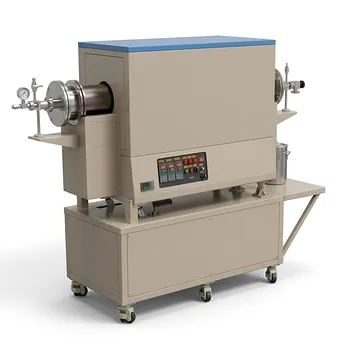
900°C Max Rotary Tube Furnace with 8 Inch 310S Alloy Tube and Optional Multi Zone Heating for Industrial Material Calcination
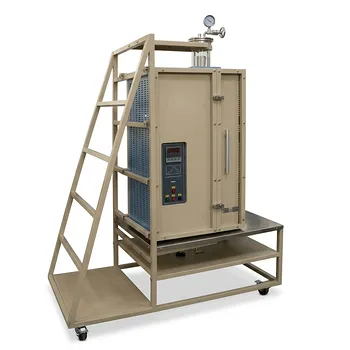
Split Vertical Tube Furnace with 1200C Quartz Tube and Stainless Steel Vacuum Flanges for Rapid Thermal Processing

High Temperature 1700C Tube Furnace with High Vacuum Turbomolecular Pump System and Multi Channel Mass Flow Controller Gas Mixer

1100C Tube Furnace with Vacuum Flange and Programmable Temperature Controller for Material Science and Industrial Heat Treatment

5 Inch Three Zone Rotary Tube Furnace with Integrated Gas Delivery System and 1200C Capability for Advanced Material CVD Processing

1700C Hydrogen Gas Tube Furnace with 60mm Alumina Process Tube and Integrated Hydrogen Safety Detector

1200°C 5 Inch Vertical Quartz Tube Furnace with Stainless Steel Vacuum Flanges

High Temperature 1700C Six Zone Split Tube Furnace with Alumina Tube and Water Cooled Flanges

Compact Vertical Split Quartz Tube Furnace with Stainless Steel Vacuum Flanges for Rapid Thermal Quenching and Controlled Atmosphere Material Processing

High Temperature 1700C Benchtop Tube Furnace with 5 Inch Heating Zone High Purity Alumina Tube and Vacuum Sealing Flanges
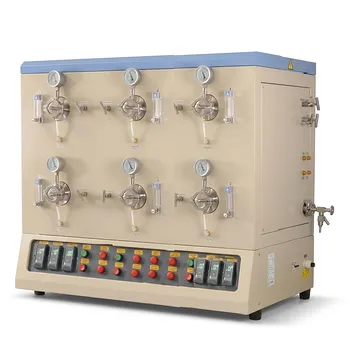
1200C High Throughput Multi Channel Tube Furnace with 50mm Quartz Tubes for Annealing and Material Phase Diagram Research

Three Zone Tube Furnace with 11 Inch or 15 Inch Quartz Tube and Hinged Flanges for Vacuum Atmosphere Heat Treatment

1800C High Temperature Compact Vacuum Tube Furnace with 60mm OD Alumina Tube and Kanthal MoSi2 Heating Elements

High Temperature 1700C Vertical Tube Furnace for Powder Spherification and Material Sintering
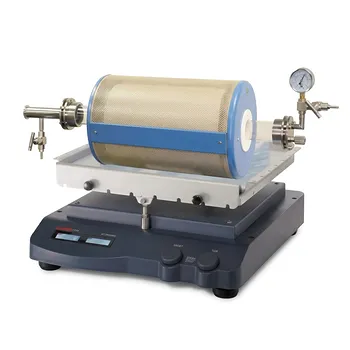
High Temperature Rocking Tube Furnace with Quartz Tube and Vacuum Flange for Materials Synthesis

High Temperature Automated 5 Inch Tube Furnace for Autonomous Material Research and Advanced Laboratory R&D
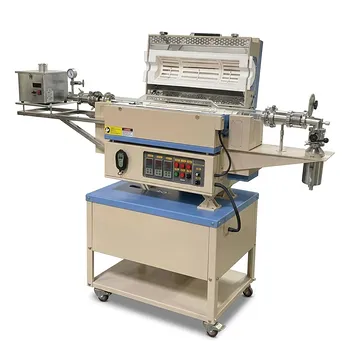
5 Inch Rotary Tube Furnace with Automatic Feeding and Receiving System 1200C Three Zone CVD Powder Processing