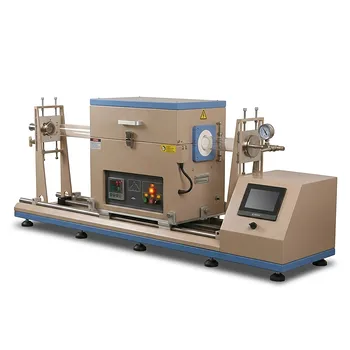
Why is a tube furnace equipped with an argon flow control system necessary for synthesizing porous doped carbon materials?
Updated 3 months ago
The necessity of a tube furnace with argon flow control stems from the need to create a strictly anaerobic, high-temperature environment for precise chemical transformation. This specialized equipment provides the stable thermal energy required for carbonization while the argon flow eliminates oxygen to prevent the immediate combustion of biomass precursors. By maintaining this inert atmosphere, the system ensures that heteroatoms like nitrogen and sulfur are successfully embedded into the carbon framework, resulting in a high-surface-area material with specific electrochemical properties.
Core Takeaway: A tube furnace with argon flow control is the essential foundation for synthesizing doped carbon because it enables high-temperature carbonization while preventing destructive oxidation. This controlled environment protects the material's microscopic morphology and ensures the successful integration of functional atoms and pore structures.
Preventing Oxidative Degradation at High Temperatures
Excluding Oxygen and Moisture
High-purity argon acts as an inert protective atmosphere that completely displaces oxygen and moisture within the furnace chamber. Without this displacement, carbon precursors would undergo oxidative combustion or "burning off" when exposed to temperatures reaching 700°C to 800°C.
Maintaining Material Integrity and Yield
The argon environment is critical for preserving the delicate microscopic morphology of materials, such as carbon nanofibers or nano-alloys. By preventing ablation—the erosive removal of material through oxidation—the system maximizes the final yield and ensures the carbon framework remains highly conductive.
Protecting Metal Nano-Alloys
In many doped carbon syntheses, metal ions are reduced into catalytically active nanoparticles within the carbon matrix. An oxygen-free environment is mandatory to prevent these metals from re-oxidizing, ensuring they maintain the intended valence states and catalytic activity.
Facilitating Chemical Doping and Pore Formation
Successful Heteroatom Embedding
The controlled thermal environment allows organic components to decompose and facilitates the embedding of heteroatoms like nitrogen, phosphorus, and sulfur into the carbon lattice. These "dopants" create high electrochemical activity structures that are essential for energy storage and catalysis applications.
Activation and Pore Development
A tube furnace provides the precise heat necessary for activators to react with the carbon precursor, creating the intricate pore structures required for high surface area. The continuous flow of argon ensures that the activation reactions occur under anaerobic conditions, leading to distinct and tunable pore architectures.
Management of Volatile Byproducts
As polymer ligands and organic precursors decompose, they release volatile organic compounds and gases. The argon flow control system effectively carries these byproducts away, preventing them from condensing and contaminating the catalyst or clogging the emerging pore structure.
Precision Control of the Reaction Environment
Thermal Stability and Ramp Rates
Laboratory-grade tube furnaces provide exceptional stability by allowing users to program specific temperature ramp rates. This precision ensures that pre-carbonization and final activation occur at the exact temperatures required for optimal material performance.
Atmosphere Switching and Regulation
Advanced flow control systems allow researchers to strictly regulate the atmosphere, such as switching between inert argon and air for controlled oxidation stages. This level of control is vital for fine-tuning the chemical properties of the carbon surface without destroying the underlying framework.
Understanding the Technical Trade-offs
Argon vs. Nitrogen Cost and Performance
While nitrogen is often used as an inert gas, argon is preferred for more sensitive syntheses because it is truly inert and heavier than air, providing a more effective blanket against oxygen. However, argon is significantly more expensive, which can increase the operational costs of long-duration carbonization processes.
Flow Rate Sensitivity
Setting the flow rate too low may allow for "back-diffusion" of oxygen into the tube, leading to partial oxidation of the sample. Conversely, an excessively high flow rate can cause localized cooling or even physically carry away fine precursor powders, potentially altering the intended synthesis outcomes.
How to Apply This to Your Synthesis Project
Choosing the Right Configuration for Your Goal
- If your primary focus is maximizing catalytic activity: Use high-purity argon (99.999%) to ensure metal nanoparticles remain in their reduced, active states without oxidation.
- If your primary focus is fine-tuning pore size: Prioritize a furnace with precision programmed temperature control to manage the specific activation stages accurately.
- If your primary focus is high-volume biomass conversion: Ensure the flow control system is robust enough to continuously remove large volumes of volatile byproducts released during decomposition.
Precise atmospheric and thermal control is the only way to transform raw organic precursors into high-performance, functionalized carbon materials.
Summary Table:
| Feature | Function | Impact on Synthesis |
|---|---|---|
| Inert Atmosphere | Displaces Oxygen/Moisture | Prevents oxidative combustion and material loss. |
| Flow Control | Removes Volatile Byproducts | Prevents sample contamination and pore clogging. |
| Temp Precision | Stable Thermal Ramp Rates | Ensures successful heteroatom embedding (N, S, P). |
| Atmosphere Purity | Protects Metal Nano-alloys | Maintains active valence states for catalysis. |
Elevate Your Material Science Research with THERMUNITS
Achieving precision in doped carbon synthesis requires a strictly controlled thermal environment. THERMUNITS is a leading manufacturer of high-temperature laboratory equipment, providing the advanced solutions necessary for cutting-edge industrial R&D.
Our comprehensive range of thermal processing equipment includes:
- Tube & Atmosphere Furnaces (with precision flow control)
- Vacuum, Muffle, and Rotary Furnaces
- CVD/PECVD Systems for advanced coating
- Vacuum Induction Melting (VIM) & Hot Press Furnaces
- Dental Furnaces & Electric Rotary Kilns
Whether you are fine-tuning pore architecture or scaling up biomass conversion, our equipment ensures the stability and purity your materials demand. Contact our technical experts today to find the perfect heat treatment solution for your laboratory.
References
- Souleymane Thior, Ncholu Manyala. Influence of water-in-salt electrolytes on the electrochemical performance of porous N and S co-doped carbon electrodes in supercapacitors. DOI: 10.1039/d4nj04507f
Mentioned Products
- Vertical 1700C Vacuum and Atmosphere Tube Furnace with 80mm Alumina Tube
- Compact High Temperature 1600C Tube Furnace with 50mm Alumina Tube and Vacuum Flanges for Material Sintering
- 900°C Max Rotary Tube Furnace with 8 Inch 310S Alloy Tube and Optional Multi Zone Heating for Industrial Material Calcination
- Split Vertical Tube Furnace with 1200C Quartz Tube and Stainless Steel Vacuum Flanges for Rapid Thermal Processing
- High Temperature 1700C Tube Furnace with High Vacuum Turbomolecular Pump System and Multi Channel Mass Flow Controller Gas Mixer
People Also Ask
- How is an industrial-grade vertical tube furnace utilized in smelting leaching residues? Enhance Metal Recovery Efficiency
- What is the function of a laboratory-grade vertical tube furnace in fast pyrolysis? Optimize Composite Research.
- How does a vertical tube furnace facilitate thermoelectric alloy melting? Precision synthesis for material homogeneity.
- Why is a thermocouple sensor indispensable for monitoring the vertical tube furnace during gallium oxide nanowire production? Optimize VLS Growth
- What are the advantages of using a vertical tube furnace for crucible experiments simulating steel-slag interactions?

Tech Team · ThermUnits
Last updated on Jun 03, 2026
Related Products

Vertical 1700C Vacuum and Atmosphere Tube Furnace with 80mm Alumina Tube

Compact High Temperature 1600C Tube Furnace with 50mm Alumina Tube and Vacuum Flanges for Material Sintering
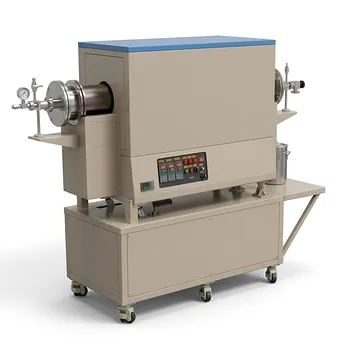
900°C Max Rotary Tube Furnace with 8 Inch 310S Alloy Tube and Optional Multi Zone Heating for Industrial Material Calcination
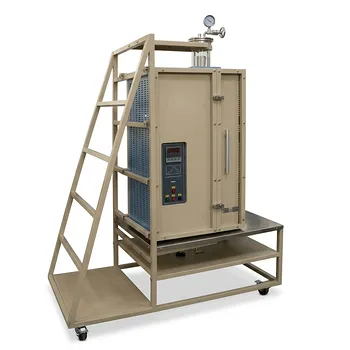
Split Vertical Tube Furnace with 1200C Quartz Tube and Stainless Steel Vacuum Flanges for Rapid Thermal Processing

High Temperature 1700C Tube Furnace with High Vacuum Turbomolecular Pump System and Multi Channel Mass Flow Controller Gas Mixer

1100C Tube Furnace with Vacuum Flange and Programmable Temperature Controller for Material Science and Industrial Heat Treatment

5 Inch Three Zone Rotary Tube Furnace with Integrated Gas Delivery System and 1200C Capability for Advanced Material CVD Processing

1200°C 5 Inch Vertical Quartz Tube Furnace with Stainless Steel Vacuum Flanges

High Temperature 1700C Six Zone Split Tube Furnace with Alumina Tube and Water Cooled Flanges

1700C Hydrogen Gas Tube Furnace with 60mm Alumina Process Tube and Integrated Hydrogen Safety Detector

Compact Vertical Split Quartz Tube Furnace with Stainless Steel Vacuum Flanges for Rapid Thermal Quenching and Controlled Atmosphere Material Processing

High Temperature 1700C Benchtop Tube Furnace with 5 Inch Heating Zone High Purity Alumina Tube and Vacuum Sealing Flanges

1200C High Throughput Multi Channel Tube Furnace with 50mm Quartz Tubes for Annealing and Material Phase Diagram Research

Three Zone Tube Furnace with 11 Inch or 15 Inch Quartz Tube and Hinged Flanges for Vacuum Atmosphere Heat Treatment

1800C High Temperature Compact Vacuum Tube Furnace with 60mm OD Alumina Tube and Kanthal MoSi2 Heating Elements

High Temperature 1700C Vertical Tube Furnace for Powder Spherification and Material Sintering
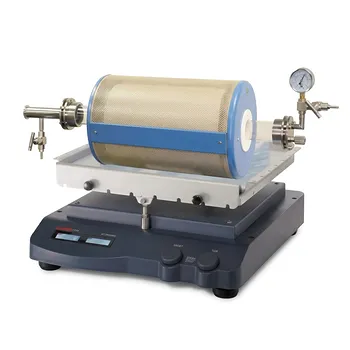
High Temperature Rocking Tube Furnace with Quartz Tube and Vacuum Flange for Materials Synthesis

High Temperature Automated 5 Inch Tube Furnace for Autonomous Material Research and Advanced Laboratory R&D
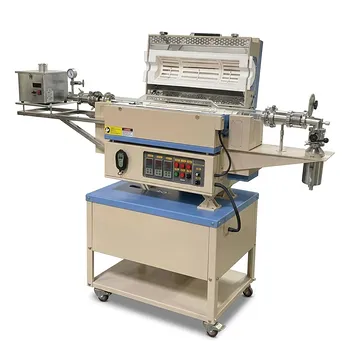
5 Inch Rotary Tube Furnace with Automatic Feeding and Receiving System 1200C Three Zone CVD Powder Processing