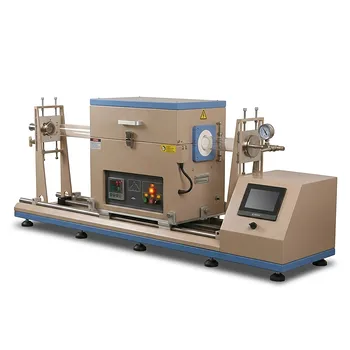
Why is a tube furnace providing a H2/Ar mixed atmosphere required for CrI3 stacks? Achieve Superior Interface Purity
Updated 3 months ago
The use of a Hydrogen/Argon (H2/Ar) mixed atmosphere in a tube furnace is essential for the pretreatment of the graphite substrates used in CrI3 stacks. At temperatures around 600°C, this specific environment facilitates the removal of organic residues and surface contaminants that accumulate during substrate preparation. By cleaning the graphite at a molecular level, the process ensures superior adhesion and high interface quality during the subsequent transfer of thin-layer Chromium Triiodide, which is critical for achieving high-purity experimental results.
Core Takeaway: The H2/Ar atmosphere acts as a high-temperature cleaning agent that strips contaminants from the substrate surface. This preparation is vital for ensuring the structural integrity and electronic purity of the CrI3 interface by preventing trapped residues from degrading the sample.
Ensuring Pristine Interface Quality
Removing Microscopic Surface Residues
The primary technical hurdle in 2D material stacking is the presence of residues on the substrate. The H2/Ar mixed atmosphere at 600°C chemically interacts with and carries away these contaminants.
This thermal process targets residues that standard solvent cleaning cannot reach. Without this step, trapped particles can create "bubbles" or pinholes in the CrI3 flakes, leading to inconsistent data or device failure.
Enhancing Adhesion for Material Transfer
A clean graphite surface provides a higher energy interface, which significantly improves the adhesion of the thin-layer CrI3. This is necessary because atomic-level contact is required for the stack to remain stable.
Improved adhesion ensures that the CrI3 layers remain flat and uniform. This uniformity is a prerequisite for studying the intrinsic properties of the material without interference from physical defects or structural gaps.
The Dual Role of the Reducing Atmosphere
The Protective Function of Argon
Argon serves as a chemically inert carrier gas that displaces oxygen and moisture within the tube furnace. This displacement prevents the graphite substrate or the furnace components from oxidizing or burning at the 600°C setpoint.
By creating an oxygen-free environment, the furnace ensures that mass loss is driven only by the removal of unwanted contaminants. This preserves the microscopic morphology of the graphite for the subsequent transfer process.
The Reducing Action of Hydrogen
Hydrogen acts as a reducing agent that actively reacts with oxide layers and other chemical impurities. While Argon provides a "shield," Hydrogen provides a "scouring" effect.
This combination is vital for converting surface oxides back into their elemental forms or volatile byproducts. The result is a chemically reduced surface that is optimized for the van der Waals bonding required in CrI3 heterostructures.
Understanding the Technical Trade-offs
Temperature Sensitivity
While 600°C is effective for cleaning, exceeding the recommended temperature limits can lead to substrate damage. Excessive heat may cause unwanted diffusion or structural changes in the graphite lattice.
Maintaining a precise thermal field is necessary to balance the energy required for cleaning with the need to maintain the substrate's structural integrity.
Safety and Gas Concentration
The ratio of Hydrogen to Argon must be carefully managed to remain below explosive limits. High-purity gas flows are required to avoid introducing trace contaminants through the gas lines themselves.
Furthermore, the cooling phase must also be protected. If the atmosphere is removed before the sample reaches room temperature, residual oxygen can immediately re-contaminate the freshly cleaned surface.
How to Apply These Principles to Your Process
To achieve the highest quality CrI3 stacks, the heat treatment process must be meticulously controlled within the tube furnace.
- If your primary focus is maximizing sample purity: Ensure the furnace is purged with Argon for a sufficient duration before introducing Hydrogen to completely eliminate atmospheric oxygen.
- If your primary focus is structural integrity of the 2D stack: Maintain the 600°C setpoint precisely and ensure the gas flow is uniform to avoid localized temperature gradients that could warp the substrate.
- If your primary focus is batch consistency: Standardize the cooling rate under the H2/Ar atmosphere to prevent the "re-oxidation" of the graphite before the CrI3 transfer occurs.
Mastering the high-temperature reducing environment of the tube furnace is the definitive step in transforming a standard substrate into a high-performance platform for 2D material research.
Summary Table:
| Component/Parameter | Role in Heat Treatment | Key Benefit for CrI3 Stacks |
|---|---|---|
| Argon (Ar) | Inert Carrier Gas | Displaces oxygen to prevent substrate oxidation. |
| Hydrogen (H2) | Reducing Agent | Chemically strips microscopic oxides and residues. |
| 600°C Temperature | Thermal Activation | Enables high-level cleaning without structural damage. |
| Tube Furnace | Environment Control | Maintains precise gas ratios and uniform thermal fields. |
Optimize Your Research with THERMUNITS High-Performance Furnaces
As a global leader in high-temperature laboratory equipment, THERMUNITS provides the specialized thermal processing solutions required for cutting-edge material science. From Tube and Vacuum furnaces optimized for H2/Ar atmospheres to advanced CVD/PECVD systems, we empower researchers to achieve the ultimate interface purity in CrI3 stacks and other 2D materials.
Our equipment, including Muffle, Rotary, and Hot Press furnaces, is designed for the rigorous demands of industrial R&D and academic excellence. Contact us today to discuss your specific heat treatment requirements and see how our expertise in thermal elements and furnace design can accelerate your next breakthrough.
References
- Myeongjin Jang, Kwanpyo Kim. Direct observation of twisted stacking domains in the van der Waals magnet CrI3. DOI: 10.1038/s41467-024-50314-z
Mentioned Products
- Vertical 1700C Vacuum and Atmosphere Tube Furnace with 80mm Alumina Tube
- Compact High Temperature 1600C Tube Furnace with 50mm Alumina Tube and Vacuum Flanges for Material Sintering
- 900°C Max Rotary Tube Furnace with 8 Inch 310S Alloy Tube and Optional Multi Zone Heating for Industrial Material Calcination
- Split Vertical Tube Furnace with 1200C Quartz Tube and Stainless Steel Vacuum Flanges for Rapid Thermal Processing
- High Temperature 1700C Tube Furnace with High Vacuum Turbomolecular Pump System and Multi Channel Mass Flow Controller Gas Mixer
People Also Ask
- How is an industrial-grade vertical tube furnace utilized in smelting leaching residues? Enhance Metal Recovery Efficiency
- What is the function of a laboratory-grade vertical tube furnace in fast pyrolysis? Optimize Composite Research.
- How does a vertical tube furnace facilitate thermoelectric alloy melting? Precision synthesis for material homogeneity.
- Why is a thermocouple sensor indispensable for monitoring the vertical tube furnace during gallium oxide nanowire production? Optimize VLS Growth
- What are the advantages of using a vertical tube furnace for crucible experiments simulating steel-slag interactions?

Tech Team · ThermUnits
Last updated on Jun 02, 2026
Related Products

Vertical 1700C Vacuum and Atmosphere Tube Furnace with 80mm Alumina Tube

Compact High Temperature 1600C Tube Furnace with 50mm Alumina Tube and Vacuum Flanges for Material Sintering
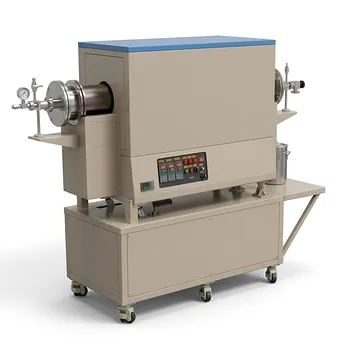
900°C Max Rotary Tube Furnace with 8 Inch 310S Alloy Tube and Optional Multi Zone Heating for Industrial Material Calcination
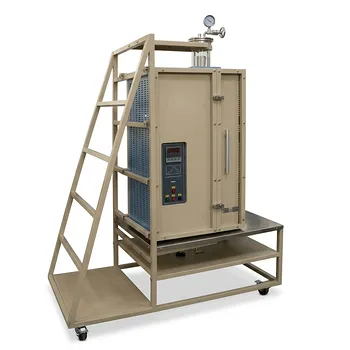
Split Vertical Tube Furnace with 1200C Quartz Tube and Stainless Steel Vacuum Flanges for Rapid Thermal Processing

High Temperature 1700C Tube Furnace with High Vacuum Turbomolecular Pump System and Multi Channel Mass Flow Controller Gas Mixer

1100C Tube Furnace with Vacuum Flange and Programmable Temperature Controller for Material Science and Industrial Heat Treatment

5 Inch Three Zone Rotary Tube Furnace with Integrated Gas Delivery System and 1200C Capability for Advanced Material CVD Processing

1700C Hydrogen Gas Tube Furnace with 60mm Alumina Process Tube and Integrated Hydrogen Safety Detector
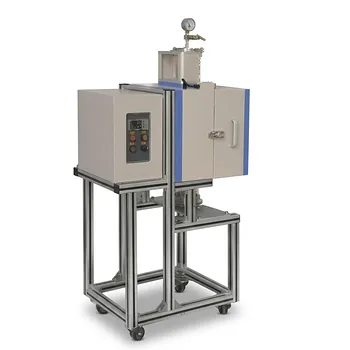
1200°C 5 Inch Vertical Quartz Tube Furnace with Stainless Steel Vacuum Flanges

High Temperature 1700C Six Zone Split Tube Furnace with Alumina Tube and Water Cooled Flanges

Compact Vertical Split Quartz Tube Furnace with Stainless Steel Vacuum Flanges for Rapid Thermal Quenching and Controlled Atmosphere Material Processing

High Temperature 1700C Benchtop Tube Furnace with 5 Inch Heating Zone High Purity Alumina Tube and Vacuum Sealing Flanges

1200C High Throughput Multi Channel Tube Furnace with 50mm Quartz Tubes for Annealing and Material Phase Diagram Research

Three Zone Tube Furnace with 11 Inch or 15 Inch Quartz Tube and Hinged Flanges for Vacuum Atmosphere Heat Treatment

1800C High Temperature Compact Vacuum Tube Furnace with 60mm OD Alumina Tube and Kanthal MoSi2 Heating Elements

High Temperature 1700C Vertical Tube Furnace for Powder Spherification and Material Sintering
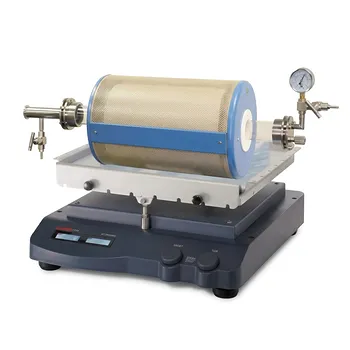
High Temperature Rocking Tube Furnace with Quartz Tube and Vacuum Flange for Materials Synthesis

High Temperature Automated 5 Inch Tube Furnace for Autonomous Material Research and Advanced Laboratory R&D
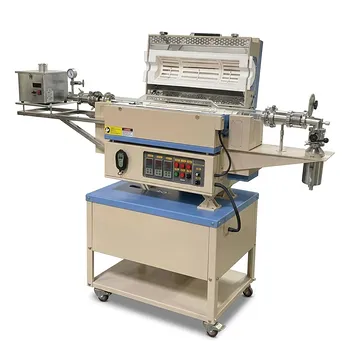
5 Inch Rotary Tube Furnace with Automatic Feeding and Receiving System 1200C Three Zone CVD Powder Processing