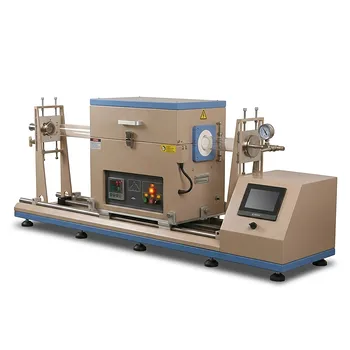
Why is high-purity CO2 gas introduced into a tube furnace during the carbonization reaction of magnesium alloy surfaces?
Updated 3 months ago
High-purity $CO_2$ functions as both a critical chemical reactant and a protective shield during the thermal treatment of magnesium alloys. In this specific carbonization process, the $CO_2$ gas reacts directly with pre-deposited magnesium oxide ($MgO$) to synthesize thermodynamically stable magnesium carbonate ($MgCO_3$) crystals. This gas-solid interface reaction is the fundamental mechanism required to construct a dense, high-performance anti-corrosion layer on the alloy surface.
Core Takeaway: High-purity $CO_2$ is indispensable because it transforms a basic oxide surface into a robust magnesium carbonate barrier through a catalyzed chemical reaction, while simultaneously preventing uncontrolled oxidation of the underlying metal.
The Dual Role of Carbon Dioxide in Surface Carbonization
$CO_2$ as an Active Chemical Reactant
Unlike inert gases like Argon or Nitrogen, $CO_2$ is a primary participant in the chemical synthesis occurring within the tube furnace. When introduced to the magnesium alloy surface, it reacts with $MgO$ that has been pre-deposited on the substrate.
This reaction is facilitated by a molten Lithium Nitrate ($LiNO_3$) salt catalyst, which allows the $CO_2$ to be absorbed efficiently. The result is the formation of Magnesium Carbonate ($MgCO_3$), a crystalline structure that provides significantly better chemical stability than simple oxides.
Establishing a Protective Atmosphere
While $CO_2$ is reacting, it also serves the mechanical purpose of displacing ambient oxygen and moisture. Magnesium alloys are highly reactive at elevated temperatures and will oxidize or even ignite if exposed to air.
By maintaining a continuous flow of high-purity $CO_2$, the furnace environment remains controlled. This ensures that the only reactions occurring are those intended for the anti-corrosion layer, rather than destructive oxidative combustion.
Kinetic and Structural Impact on the Alloy
The Gas-Solid Interface Reaction
The success of the carbonization process depends on the kinetics of the gas-solid interface. High-purity $CO_2$ ensures that the concentration of the reactant is consistent across the entire surface of the alloy.
This consistency allows for the growth of a dense, uniform layer of crystals. A high concentration of $CO_2$ is necessary to drive the reaction forward to completion, ensuring the resulting layer is non-porous and mechanically sound.
Achieving Thermodynamic Stability
The conversion of $MgO$ to $MgCO_3$ is a move toward a more thermodynamically stable state. This stability is what gives the magnesium alloy its enhanced resistance to environmental degradation.
Without the introduction of $CO_2$, the surface would remain as a relatively weak oxide layer. The carbonization reaction essentially "locks" the surface into a state that is far less susceptible to the corrosive effects of moisture and salts.
Understanding the Trade-offs and Pitfalls
Purity vs. Contamination
The use of "high-purity" gas is not optional; any oxygen or water vapor impurities in the $CO_2$ stream can lead to the formation of hydroxides or secondary oxides. These impurities create defects in the $MgCO_3$ crystal lattice, which act as "weak points" where corrosion can begin.
Temperature Sensitivity
While $CO_2$ is used for building layers in magnesium alloys, in other carbonization contexts (like carbon sphere gels), $CO_2$ at high temperatures (900°C) is used for physical activation or etching. If temperatures are not strictly controlled during magnesium alloy treatment, there is a risk of over-reacting or "etching" the surface rather than building a dense protective barrier.
How to Apply This to Your Surface Treatment Goal
To achieve the best results in magnesium alloy carbonization, you must align your gas flow strategy with your specific material objectives.
- If your primary focus is maximum corrosion resistance: Ensure the $CO_2$ flow is consistent and the gas is of the highest available purity to prevent lattice defects in the carbonate layer.
- If your primary focus is layer thickness and density: Optimize the concentration of the $LiNO_3$ catalyst in conjunction with the $CO_2$ flow rate to accelerate the gas-solid interface reaction.
- If your primary focus is preventing alloy oxidation: Ensure the tube furnace is fully purged with $CO_2$ before raising the temperature to the reaction threshold.
By treating $CO_2$ as a precise chemical reagent rather than a simple shielding gas, you can successfully engineer a surface layer that fundamentally alters the durability of magnesium alloys.
Summary Table:
| Role of CO2 | Mechanism / Function | Key Outcome |
|---|---|---|
| Chemical Reactant | Reacts with MgO via LiNO3 catalyst | Formation of stable MgCO3 crystals |
| Protective Shield | Displaces O2 and ambient moisture | Prevents alloy oxidation and ignition |
| Kinetic Driver | Consistent gas-solid interface | Creates a dense, non-porous layer |
| Purity Guard | Minimizes oxygen/vapor impurities | Eliminates lattice defects and weak points |
Optimize Your Material Research with THERMUNITS
Precise surface engineering requires absolute control over thermal and atmospheric conditions. THERMUNITS is a leading manufacturer of high-temperature laboratory equipment, providing the advanced technology needed for critical material science R&D.
Our high-performance Tube Furnaces and Atmosphere Furnaces are specifically designed to handle complex gas-solid interface reactions like magnesium alloy carbonization with unmatched precision. From CVD/PECVD systems to Vacuum Induction Melting (VIM) and Rotary Kilns, we offer a comprehensive range of thermal processing solutions tailored to your specific lab requirements.
Enhance your heat treatment results with THERMUNITS today.
References
- Gyoung Gug Jang, Vineet V. Joshi. Lithium nitrate salt-assisted CO<sub>2</sub> absorption for the formation of corrosion barrier layer on AZ91D magnesium alloy. DOI: 10.1039/d4ra02829e
Mentioned Products
- Vertical 1700C Vacuum and Atmosphere Tube Furnace with 80mm Alumina Tube
- Compact High Temperature 1600C Tube Furnace with 50mm Alumina Tube and Vacuum Flanges for Material Sintering
- 900°C Max Rotary Tube Furnace with 8 Inch 310S Alloy Tube and Optional Multi Zone Heating for Industrial Material Calcination
- Split Vertical Tube Furnace with 1200C Quartz Tube and Stainless Steel Vacuum Flanges for Rapid Thermal Processing
- High Temperature 1700C Tube Furnace with High Vacuum Turbomolecular Pump System and Multi Channel Mass Flow Controller Gas Mixer
People Also Ask
- How is an industrial-grade vertical tube furnace utilized in smelting leaching residues? Enhance Metal Recovery Efficiency
- What is the function of a laboratory-grade vertical tube furnace in fast pyrolysis? Optimize Composite Research.
- How does a vertical tube furnace facilitate thermoelectric alloy melting? Precision synthesis for material homogeneity.
- Why is a thermocouple sensor indispensable for monitoring the vertical tube furnace during gallium oxide nanowire production? Optimize VLS Growth
- What are the advantages of using a vertical tube furnace for crucible experiments simulating steel-slag interactions?

Tech Team · ThermUnits
Last updated on Jun 02, 2026
Related Products

Vertical 1700C Vacuum and Atmosphere Tube Furnace with 80mm Alumina Tube

Compact High Temperature 1600C Tube Furnace with 50mm Alumina Tube and Vacuum Flanges for Material Sintering
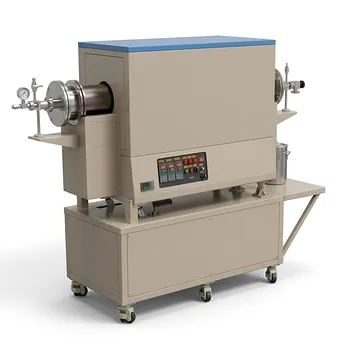
900°C Max Rotary Tube Furnace with 8 Inch 310S Alloy Tube and Optional Multi Zone Heating for Industrial Material Calcination
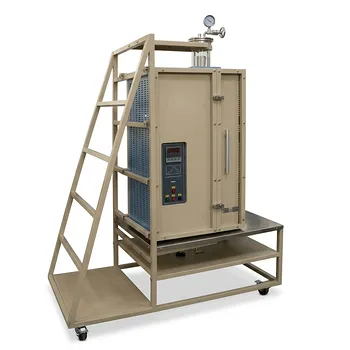
Split Vertical Tube Furnace with 1200C Quartz Tube and Stainless Steel Vacuum Flanges for Rapid Thermal Processing

High Temperature 1700C Tube Furnace with High Vacuum Turbomolecular Pump System and Multi Channel Mass Flow Controller Gas Mixer

1100C Tube Furnace with Vacuum Flange and Programmable Temperature Controller for Material Science and Industrial Heat Treatment

5 Inch Three Zone Rotary Tube Furnace with Integrated Gas Delivery System and 1200C Capability for Advanced Material CVD Processing

1200°C 5 Inch Vertical Quartz Tube Furnace with Stainless Steel Vacuum Flanges

High Temperature 1700C Six Zone Split Tube Furnace with Alumina Tube and Water Cooled Flanges

1700C Hydrogen Gas Tube Furnace with 60mm Alumina Process Tube and Integrated Hydrogen Safety Detector

Compact Vertical Split Quartz Tube Furnace with Stainless Steel Vacuum Flanges for Rapid Thermal Quenching and Controlled Atmosphere Material Processing

High Temperature 1700C Benchtop Tube Furnace with 5 Inch Heating Zone High Purity Alumina Tube and Vacuum Sealing Flanges

1200C High Throughput Multi Channel Tube Furnace with 50mm Quartz Tubes for Annealing and Material Phase Diagram Research

1800C High Temperature Compact Vacuum Tube Furnace with 60mm OD Alumina Tube and Kanthal MoSi2 Heating Elements

Three Zone Tube Furnace with 11 Inch or 15 Inch Quartz Tube and Hinged Flanges for Vacuum Atmosphere Heat Treatment

High Temperature 1700C Vertical Tube Furnace for Powder Spherification and Material Sintering
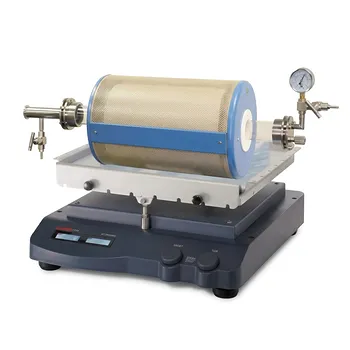
High Temperature Rocking Tube Furnace with Quartz Tube and Vacuum Flange for Materials Synthesis

High Temperature Automated 5 Inch Tube Furnace for Autonomous Material Research and Advanced Laboratory R&D
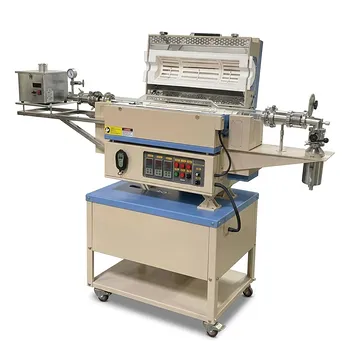
5 Inch Rotary Tube Furnace with Automatic Feeding and Receiving System 1200C Three Zone CVD Powder Processing