How does a tube furnace facilitate the conversion of MnNi2O4 into NiS2/NiS/Mn2O3? Precision Gas-Solid Synthesis
Updated 3 months ago
A tube furnace facilitates the conversion of $\text{MnNi}_2\text{O}_4$ into a $\text{NiS}_2/\text{NiS}/\text{Mn}_2\text{O}_3$ composite by acting as a controlled micro-reactor that enables a precise gas-solid interface reaction. By sublimating solid sulfur into a vapor and transporting it via an inert carrier gas, the furnace allows for the partial sulfurization of the oxide precursor under strictly regulated thermal conditions.
The tube furnace provides the dual necessity of a high-temperature environment and a chemically isolated atmosphere. This setup ensures that sulfur vapor reacts uniformly with the $\text{MnNi}_2\text{O}_4$ nanofibers while preventing unwanted secondary oxidation from the surrounding air.
Mechanisms of Chemical Transformation
Controlled Sublimation and Vapor Transport
The process begins by placing sulfur powder upstream and the $\text{MnNi}_2\text{O}_4$ precursor downstream within the furnace tube. As the furnace heats, the sulfur sublimates into a vapor, which is then carried by a gas (typically nitrogen) toward the sample.
The Gas-Solid Interface Reaction
The conversion occurs when the sulfur vapor comes into contact with the solid $\text{MnNi}_2\text{O}_4$ surface. This gas-solid interface reaction allows sulfur atoms to integrate into the crystal lattice, facilitating the phase transformation into nickel sulfides ($\text{NiS}_2$ and $\text{NiS}$) while the remaining oxide transitions to $\text{Mn}_2\text{O}_3$.
Uniform Atmospheric Concentration
The enclosed nature of the tube furnace ensures a stable concentration of sulfur in the reaction atmosphere. Because the carrier gas moves at a constant rate, the sulfur vapor is distributed evenly across the material, resulting in a composite catalyst with uniform components.
Thermal and Environmental Control
Isolation via Inert Atmosphere
A critical function of the tube furnace is maintaining a nitrogen-filled environment. This inert atmosphere is essential because it prevents the unnecessary oxidation of the newly formed sulfides, which would otherwise occur at high temperatures if oxygen were present.
Precision Temperature Fields
The furnace provides a uniform temperature field that is vital for the crystallization of the product. By controlling the heating rate (e.g., $5\text{ °C/min}$) and maintaining a specific dwell temperature, the furnace ensures the stability of the thermophysical properties of the resulting nanofibers.
Phase Transformation and Crystallization
High-temperature processing within the furnace facilitates the chemical decomposition and subsequent crystallization of the precursor. This precise thermal energy allows the material to reach the desired spinel or multiphase structures necessary for high-performance applications like electrocatalysis.
Understanding the Trade-offs
Mass Transport Limitations
One primary challenge is the reliance on diffusion and flow rates; if the carrier gas flow is too high, sulfur vapor may pass the sample too quickly to react. Conversely, if the flow is too low, the sulfurization may be non-uniform, leading to a core-shell structure rather than a fully integrated composite.
Thermal Gradients and Scaling
While tube furnaces provide excellent uniformity at a small scale, thermal gradients can develop in larger tubes. These variations can lead to inconsistent phase ratios between the $\text{NiS}_2$, $\text{NiS}$, and $\text{Mn}_2\text{O}_3$ components across different areas of the sample batch.
Precursor Sensitivity
The success of the conversion is highly dependent on the microstructure of the precursor. If the $\text{MnNi}_2\text{O}_4$ is too dense, the sulfur vapor may only react with the surface, leaving the interior unreacted and creating a material with inconsistent electrical and chemical properties.
Optimizing the Synthesis for Specific Goals
How to Apply This to Your Project
- If your primary focus is phase purity: Ensure the sulfur powder is placed in the optimal upstream "hot zone" to maintain a saturation of vapor throughout the dwell time.
- If your primary focus is nanofiber morphology: Use a slow heating ramp rate to prevent the rapid decomposition of organic components, which helps maintain the structural integrity of the fibers.
- If your primary focus is electrical conductivity: Maintain a strictly inert nitrogen environment to ensure the formation of a conductive sulfide layer without interference from oxide impurities.
By mastering the spatial layout and thermal parameters of the tube furnace, you can precisely engineer the complex phase transitions required for advanced transition metal sulfide catalysts.
Summary Table:
| Key Feature | Role in Material Conversion | Benefit to Catalyst Synthesis |
|---|---|---|
| Controlled Sublimation | Vaporizes solid sulfur upstream | Enables precise gas-solid interface reactions |
| Inert Atmosphere (N2) | Prevents secondary oxidation | Maintains high purity of NiS2/NiS phases |
| Uniform Thermal Field | Regulates crystallization rates | Ensures stable thermophysical properties |
| Mass Transport Flow | Transports sulfur vapor via carrier gas | Achieves uniform distribution across nanofibers |
Elevate Your Material Research with THERMUNITS
Precision in thermal processing is the difference between a failed experiment and a breakthrough in material science. THERMUNITS is a leading manufacturer of high-temperature laboratory equipment, providing researchers with the exact control needed for complex phase transformations.
Our advanced solutions, including Tube Furnaces, CVD/PECVD systems, and Vacuum Atmosphere Furnaces, are engineered to deliver the uniform temperature fields and chemically isolated environments required for high-performance electrocatalysis R&D. Whether you are performing sulfurization, calcination, or sintering, our equipment ensures repeatable and high-quality results for industrial and academic laboratories.
Ready to optimize your heat treatment process? Contact our technical team today to find the perfect thermal solution for your specific material goals.
References
- Bin Yang, Mingyi Zhang. NiS2/NiS/Mn2O3 Nanofibers with Enhanced Oxygen Evolution Reaction Activity. DOI: 10.3390/molecules29163892
Mentioned Products
- High Temperature Tube Furnace 1500C with Sliding Flanges and 50mm OD for Rapid Thermal Processing Fast Heating and Cooling
- Vertical 1700C Vacuum and Atmosphere Tube Furnace with 80mm Alumina Tube
- 1100C Tube Furnace with Vacuum Flange and Programmable Temperature Controller for Material Science and Industrial Heat Treatment
- Compact High Temperature 1600C Tube Furnace with 50mm Alumina Tube and Vacuum Flanges for Material Sintering
- 900°C Max Rotary Tube Furnace with 8 Inch 310S Alloy Tube and Optional Multi Zone Heating for Industrial Material Calcination
People Also Ask
- How are high-temperature tube furnaces utilized to repair etching damage? Precision Lattice Restoration Solutions
- What role does a high-temperature tube furnace play in CVD synthesis of silicon nanowires? Master VLS Growth Precision.
- What core conditions does a high-temperature tube furnace provide for rGO aerogels? Mastering Precision Synthesis.
- What role does a high-temperature tube furnace play in the sulfidation heat treatment of CoS@C/MXene nanocomposites? Guide
- How does precision tube furnace control influence CoFe nanoparticle formation? Master Your Bimetallic Synthesis.

Tech Team · ThermUnits
Last updated on Jun 03, 2026
Related Products

High Temperature Tube Furnace 1500C with Sliding Flanges and 50mm OD for Rapid Thermal Processing Fast Heating and Cooling

Vertical 1700C Vacuum and Atmosphere Tube Furnace with 80mm Alumina Tube

1100C Tube Furnace with Vacuum Flange and Programmable Temperature Controller for Material Science and Industrial Heat Treatment

Compact High Temperature 1600C Tube Furnace with 50mm Alumina Tube and Vacuum Flanges for Material Sintering
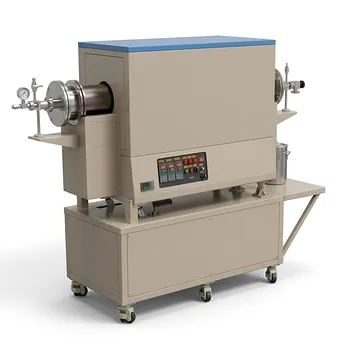
900°C Max Rotary Tube Furnace with 8 Inch 310S Alloy Tube and Optional Multi Zone Heating for Industrial Material Calcination

1700C Hydrogen Gas Tube Furnace with 60mm Alumina Process Tube and Integrated Hydrogen Safety Detector

High Temperature 1700C Tube Furnace with High Vacuum Turbomolecular Pump System and Multi Channel Mass Flow Controller Gas Mixer

5 Inch Three Zone Rotary Tube Furnace with Integrated Gas Delivery System and 1200C Capability for Advanced Material CVD Processing

Three Zone Tube Furnace with 11 Inch or 15 Inch Quartz Tube and Hinged Flanges for Vacuum Atmosphere Heat Treatment
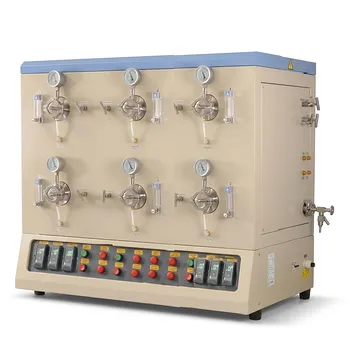
1200C High Throughput Multi Channel Tube Furnace with 50mm Quartz Tubes for Annealing and Material Phase Diagram Research

1200°C 5 Inch Vertical Quartz Tube Furnace with Stainless Steel Vacuum Flanges

1800C High Temperature Compact Vacuum Tube Furnace with 60mm OD Alumina Tube and Kanthal MoSi2 Heating Elements

High Temperature 1700C Benchtop Tube Furnace with 5 Inch Heating Zone High Purity Alumina Tube and Vacuum Sealing Flanges
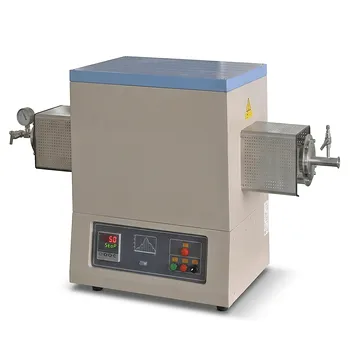
High Temperature 1700C Tube Furnace with 4 Inch OD Alumina Tube and Vacuum Sealing Flanges

Compact Vertical Split Quartz Tube Furnace with Stainless Steel Vacuum Flanges for Rapid Thermal Quenching and Controlled Atmosphere Material Processing

High Temperature 1700C Six Zone Split Tube Furnace with Alumina Tube and Water Cooled Flanges
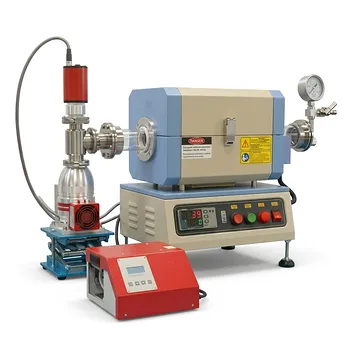
High Vacuum Compact Tube Furnace 1200C with Integrated Turbo Pump System and 8 Inch Heating Zone
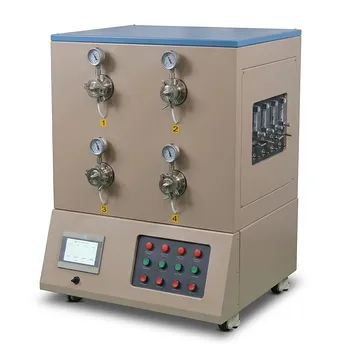
High Throughput 1200C Four Channel Tube Furnace with 3 Inch Quartz Tubes for Multi Zone Annealing and Material Research

High Temperature Automated 5 Inch Tube Furnace for Autonomous Material Research and Advanced Laboratory R&D
