What are the key functions of an argon atmosphere tube furnace in CoxFe1−x–Mo2C‐80 prep? Achieve High-Purity Synthesis
Updated 3 months ago
The argon atmosphere tube furnace is the fundamental environment for the thermal synthesis of $Co_xFe_{1-x}–Mo_2C-80$ heterostructures. It serves as a controlled micro-reactor that prevents the oxidative degradation of carbon and metal components at temperatures reaching $700^\circ C$. By regulating the chemical environment and thermal profile, the furnace facilitates the simultaneous conversion of organic precursors into nitrogen-doped graphitic carbon and the crystallization of molybdenum carbide ($Mo_2C$) alongside metallic cobalt and iron.
The tube furnace functions as a critical protective and transformative vessel, ensuring that precursors transition into high-purity, multi-phase heterostructures without the interference of oxygen. It orchestrates the delicate balance between organic carbonization and metallic solidification through precise atmospheric and thermal control.
Maintaining Chemical Integrity through Inert Protection
Prevention of High-Temperature Oxidation
At the synthesis temperature of $700^\circ C$, both the carbon framework and the metallic components ($Co$ and $Fe$) are highly susceptible to oxidation. The argon atmosphere provides a strict inert barrier that displaces oxygen, ensuring the materials do not turn into unwanted oxides.
Facilitating Reductive Carbonization
The furnace environment allows for the "smooth" conversion of organic precursors into nitrogen-doped graphitic carbon. This inert setting is essential for maintaining the nitrogen content within the carbon lattice, which is vital for the final heterostructure's electronic properties.
Ensuring Phase Purity
By excluding atmospheric contaminants, the tube furnace ensures that the molybdenum source reacts exclusively with the intended carbon sources. This results in the formation of high-purity $Mo_2C$ phases rather than molybdenum oxides or impure carbides.
Orchestrating Material Transformation
Precision Thermal Profiling
The ability to control the heating rate—specifically at a slow pace such as $3^\circ C/min$—is critical for uniform precursor decomposition. This prevents rapid gas evolution that could rupture the developing carbon framework or lead to non-uniform particle sizes.
Synergistic Solidification
The furnace manages the "constant temperature phases" (soaking time) required for cobalt and iron metals to solidify synergistically with the $Mo_2C$. This controlled dwell time allows the different phases to interface correctly, creating the desired heterostructure rather than a simple physical mixture.
In-Situ Matrix Development
While the metals and carbides are crystallizing, the furnace simultaneously drives the graphitization of the surrounding carbon. This creates a conductive, nitrogen-doped matrix that physically supports and electrically connects the active $Co_xFe_{1-x}$ and $Mo_2C$ sites.
Understanding the Trade-offs
Gas Purity and Flow Dynamics
The effectiveness of the furnace is entirely dependent on the purity of the argon gas; even trace amounts of oxygen can lead to surface oxidation. Additionally, while high flow rates ensure a clean atmosphere, they can cause temperature fluctuations or strip away volatile intermediate species necessary for the reaction.
Thermal Gradients
In a tube furnace, the temperature at the center (the "hot zone") may differ significantly from the ends of the tube. If the precursor boat is not placed precisely, the $Co_xFe_{1-x}–Mo_2C-80$ heterostructure may suffer from inconsistent crystallization or incomplete carbonization.
Complexity of Precursor Evolution
Managing the transition of organic precursors is a delicate process. If the heating rate is too high, the nitrogen-doping process may be inefficient; if it is too low, the energy consumption increases and the throughput of the material synthesis decreases.
How to Apply This to Your Synthesis Goal
Professional Recommendations for Heterostructure Preparation
- If your primary focus is Phase Purity: Ensure a rigorous pre-purging cycle with high-purity argon (99.999%) to eliminate all residual oxygen before initiating the heating program.
- If your primary focus is Morphological Control: Prioritize the precision of your heating rate (e.g., $3^\circ C/min$) to allow for steady gas release and uniform crystallization of the $Mo_2C$ and metallic alloys.
- If your primary focus is High Conductivity: Optimize the constant temperature phase at $700^\circ C$ to ensure the nitrogen-doped graphitic carbon is fully formed and well-integrated with the metallic cores.
Mastery of the tube furnace's atmospheric and thermal parameters is the defining factor in achieving the synergistic properties required for advanced $Co_xFe_{1-x}–Mo_2C-80$ heterostructures.
Summary Table:
| Key Function | Impact on Heterostructure | Critical Parameter |
|---|---|---|
| Inert Protection | Prevents metallic oxidation & preserves nitrogen content | Argon Purity (99.999%) |
| Thermal Profiling | Ensures uniform precursor decomposition & particle size | Heating Rate (3°C/min) |
| Phase Purity | Drives Mo2C crystallization without oxide contamination | Gas Flow Dynamics |
| Matrix Development | Facilitates N-doped graphitization for high conductivity | Dwell Time at 700°C |
Elevate Your Material Research with THERMUNITS
Precision is the defining factor in advanced material synthesis. As a leading manufacturer of high-temperature laboratory equipment, THERMUNITS provides the specialized thermal processing solutions required for complex R&D like $Co_xFe_{1-x}–Mo_2C-80$ heterostructures.
From high-purity Atmosphere and Vacuum Tube Furnaces to advanced CVD/PECVD systems, Muffle Furnaces, and Vacuum Induction Melting (VIM) units, our equipment is designed to deliver the exact thermal profiles and atmospheric control your project demands.
Ready to optimize your lab’s efficiency and synthesis quality?
Contact our expert team today to find the perfect heating solution for your material science needs!
References
- Md. Selim Arif Sher Shah, Jong Hyeok Park. Fine‐tuning electronic structure of N‐doped graphitic carbon‐supported Co‐ and Fe‐incorporated Mo<sub>2</sub>C to achieve ultrahigh electrochemical water oxidation activity. DOI: 10.1002/cey2.488
Mentioned Products
- 1200°C Atmosphere Controlled Automatic Bottom Loading Furnace with 6 Inch Quartz Tube
- Vertical 1700C Vacuum and Atmosphere Tube Furnace with 80mm Alumina Tube
- Compact Vertical Split Quartz Tube Furnace with Stainless Steel Vacuum Flanges for Rapid Thermal Quenching and Controlled Atmosphere Material Processing
- 1700C High Temperature Alumina Tube Furnace with 18 Inch Heated Zone and Vacuum Sealing Flanges
- 1200C Hybrid Muffle and Tube Furnace for Material Research with Dual Atmosphere Control Quartz Tubes
People Also Ask
- Why is a tube furnace required for FGM-PhG structural color ceramics? Key to Carbon Preservation & Vibrant Color
- Why is an atmosphere-controlled tube furnace required for the pre-sulfidation of NiMo/gamma-Al2O3 catalysts?
- Why is an atmosphere-controlled tube furnace required for 800 °C CNF annealing? Essential for Oxidative Protection.
- Why is an atmosphere-controlled tube furnace required for [email protected]/C preparation? Key for Purity & Structure
- Why is an atmosphere-controlled tube furnace required for single-atom sensor calcination? Ensure Atomic Dispersion.

Tech Team · ThermUnits
Last updated on Jun 02, 2026
Related Products
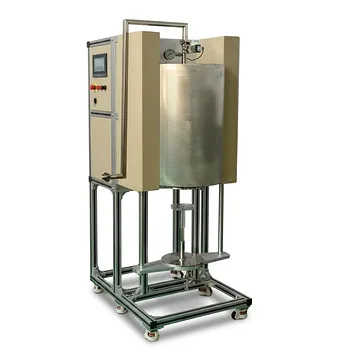
1200°C Atmosphere Controlled Automatic Bottom Loading Furnace with 6 Inch Quartz Tube

Vertical 1700C Vacuum and Atmosphere Tube Furnace with 80mm Alumina Tube

Compact Vertical Split Quartz Tube Furnace with Stainless Steel Vacuum Flanges for Rapid Thermal Quenching and Controlled Atmosphere Material Processing
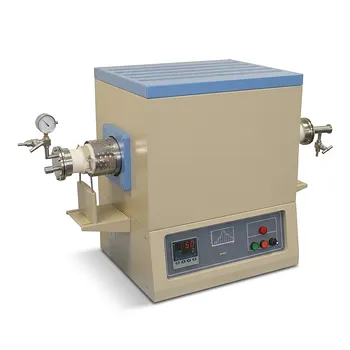
1700C High Temperature Alumina Tube Furnace with 18 Inch Heated Zone and Vacuum Sealing Flanges
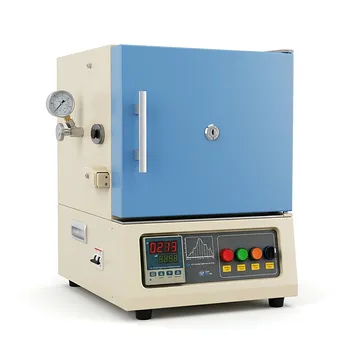
1200C Hybrid Muffle and Tube Furnace for Material Research with Dual Atmosphere Control Quartz Tubes
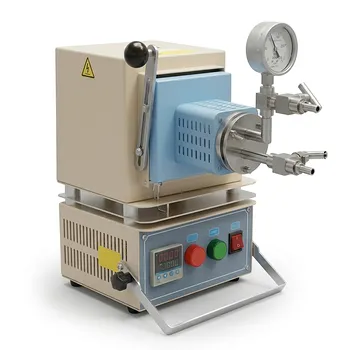
Compact Hybrid Muffle and Tube Furnace for 1000C Controlled Atmosphere Laboratory Material Sintering
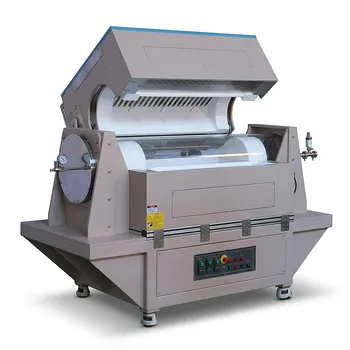
Three Zone Tube Furnace with 11 Inch or 15 Inch Quartz Tube and Hinged Flanges for Vacuum Atmosphere Heat Treatment

1100°C High Temperature Quartz Chamber Furnace 8 Inch OD with 7.6 Liter Capacity and Vacuum Atmosphere Capability
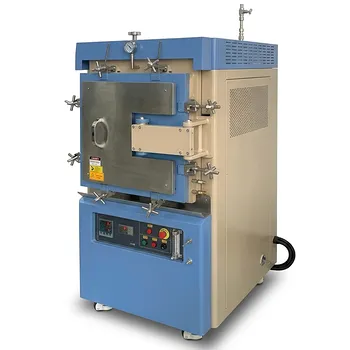
Atmosphere Controlled Muffle Furnace 1700C Maximum Temperature 80L High Capacity Vacuum Inert Gas Box Furnace
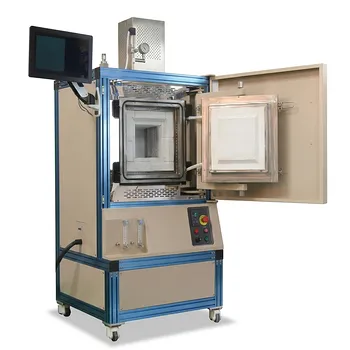
High Temperature Hydrogen Atmosphere Box Furnace 1650C Max Reducing Environment Material Synthesis System 8x8x8 Chamber
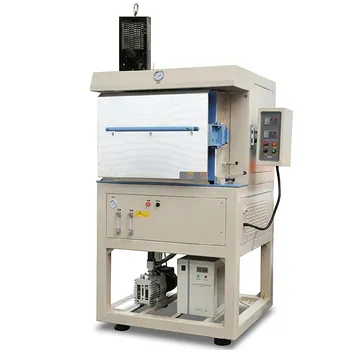
1200C Hydrogen Atmosphere Box Furnace with 5 Heated Sides and 64L Chamber

High Temperature 1700C Vertical Tube Furnace for Powder Spherification and Material Sintering
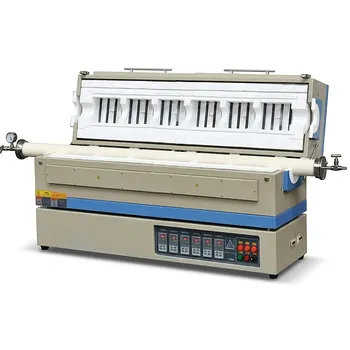
High Temperature 1700C Six Zone Split Tube Furnace with Alumina Tube and Water Cooled Flanges

1800C High Temperature Compact Vacuum Tube Furnace with 60mm OD Alumina Tube and Kanthal MoSi2 Heating Elements

High Temperature 1700C Benchtop Tube Furnace with 5 Inch Heating Zone High Purity Alumina Tube and Vacuum Sealing Flanges
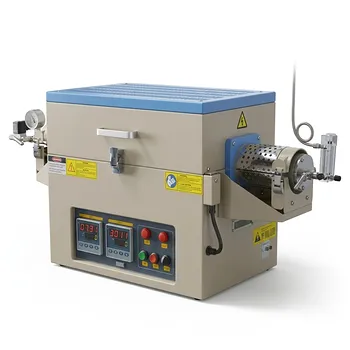
1100C Dual Zone Hydrogen Gas Tube Furnace with Quartz Tube and Integrated H2 Leak Detection System
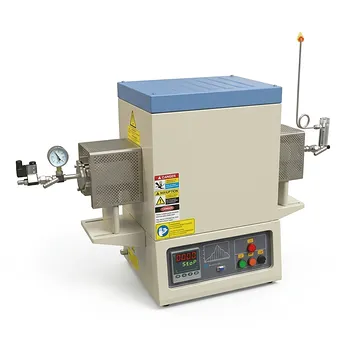
1700C Hydrogen Gas Tube Furnace with 60mm Alumina Process Tube and Integrated Hydrogen Safety Detector

High Temperature 1700C Tube Furnace with High Vacuum Turbomolecular Pump System and Multi Channel Mass Flow Controller Gas Mixer
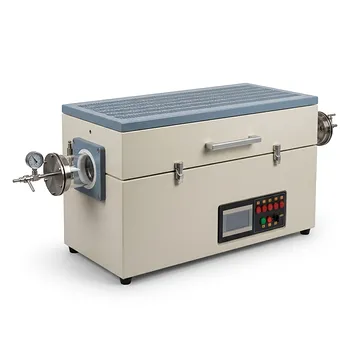
Five Zone 1200C High Temperature Split Tube Furnace with Touch Screen Controller and Multiple Quartz Tube Options