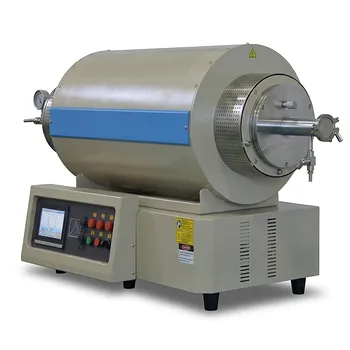
What role does a tube atmosphere furnace play in the final synthesis of Na3V2(PO4)3-xF3x/C? Key for NASICON Materials.
Updated 3 months ago
The tube atmosphere furnace is the essential reactor that enables the final synthesis of $Na_3V_2(PO_4){3-x}F{3x}/C$ by providing a strictly controlled thermal and chemical environment. It performs three critical functions: protecting vanadium from oxidation through inert gas shielding (typically Argon), driving the solid-state crystallization of the NASICON structure, and facilitating the in-situ carbonization of organic precursors into a conductive coating.
Core Takeaway: The tube atmosphere furnace serves as a precision tool that prevents the degradation of vanadium's valence state while simultaneously providing the thermal energy necessary to transform chemical precursors into a stable, high-performance crystalline composite.
Protecting Chemical Integrity through Atmosphere Control
Prevention of Vanadium Oxidation
The primary role of the furnace is to exclude oxygen during high-temperature cycles to keep vanadium in its trivalent state ($V^{3+}$). If exposed to air at temperatures like 700°C, vanadium would oxidize to higher valence states, destroying the material's electrochemical activity and theoretical capacity.
Regulation of Stoichiometric Ratios
By controlling the oxygen partial pressure and utilizing inert gases like Argon or Nitrogen, the furnace ensures the material maintains its intended chemical composition. This precise environment allows the fluorine and phosphorus components to integrate correctly into the NASICON framework without interference from atmospheric contaminants.
Removal of Reaction Byproducts
As the precursors react, they often release byproducts such as carbon dioxide and water vapor. The continuous flow of gas within the tube furnace effectively sweeps these byproducts away, preventing them from interfering with the final phase formation or the quality of the carbon layer.
Driving Structural Transformation and Crystallization
Promotion of the NASICON Framework
The furnace provides the high-temperature field (typically around 700°C for formal sintering) required to induce the solid-state reactions that form the $Na_3V_2(PO_4){3-x}F{3x}$ crystal lattice. High temperature uniformity across the heating zone is vital for ensuring that the entire batch of material achieves the same degree of crystallinity.
Multi-Stage Thermal Processing
Advanced tube furnaces allow for programmable, multi-stage temperature control, such as a 300°C pre-calcination followed by a 700°C sintering stage. This staged approach is necessary for the gradual decomposition of organic matter and the controlled growth of the target crystal structure.
Phase Purity and Symmetry
The consistent thermal environment determines the specific space group symmetry and phase purity of the final powder. Without the precise temperature ramp rates and hold times provided by the furnace, the resulting material might contain unwanted impurities that hinder ion transport.
Facilitating the Conductive Carbon Coating
In-Situ Carbonization of Organics
The furnace provides the thermal energy required to pyrolyze organic precursors, such as citric acid, directly onto the surface of the active material. This process occurs simultaneously with the sintering of the NASICON structure, ensuring an intimate and uniform contact between the carbon and the crystal.
Enhancing Electrical Conductivity
The resulting conductive carbon layer is essential for the performance of the $Na_3V_2(PO_4){3-x}F{3x}/C$ composite, as it compensates for the low intrinsic conductivity of the phosphate framework. The furnace environment dictates the thickness and quality of this carbon shell, which is critical for high-rate discharge capabilities.
Stabilizing the Active Material
The carbon layer formed within the furnace serves as a protective barrier that further stabilizes the vanadium valence state. By creating a reductive or inert micro-environment at the particle surface, the furnace-driven carbonization helps maintain the long-term stability of the cathode material.
Understanding the Trade-offs
Gas Flow vs. Temperature Uniformity
High gas flow rates are excellent for maintaining a pure atmosphere and removing byproducts, but they can create cold spots within the tube. If the temperature field becomes non-uniform, the material may exhibit inconsistent crystallinity across the batch, leading to poor electrochemical performance.
Atmosphere Leakage Risks
Even minor leaks in the furnace seals can introduce trace amounts of oxygen, which significantly degrades $V^{3+}$-based materials. While tube furnaces are excellent for atmosphere control, they require rigorous maintenance of gaskets and fittings to ensure the "inert" environment remains truly oxygen-free.
Scalability and Throughput
Tube furnaces offer superior control for laboratory-scale synthesis but have limited volume compared to industrial box or rotary furnaces. Achieving the same level of atmospheric precision in larger systems remains a significant engineering challenge when transitioning from research to mass production.
How to Apply This to Your Project
Recommendations for Synthesis
- If your primary focus is phase purity: Prioritize a furnace with multi-stage programmable control and high-purity Argon (99.999%) to ensure the NASICON structure forms without oxidative impurities.
- If your primary focus is high-rate performance: Focus on the carbonization stage by optimizing the organic precursor ratio and ensuring the furnace gas flow effectively removes decomposition byproducts.
- If your primary focus is repeatability: Use a furnace with a long "constant temperature zone" to ensure that every gram of the $Na_3V_2(PO_4){3-x}F{3x}/C$ powder experiences identical thermal conditions.
The tube atmosphere furnace is the defining factor in whether the synthesis results in a high-capacity NASICON composite or an inert, oxidized byproduct.
Summary Table:
| Key Function | Technical Mechanism | Impact on Final Material |
|---|---|---|
| Atmosphere Control | Inert gas shielding (Argon/Nitrogen) | Prevents Vanadium oxidation; maintains $V^{3+}$ valence state. |
| Thermal Regulation | Multi-stage programmable sintering | Drives NASICON framework crystallization and phase purity. |
| In-situ Carbonization | Pyrolysis of organic precursors | Creates conductive carbon coating for high-rate performance. |
| Byproduct Removal | Continuous gas flow | Sweeps away $CO_2$ and $H_2O$ to prevent impurity formation. |
Elevate Your Material Research with THERMUNITS
Are you looking to achieve peak performance in your battery material synthesis? THERMUNITS is a leading manufacturer of high-temperature laboratory equipment specifically designed for material science and industrial R&D.
Our advanced Tube Furnaces, Atmosphere Furnaces, and CVD/PECVD systems provide the precise temperature uniformity and atmospheric integrity required for complex syntheses like Na3V2(PO4)3-xF3x/C. Whether you need a Vacuum Furnace, Rotary Kiln, or Hot Press, our solutions ensure maximum phase purity and superior conductive coatings for your next-generation energy materials.
Maximize your lab's potential—Contact our experts today for a customized thermal processing solution!
References
- Yi Yang, He-Zhang Chen. Na <sub>3</sub> V <sub>2</sub> (PO <sub>4</sub> ) <sub>3</sub> -decorated Na <sub>3</sub> V <sub>2</sub> (PO <sub>4</sub> ) <sub>2</sub> F <sub>3</sub> as a high-rate and cycle-stable cathode material for sodium ion batteries. DOI: 10.1039/d4ra01653j
Mentioned Products
- Vertical 1700C Vacuum and Atmosphere Tube Furnace with 80mm Alumina Tube
- 1200C Hybrid Muffle and Tube Furnace for Material Research with Dual Atmosphere Control Quartz Tubes
- Compact Vertical Split Quartz Tube Furnace with Stainless Steel Vacuum Flanges for Rapid Thermal Quenching and Controlled Atmosphere Material Processing
- Compact Hybrid Muffle and Tube Furnace for 1000C Controlled Atmosphere Laboratory Material Sintering
- 1200°C Atmosphere Controlled Automatic Bottom Loading Furnace with 6 Inch Quartz Tube
People Also Ask
- How is an industrial-grade vertical tube furnace utilized in smelting leaching residues? Enhance Metal Recovery Efficiency
- What is the function of a laboratory-grade vertical tube furnace in fast pyrolysis? Optimize Composite Research.
- How does a vertical tube furnace facilitate thermoelectric alloy melting? Precision synthesis for material homogeneity.
- Why is a thermocouple sensor indispensable for monitoring the vertical tube furnace during gallium oxide nanowire production? Optimize VLS Growth
- What are the advantages of using a vertical tube furnace for crucible experiments simulating steel-slag interactions?

Tech Team · ThermUnits
Last updated on Jun 02, 2026
Related Products

Vertical 1700C Vacuum and Atmosphere Tube Furnace with 80mm Alumina Tube
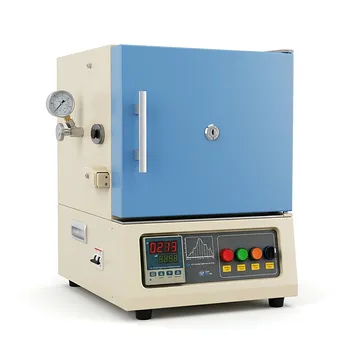
1200C Hybrid Muffle and Tube Furnace for Material Research with Dual Atmosphere Control Quartz Tubes

Compact Vertical Split Quartz Tube Furnace with Stainless Steel Vacuum Flanges for Rapid Thermal Quenching and Controlled Atmosphere Material Processing
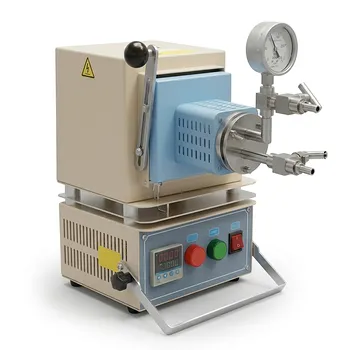
Compact Hybrid Muffle and Tube Furnace for 1000C Controlled Atmosphere Laboratory Material Sintering
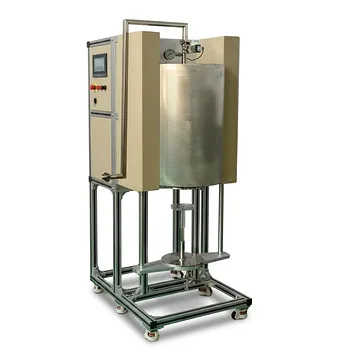
1200°C Atmosphere Controlled Automatic Bottom Loading Furnace with 6 Inch Quartz Tube

Three Zone Tube Furnace with 11 Inch or 15 Inch Quartz Tube and Hinged Flanges for Vacuum Atmosphere Heat Treatment

1200°C 5 Inch Vertical Quartz Tube Furnace with Stainless Steel Vacuum Flanges
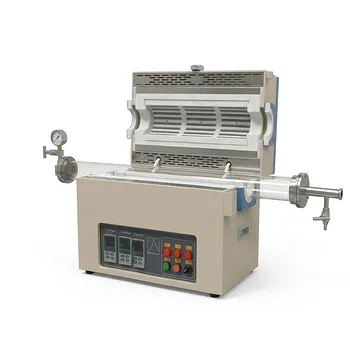
1200°C Three Zone Split Tube Furnace with 18 Inch Heating Length and Vacuum Flanges
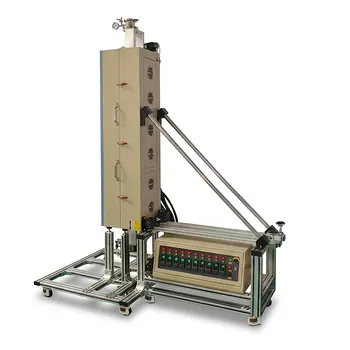
1200°C 10-Zone Split Tube Furnace with Horizontal and Vertical Mounting for Multi-Zone Thermal Gradients and Large Diameter Material Processing
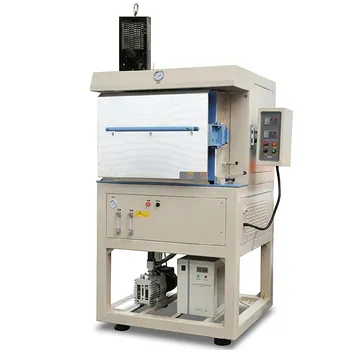
1200C Hydrogen Atmosphere Box Furnace with 5 Heated Sides and 64L Chamber

High Temperature 1700C Tube Furnace with High Vacuum Turbomolecular Pump System and Multi Channel Mass Flow Controller Gas Mixer

1700C Hydrogen Gas Tube Furnace with 60mm Alumina Process Tube and Integrated Hydrogen Safety Detector

High Temperature 1700C Vertical Tube Furnace for Powder Spherification and Material Sintering

High Temperature 1700C Six Zone Split Tube Furnace with Alumina Tube and Water Cooled Flanges
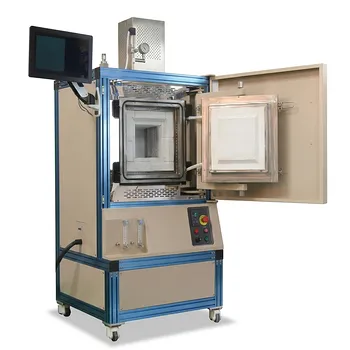
High Temperature Hydrogen Atmosphere Box Furnace 1650C Max Reducing Environment Material Synthesis System 8x8x8 Chamber

1800C High Temperature Compact Vacuum Tube Furnace with 60mm OD Alumina Tube and Kanthal MoSi2 Heating Elements
1100C Dual Zone Hydrogen Gas Tube Furnace with Quartz Tube and Integrated H2 Leak Detection System

High Temperature 1700C Benchtop Tube Furnace with 5 Inch Heating Zone High Purity Alumina Tube and Vacuum Sealing Flanges

High Temperature Automated 5 Inch Tube Furnace for Autonomous Material Research and Advanced Laboratory R&D