Why is programmable temperature control essential for a high-temperature tube furnace when preparing Co3O4-X materials?
Updated 3 months ago
Programmable temperature control is the definitive tool for managing the thermodynamics of $Co_3O_4-X$ synthesis. It allows for the strict regulation of heating and cooling ramps, which is essential for preserving the sensitive structural skeleton of precursors like Metal-Organic Frameworks (MOFs). Without this precision, uncontrolled thermal energy leads to grain coarsening, sintering, and the total loss of the desired material morphology.
Core Takeaway: Programmable control dictates the kinetic pathway of material formation, ensuring that precursors decompose into nanoparticles without losing their unique architectural features. It transforms a simple heating process into a precise tool for engineering high-performance crystal structures and morphologies.
Preserving Structural and Morphological Integrity
Maintaining the Original Precursor Skeleton
When preparing $Co_3O_4-X$ from MOF precursors, the original skeleton structure is highly sensitive to thermal stress. Programmable control allows for slow heating rates, typically around $2^\circ C$ per minute, which prevents the rapid outgassing or structural collapse that occurs during sudden temperature spikes.
Facilitating Advanced Morphologies
Achieving complex shapes, such as fiber-stacked microsphere morphologies, requires a very specific thermal environment. Precise regulation ensures that the material assembles correctly at the microscopic level, preventing the morphological loss associated with uncontrolled furnace environments.
Preventing Grain Coarsening
High temperatures naturally encourage small particles to merge into larger, less active grains. By strictly governing the thermal profile, programmable systems minimize the time the material spends at peak temperatures, effectively preventing grain coarsening and maintaining a high specific surface area.
Governing Chemical and Phase Transformations
Steady Precursor Decomposition
Materials like $Co_3O_4$ nanoparticles are formed through the steady decomposition of cobalt precursors. Programmable stages, such as an isothermal annealing stage at $300^\circ C$, ensure that this decomposition is uniform throughout the sample, leading to consistent particle sizes.
Facilitating Covalent Bond Formation
Precise thermal management triggers the formation of critical chemical links, such as Co–O–Ti covalent bonds in composite materials. Controlled heating ensures there is enough thermal activation energy to drive these reactions without reaching levels that would cause material sintering or unwanted phase changes.
Managing Phase Transitions
The transition from an amorphous precursor to a highly active crystalline structure requires meticulous heat treatment. Programmable control provides the exact "thermal budget" needed for dehydration, decomposition, and the rearrangement of atoms into the desired crystal lattice.
Understanding the Trade-offs
Process Duration vs. Structural Quality
The primary trade-off in programmable control is time. While slow heating rates ($2^\circ C/min$) produce superior structural integrity and high surface area, they significantly extend the total processing time compared to "flash" calcination.
Energy Consumption and Throughput
Maintaining precise, long-duration thermal profiles increases energy consumption per batch. For industrial applications, the challenge lies in balancing the need for precise microscopic control with the economic requirement for high-volume throughput.
Thermal Gradients in Large Samples
Even with a programmable controller, large batches of material may experience internal thermal gradients. The furnace may be at the programmed temperature, but the core of a dense sample might lag behind, potentially leading to non-uniform phase transitions if the "dwell time" (isothermal hold) is not sufficiently long.
Applying Programmable Control to Your Goals
How to Apply This to Your Project
To achieve the best results when synthesizing $Co_3O_4-X$ or similar oxides, align your furnace programming with your specific material objectives.
- If your primary focus is preserving MOF-derived structures: Utilize a very slow heating ramp (e.g., $1-2^\circ C/min$) to ensure the organic framework decomposes without collapsing the inorganic architecture.
- If your primary focus is preventing nanoparticle agglomeration: Implement a precise isothermal hold at the lowest possible decomposition temperature to finish the reaction without inducing grain growth.
- If your primary focus is preventing structural cracks: Use a programmed cooling curve (e.g., $5^\circ C/min$) to avoid the thermal shock that leads to micro-cracking and phase instability.
The success of your synthesis depends on viewing the temperature profile not just as a heat source, but as a precise reagent in your chemical reaction.
Summary Table:
| Control Feature | Purpose in Co3O4-X Synthesis | Recommended Parameter |
|---|---|---|
| Heating Ramp | Preserves precursor skeleton (MOFs); prevents structural collapse. | 1 - 2°C / minute |
| Isothermal Hold | Ensures steady decomposition and uniform particle size. | e.g., 300°C for annealing |
| Cooling Curve | Avoids thermal shock, micro-cracking, and phase instability. | ~5°C / minute |
| Precision Regulation | Prevents grain coarsening and morphological loss. | Strict thermal budget |
Master Your Material Synthesis with THERMUNITS Precision
Achieving the perfect $Co_3O_4-X$ morphology requires more than just heat; it requires absolute thermal control. THERMUNITS is a leading manufacturer of high-performance laboratory equipment designed specifically for material science and industrial R&D.
Whether you need to preserve sensitive MOF-derived architectures or prevent nanoparticle agglomeration, our comprehensive range of equipment—including Tube, Muffle, Vacuum, and Atmosphere Furnaces, as well as advanced CVD/PECVD systems—delivers the programmable accuracy your research demands.
Why partner with THERMUNITS?
- Precision Control: Advanced programming to manage delicate kinetic pathways.
- Versatile Solutions: From Rotary and Hot Press furnaces to Dental and VIM systems.
- Expert Support: We help you select the ideal thermal budget for your specific R&D goals.
Ready to elevate your lab's efficiency and structural quality? Contact our thermal processing experts today to find the perfect furnace for your next breakthrough.
References
- Jieli Guo, Hao Li. Development of MOF-derived Co3O4 microspheres composed of fiber stacks for simultaneous electrochemical detection of Pb2+ and Cu2+. DOI: 10.1007/s00604-024-06623-7
Mentioned Products
- High Temperature Tube Furnace 1500C with Sliding Flanges and 50mm OD for Rapid Thermal Processing Fast Heating and Cooling
- Vertical 1700C Vacuum and Atmosphere Tube Furnace with 80mm Alumina Tube
- Compact High Temperature 1600C Tube Furnace with 50mm Alumina Tube and Vacuum Flanges for Material Sintering
- 900°C Max Rotary Tube Furnace with 8 Inch 310S Alloy Tube and Optional Multi Zone Heating for Industrial Material Calcination
- 1100C Tube Furnace with Vacuum Flange and Programmable Temperature Controller for Material Science and Industrial Heat Treatment
People Also Ask
- How are high-temperature tube furnaces utilized to repair etching damage? Precision Lattice Restoration Solutions
- What role does a high-temperature tube furnace play in CVD synthesis of silicon nanowires? Master VLS Growth Precision.
- What core conditions does a high-temperature tube furnace provide for rGO aerogels? Mastering Precision Synthesis.
- What role does a high-temperature tube furnace play in the sulfidation heat treatment of CoS@C/MXene nanocomposites? Guide
- How does precision tube furnace control influence CoFe nanoparticle formation? Master Your Bimetallic Synthesis.

Tech Team · ThermUnits
Last updated on Jun 03, 2026
Related Products
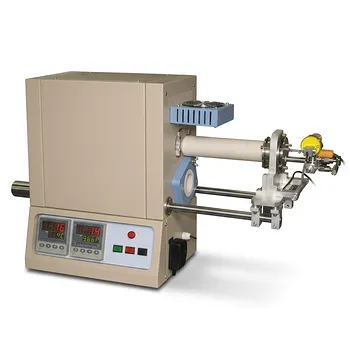
High Temperature Tube Furnace 1500C with Sliding Flanges and 50mm OD for Rapid Thermal Processing Fast Heating and Cooling

Vertical 1700C Vacuum and Atmosphere Tube Furnace with 80mm Alumina Tube

Compact High Temperature 1600C Tube Furnace with 50mm Alumina Tube and Vacuum Flanges for Material Sintering
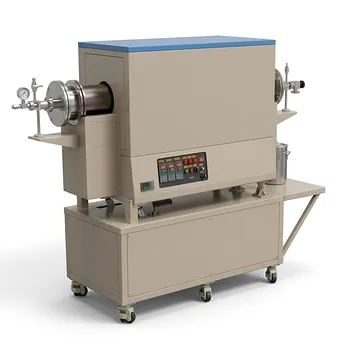
900°C Max Rotary Tube Furnace with 8 Inch 310S Alloy Tube and Optional Multi Zone Heating for Industrial Material Calcination

1100C Tube Furnace with Vacuum Flange and Programmable Temperature Controller for Material Science and Industrial Heat Treatment

High Temperature 1700C Tube Furnace with High Vacuum Turbomolecular Pump System and Multi Channel Mass Flow Controller Gas Mixer
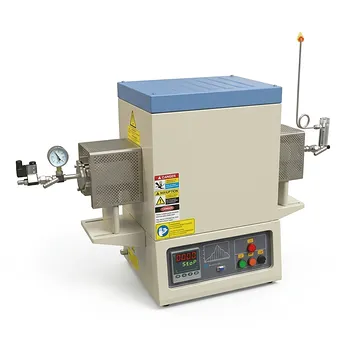
1700C Hydrogen Gas Tube Furnace with 60mm Alumina Process Tube and Integrated Hydrogen Safety Detector
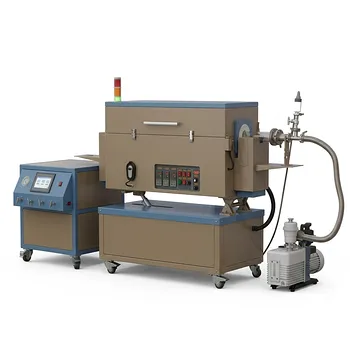
5 Inch Three Zone Rotary Tube Furnace with Integrated Gas Delivery System and 1200C Capability for Advanced Material CVD Processing

High Temperature 1700C Six Zone Split Tube Furnace with Alumina Tube and Water Cooled Flanges
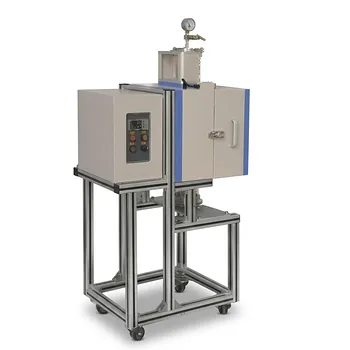
1200°C 5 Inch Vertical Quartz Tube Furnace with Stainless Steel Vacuum Flanges

Compact Vertical Split Quartz Tube Furnace with Stainless Steel Vacuum Flanges for Rapid Thermal Quenching and Controlled Atmosphere Material Processing
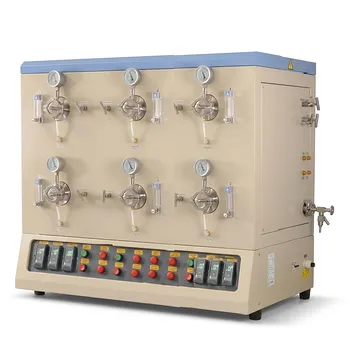
1200C High Throughput Multi Channel Tube Furnace with 50mm Quartz Tubes for Annealing and Material Phase Diagram Research
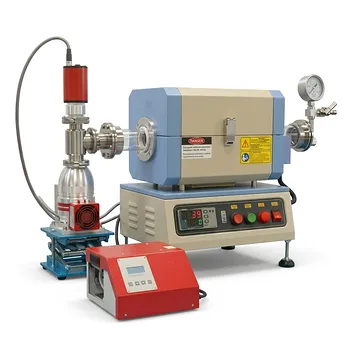
High Vacuum Compact Tube Furnace 1200C with Integrated Turbo Pump System and 8 Inch Heating Zone

High Temperature 1700C Benchtop Tube Furnace with 5 Inch Heating Zone High Purity Alumina Tube and Vacuum Sealing Flanges
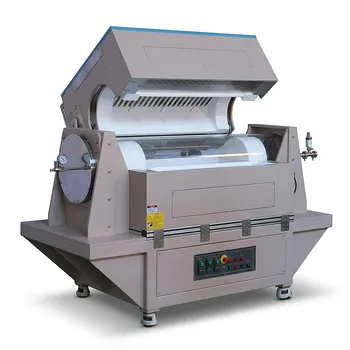
Three Zone Tube Furnace with 11 Inch or 15 Inch Quartz Tube and Hinged Flanges for Vacuum Atmosphere Heat Treatment

1800C High Temperature Compact Vacuum Tube Furnace with 60mm OD Alumina Tube and Kanthal MoSi2 Heating Elements
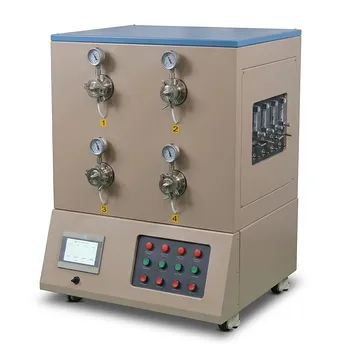
High Throughput 1200C Four Channel Tube Furnace with 3 Inch Quartz Tubes for Multi Zone Annealing and Material Research

High Temperature 1700C Vertical Tube Furnace for Powder Spherification and Material Sintering
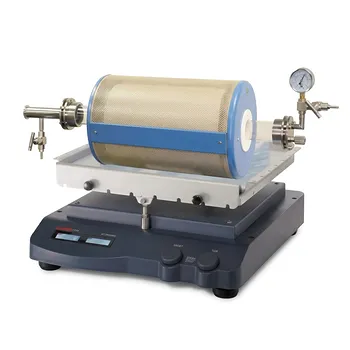
High Temperature Rocking Tube Furnace with Quartz Tube and Vacuum Flange for Materials Synthesis
